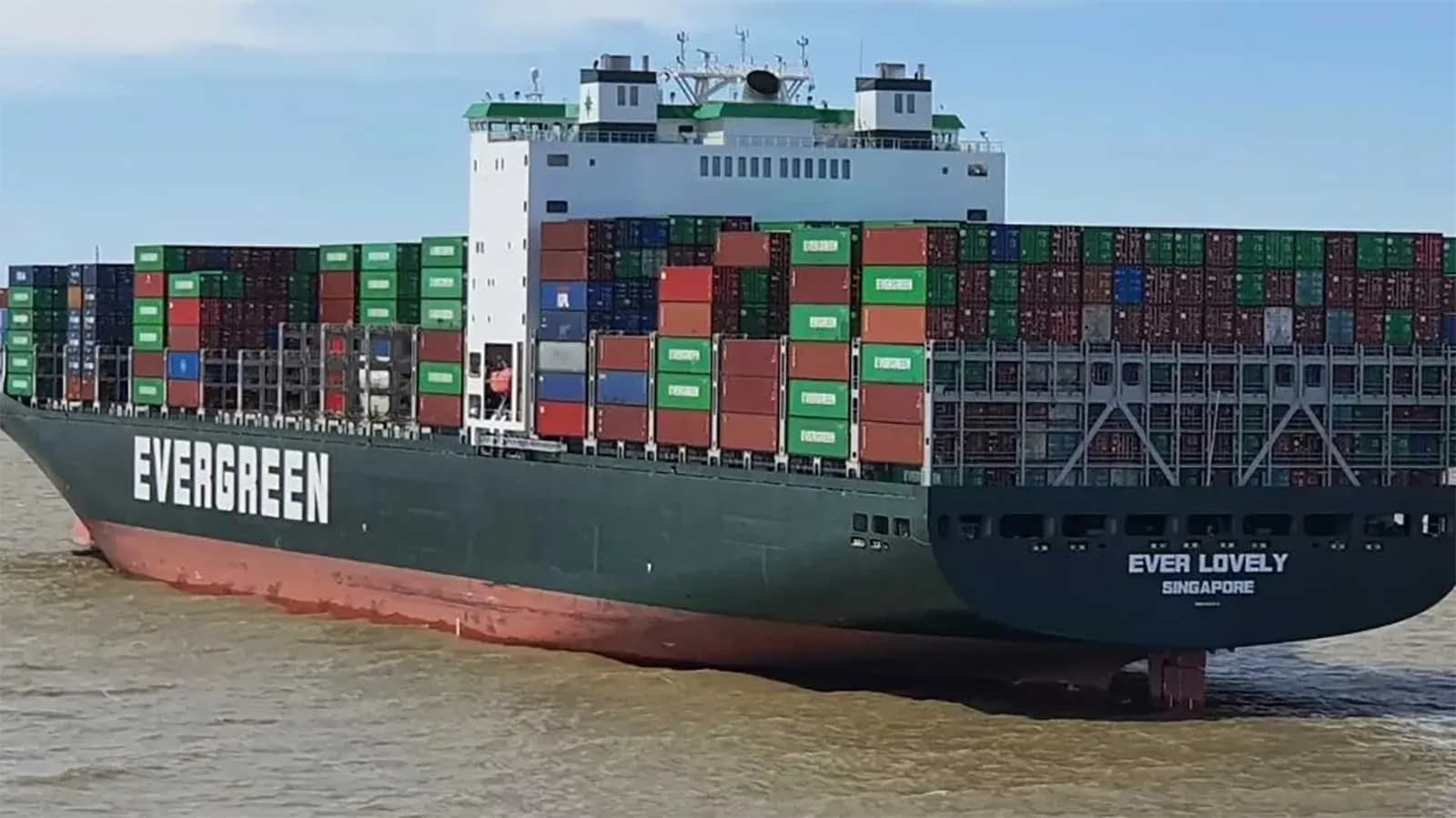
The evacuation plan for stranded sailors in the Strait of Hormuz, initiated by the International Maritime Organization (IMO) following the peace agreement between the United States and Iran, has been put on hold after the attack suffered on June 25 by the container ship Ever Lovely, registered in Singapore and operated by Evergreen Marine.
According to the notice issued by the British maritime surveillance agency UKMTO, the vessel was hit on the starboard side by an unknown projectile about 7.5 nautical miles southeast of Dahit, Oman. The impact caused damage to the bridge, although the captain reported that there were no injuries or environmental impact. The Ever Lovely, built in 2015, has a length of 335 meters, a capacity of 9,532 TEUs, and a tonnage of 104,357 DWT. It was one of three Evergreen vessels attempting to leave the Persian Gulf at the time of the incident. According to AIS data, the ship continued sailing towards Fujairah.
The IMO and BIMCO have pointed out that the Ever Lovely was not transiting within the agreed evacuation framework. The vessel took the coastal traffic zone off Oman, an alternative route to the official corridor established to the north, under Iranian control. The Gulf Strait Agency (PGSA), an Iranian body created in May 2026 to regulate maritime traffic through the strait, warned that vessels navigating outside designated routes would not have security guarantees.
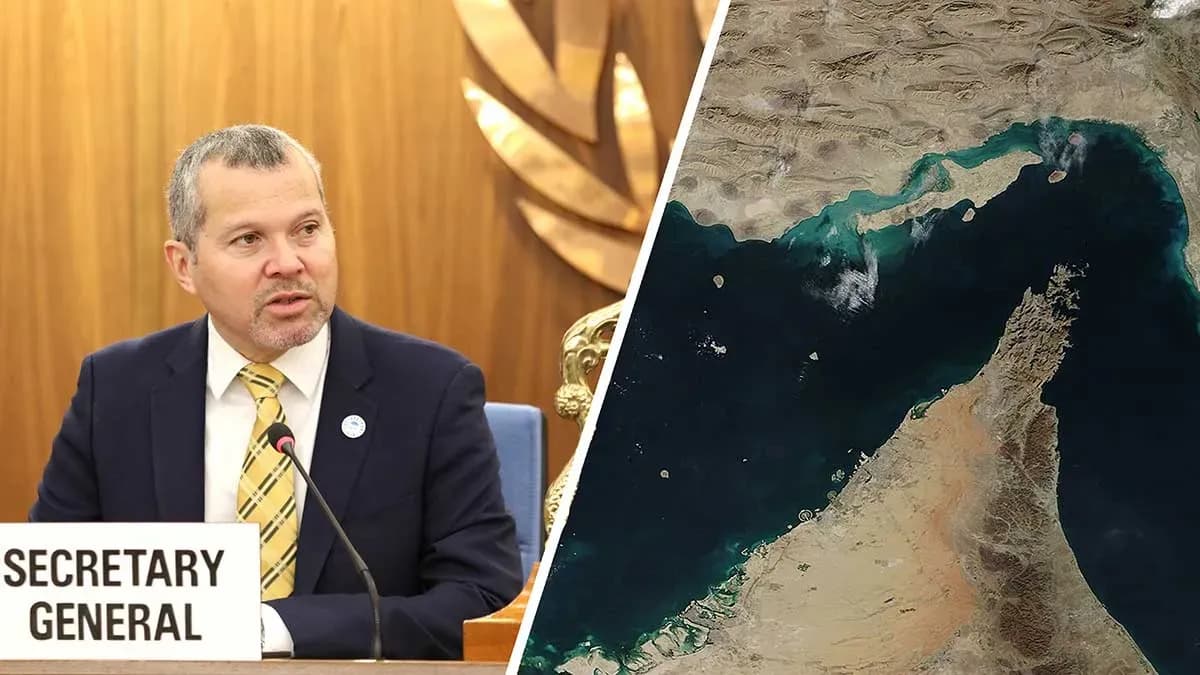
The Secretary-General of the IMO, Arsenio Dominguez, confirmed the attack and announced the temporary suspension of the plan. "I have decided to temporarily pause its implementation in order to reconfirm that the necessary security guarantees remain valid for the ships on our evacuation list and for all those in the region," Dominguez stated, adding that the plan will remain on hold until greater clarity is obtained regarding transit conditions.
The evacuation plan had been launched on June 23 in coordination with Oman, Iran, the coastal states in the vicinity, the United States, and the maritime industry. Oman had enabled a temporary maritime corridor with two alternative routes to the existing traffic separation scheme in the strait, with coordinates published by the Omani National Hydrographic Office. The IMO estimated about 11,000 stranded sailors in the Gulf area, where commercial traffic was practically halted for nearly four months due to the conflict between the United States, Israel, and Iran. Up until the time of the attack, 57 ships with approximately 1,100 sailors on board had completed transit since the operation began.
The Islamic Revolutionary Guard Corps of Iran (IRGC) had opposed the corridor established by the IMO and Oman, demanding that all vessels use routes under their control and coordinate directly with their forces. The threat was disseminated through a video in which the IRGC warned ships that they would be responsible for the consequences if they chose alternative routes. Several vessels reportedly turned back after receiving that notice, according to unconfirmed reports.
Industry analysts point out that Iran seeks to consolidate its routing authority over the strait as leverage in broader negotiations with Washington. U.S. Secretary of State Marco Rubio is on a tour of Gulf countries to assure regional allies that no tolls will be imposed on transit through the strait, a possibility that Iran has not ruled out and that has raised concerns about its effect on the principles of free navigation in international waters.
Jakob Larsen, head of Security at BIMCO, described the incident as a "setback" in evacuation plans and the resumption of traffic, although he noted that some transits may still occur. Larsen also emphasized that the memorandum of understanding between the United States and Iran "is not sufficiently clear" and called for unambiguous agreements to resume traffic regularly.
The shipping companies Maersk and Hapag-Lloyd confirmed that they had managed to remove some vessels from the Gulf before the incident. Maersk noted that the Maersk Baltimore completed transit alongside another ship chartered by the company, and that three units remain in the area with the intention of making an additional transit. Out of the 47,000 containers destined for the Gulf, 44,000 have already been delivered and 3,000 are pending their final leg. Hapag-Lloyd, for its part, confirmed that all its vessels affected by the temporary closure of the strait have already left the Gulf, without providing further details for security reasons.