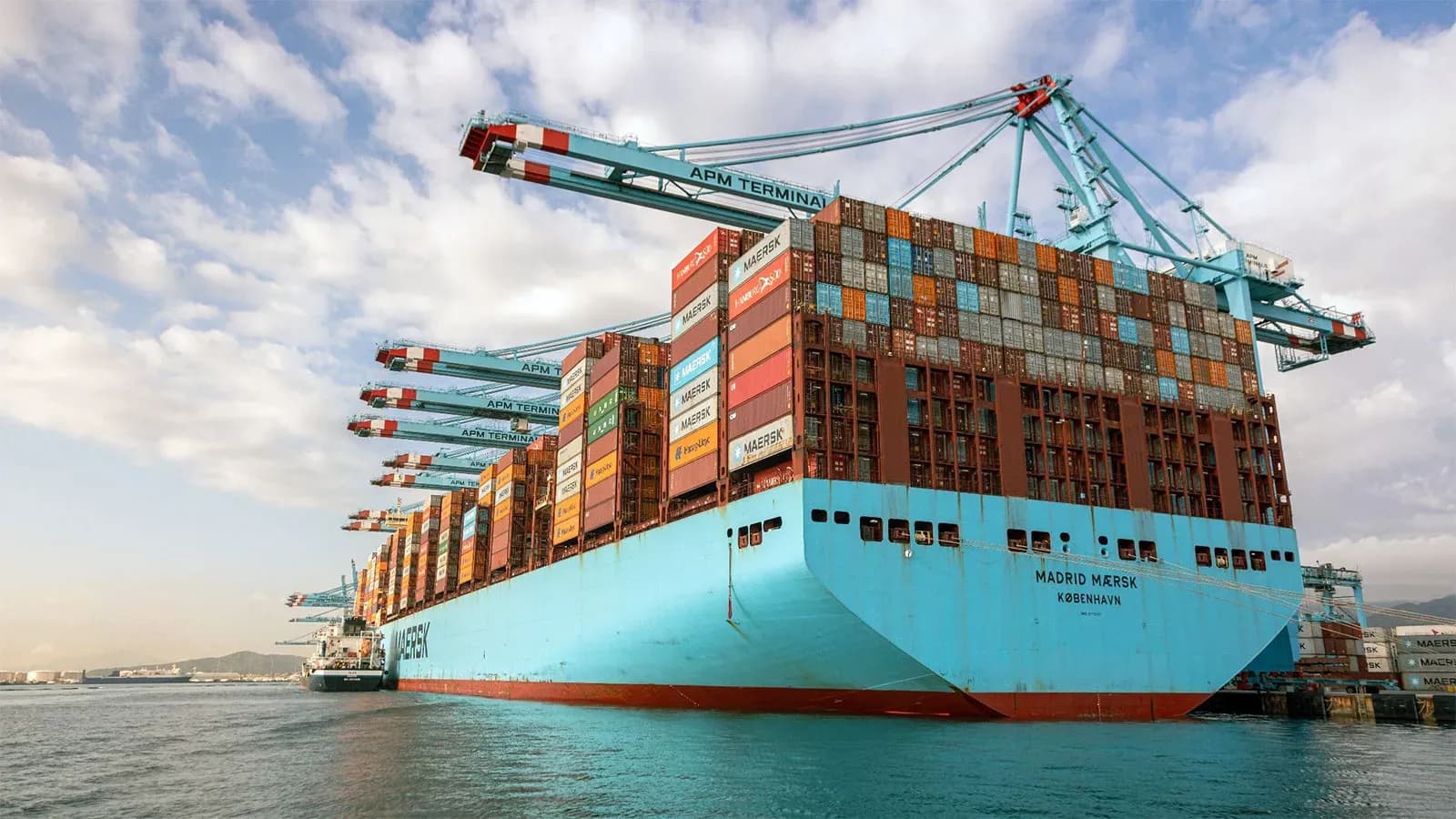
Maersk will implement a reorganization of its maritime network between Europe and West Africa starting in October 2026 that modifies the rotations of several WAF services and the transshipment structure used to connect with different ports in the region. Algeciras appears in four of the rotations included in the new configuration: WAF2, WAF3, WAF6, and WAF9B/C.
According to the table published by the company, WAF2 will follow a sequence consisting of Algeciras, Tangier, and Dakar, while WAF3 will depart from Port Said and subsequently call at Algeciras, Tangier, Lomé, Abidjan, Tema, and Apapa. In this last service, the stops at Tema and Apapa will be exclusively for exports from West Africa.
WAF6 will also include Algeciras in a rotation that Maersk details as Port Said, Tangier, Algeciras, Tema, Apapa, and Pointe-Noire. Thus, the two routes that connect Port Said with West Africa, WAF3 and WAF6, will call at the Straits port before continuing to various destinations along the African coast.
The fourth rotation that includes Algeciras is grouped by Maersk under the designation WAF9B/C. The announced sequence connects Algeciras with Leixões, Lisbon, Praia, and Mindelo, thus incorporating Portuguese and Cape Verdean ports within this structure.
The modification of the network also affects other services that use Tangier as a starting point. WAF7 will link the Moroccan port with Conakry; WAF10 will have a rotation of Tangier-Nouakchott-Nouadhibou-Nouakchott; and WAF12 will connect Tangier with Banjul. Furthermore, Maersk will maintain direct connections from Tangier to Monrovia via WAF5X and Freetown through WAF7X until further notice.
The company has also reorganized the connection services used for traffic coming from Europe. Abidjan will be the transshipment port for goods destined for San Pedro, through WAF8, and for Onne and Takoradi via WAF5. From Lomé, the MW2 service will connect to Cotonou.
Pointe-Noire will concentrate subsequent connections to various ports in Central and Southern Africa. WAF13 will connect this enclave with Luanda and Walvis Bay; service 23F with Malabo, Bata, and Libreville; 23D with Matadi; 23E with Cabinda; and FEW6 with Kribi. Tema will be, for its part, the transshipment point for Douala via service 23N.
The notice published by Maersk contains a discrepancy between its introductory text and the detailed table of rotations. In the first paragraph, the company states that WAF6 will incorporate Port Said and Lomé and that WAF3 will extend to Pointe-Noire. However, the subsequent table places Lomé within WAF3 and Pointe-Noire in WAF6. The previous itinerary list reproduces the port-by-port distribution shown in that official table.
The reorganization comes after Maersk modified the structure of WAF6 in July to have the service transit again through the Red Sea between Salalah and the western Mediterranean, as part of the gradual recovery of connections through the Suez corridor announced by the shipping company.