Foreign trade operations followed a different trend. Imports reached 329,516 containers, up 0.15%, while exports rose by 4.39% to 324,180 units. By tonnage, containerized cargo totaled 52.77 million tonnes, 6.14% less than in 2024, although exports grew by 6.09% and imports by 1.11%.
General cargo totaled 65.46 million tonnes, a decrease of 3.94%. Liquid bulk reached 28.46 million tonnes, 1.21% less than in the previous year. Loading operations for these products increased by 0.68%, while unloading fell by 2.25%. Solid bulk, which accounts for a smaller share of total traffic, rose by 14.49% to 273,893 tonnes.
Bunkering activity also declined. Ship supplies stood at around 3.2 million tonnes, 6.35% below 2024, mainly due to developments in the energy market. The decline affected the supply of petroleum products, which fell by 6.2% for both alongside and anchorage operations. The port operations section specifies that the supply of fuel and other products to ships amounted to 3,175,274 tonnes, of which 2,381,284 tonnes were bunkering operations at anchorage.
As for vessel movements, facilities managed by APBA recorded 30,888 calls in 2025, approximately 2% fewer than the previous year. Container ship calls decreased by 4.68% and passenger ship calls by 4.95%, while tanker calls increased by 1.54%. The total gross tonnage of vessels using the port facilities reached 543.6 million GT, a negative change of 1.06%.
Maritime traffic through the Strait, by contrast, increased both in passenger movements and in the transport of goods by road. The ports of Algeciras and Tarifa recorded a combined 6.35 million passengers, 6.69% more than in 2024. Passenger traffic on the Algeciras–Tanger Med route increased by 5.91%, while the Tarifa–Tangier City route grew by 14%.
The number of vehicles carried on passenger services exceeded 1.4 million, a year-on-year increase of 6.28%. Industrial vehicle traffic reached 527,087 units, 4.23% more than in the previous year. The route to Tanger Med accounted for a large share of this activity, with road transport growing by 4.73%.
Of the calls recorded during the year, 20,468 were made by Strait shipping routes. The Algeciras–Ceuta route recorded 6,797, Algeciras–Tanger Med recorded 9,748 and the Tarifa–Tangier City route reached 3,923. These movements took place in a year when Operation Crossing the Strait once again recorded high volumes of passengers and vehicles.
Other activity segments followed mixed trends. Fresh fish landings reached 1,533 tonnes, 19.11% more than in 2024. Rail transport, meanwhile, remained constrained by capacity limitations on the Algeciras–Bobadilla corridor and infrastructure modernization works. The report records rail traffic of 28,392 TEUs in 2025, below the figure recorded in the previous year.
In financial terms, APBA generated revenues of €107.43 million, compared with €104.66 million in 2024, an increase of 2.64%. This result was linked to the performance of revenue from port charges, which rose by 4.53% and offset the decline in other business income.
According to the financial statements in the Annual Report, revenue from port charges amounted to €97.67 million, compared with €93.44 million in the previous year. Items that increased included the occupancy charge, up 9.64%; the activity charge, up 9.17%; and the passenger charge, up 7.72%, reflecting the higher number of passengers and vehicles.
In absolute terms, occupancy charge revenue reached €18.10 million, usage charges totaled €61.44 million and activity charge revenue amounted to €15.66 million. Within usage charges, the passenger charge generated €22.87 million, while the cargo charge contributed €24.30 million.
Operating expenses decreased by 6.28%, mainly due to a reduction in extraordinary items related to provisions and impairment. However, ordinary expenses associated with activity rose by 13.84%, driven by increases in supplies, up 23.86%, and other external services, up 20.99%. Staff costs rose by approximately 6.62%, in connection with an increase in headcount.
The performance of revenue and expenses enabled the year to close with a result of €35.65 million, compared with €29.29 million in 2024. The Annual Report records an operating result of €25.16 million, up from €17.63 million in the previous year, and a profit before tax of €32.48 million.
In terms of investment, the Port Authority carried out projects worth €31.39 million in 2025, a 9.4% decrease from the investment volume in 2024. Projects included works to expand the quay and apron at La Galera basin, work on the breakwater at Isla Verde, restoration of Fort Isla Verde and improvements at El Saladillo basin.
Works related to the berths at the Port of Saladillo were also completed during the year, along with improvements to maritime facilities, access routes, berthing structures and equipment in port areas. The Marqués de Rodil quay, intended for the Civil Guard’s Maritime Service, was inaugurated in October 2025.
APBA’s investment plan includes further projects in the coming years. The 2025–2029 Business Plan provides for €580 million in planned public investment, in addition to a further €700 million in private initiatives. These plans form part of the 2030 Strategic Plan, with a vision to 2040, structured around competitiveness, decarbonization and social commitment.
Among the projects included in this plan is the Hercules Plan, with an estimated investment of €200 million, aimed at reorganizing and expanding the capacity of facilities for road traffic. The works include expanding La Galera quay, modifying the internal road network and expanding the Border Inspection Post. APBA’s planning objective is to have capacity to handle 800,000 industrial vehicles annually by the end of the decade.
The documents also cover the installation of onshore power supply systems for ships, known as OPS, with a planned investment of €92 million. Electrifying berths is part of the energy transition strategy for the port facilities and includes scheduled works in both Algeciras and Tarifa.
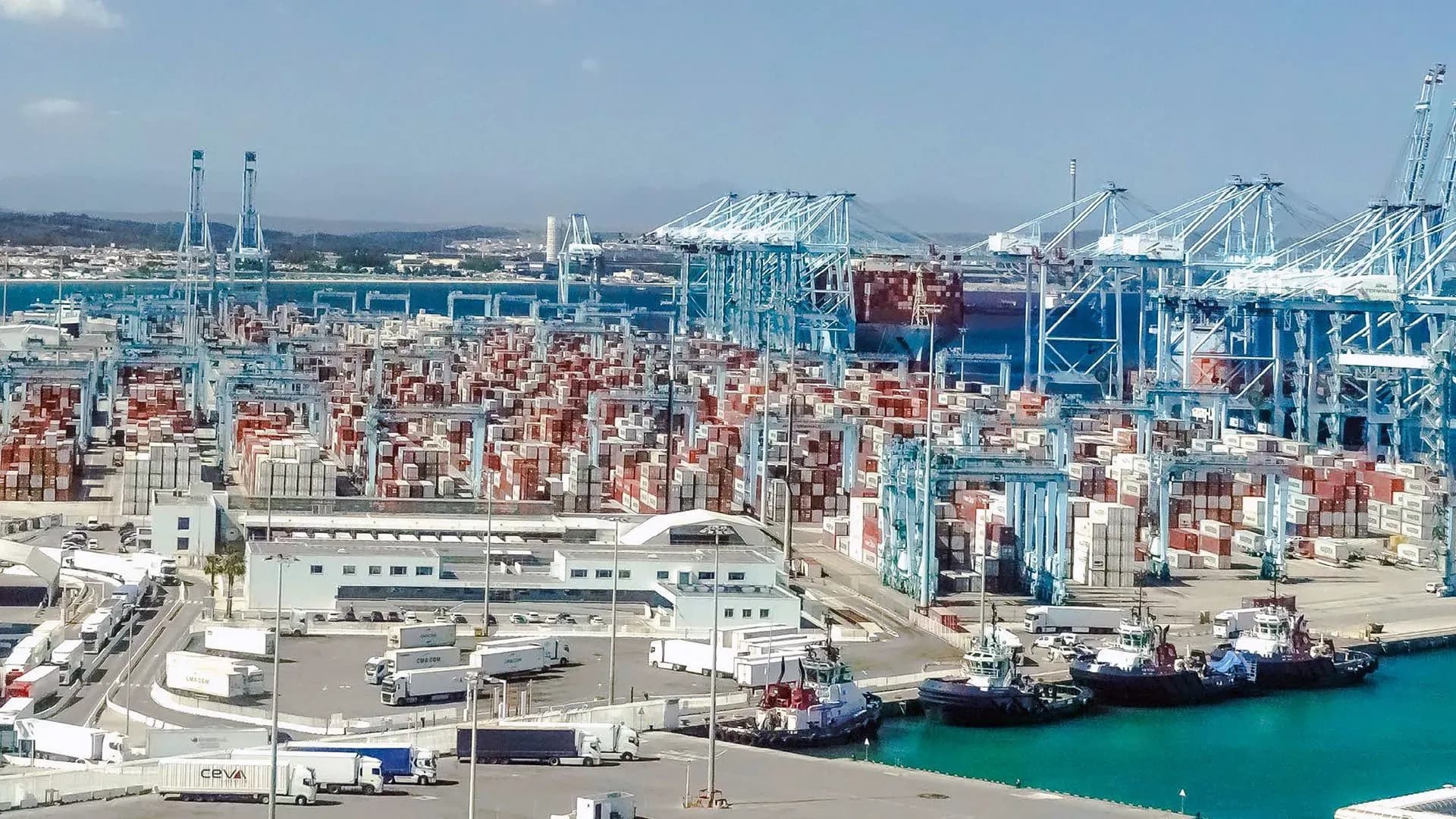
For container terminals, the plan includes the expansion of TTI Algeciras in Phase B of Isla Verde Exterior, a project with a planned private investment of approximately €150 million. The project will add around 16 hectares to the semi-automated terminal, with projected annual capacity of 2.1 million TEUs in 2028.
Improving rail connectivity is another subject covered in the report. APBA outlines modernization works on the Algeciras–Zaragoza corridor, including track renewals, tunnel clearance adjustments and the extension of passing loops to accommodate rail motorway services. The document sets 15 September 2027 as the planned date for its commissioning on Iberian gauge.
These works are complemented by plans to expand the rail-port terminals at Isla Verde Exterior, T1, and Isla Verde Interior, T2, with estimated budgets of €6.2 million and €10 million, respectively. Changes to access connections are also planned, including the removal of the level crossing at the entrance to Algeciras railway station and works associated with the Botafuegos connection.
Logistics activity outside the port area is also covered in the documentation. The Bay of Algeciras Logistics Area, comprising the El Fresno and San Roque sectors, is projected to cover approximately 300 hectares at full development. At El Fresno, the Bay of Algeciras Customs Area has 80,000 square metres of land available for sale, while the San Roque sector includes a nine-hectare intermodal area. The report also notes Calsina Carré’s announced investment of €6 million to establish a transport operations and services centre.
Management of land-based traffic was supported by new digital tools. In December 2025, the Unified Road Freight Service went into operation as part of the Teleport 2.0 Port Community System, centralizing shipping reservations and truck access appointments. Work also continued during the year on coordinating inspections, access control and information systems for hauliers and operators.
The innovation section notes the renewal of APBA’s Innovation Management System certification and its adaptation to the international standard ISO 56001:2024. The Port of Algeciras Digital Entrepreneurship Centre for Port Logistics was also launched as part of the Misión Andalucía initiative. In 2025, more than 60 training activities and over 100 hours of specialized mentoring were delivered, with the first 13 startups joining the project.
The documents also cover the development of artificial intelligence applications and predictive models for operational planning, vessel arrival management and bunkering operations, as well as technology projects related to maritime communications, infrastructure monitoring and marine biodiversity.
On environmental matters, the Port Authority presented its Decarbonization Plan in August 2025, setting out a roadmap of measures to reduce emissions by 36,500 tonnes of carbon dioxide equivalent. During the year, the design of a photovoltaic plant with energy storage for self-consumption at the Algeciras Maritime Station was completed, and 38 electric vehicle charging points were brought into operation.
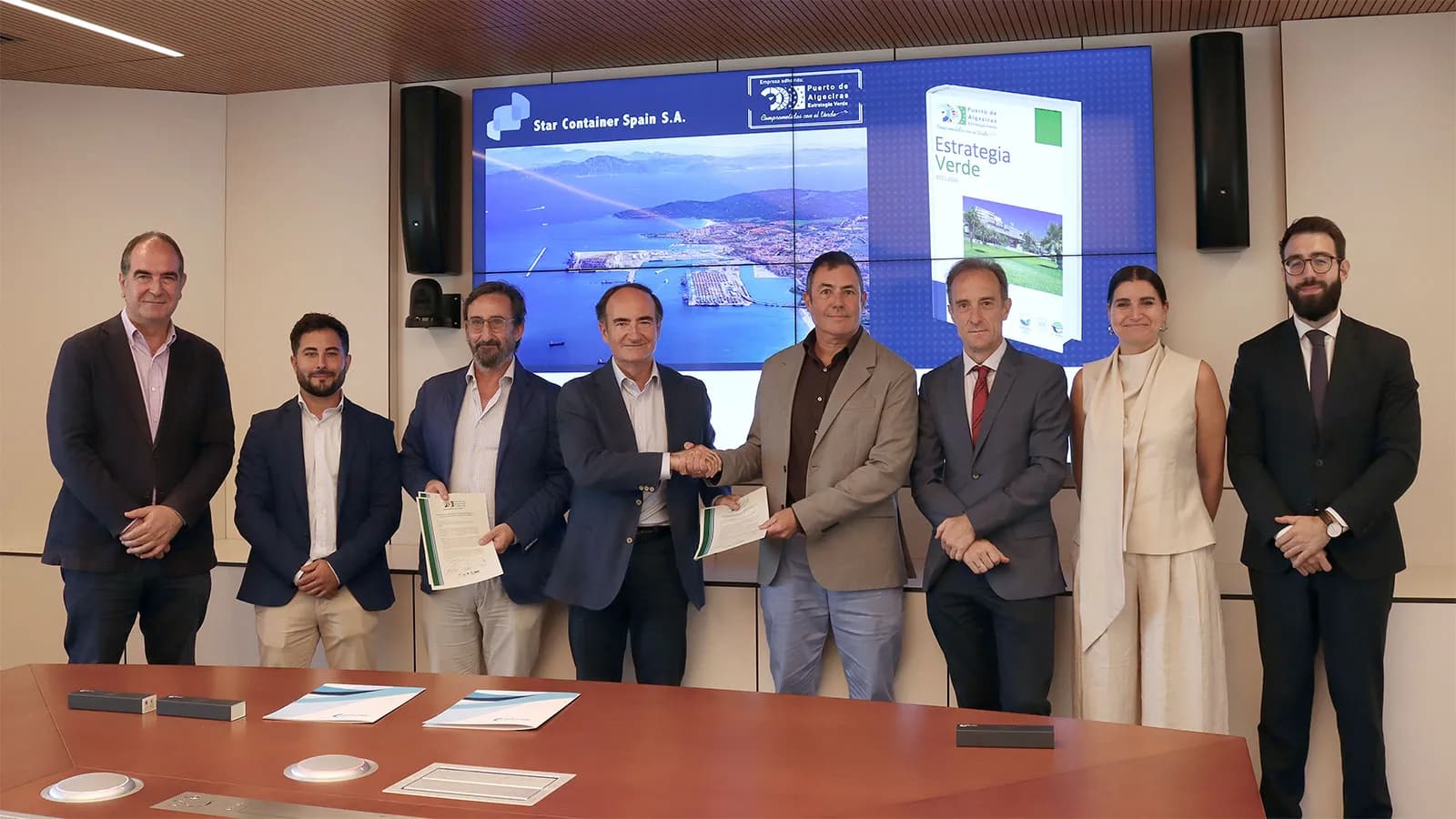
By the end of 2025, 40 companies had joined APBA’s Green Strategy. Environmental measures carried out also included monitoring water and air quality, controlling invasive species and managing waste from ships. In this area, approximately 66,500 cubic metres of MARPOL I oily waste were collected, of which around 50,696 cubic metres were treated at existing facilities in the Port of Algeciras.
Biodiversity initiatives included studies to detect exotic species with invasive potential, particularly the alga Rugulopteryx okamurae, in port infrastructure in Algeciras and Tarifa. Outreach activities were also held and, in October 2025, the Strait Cetacean Guide was presented, promoting knowledge of the marine species found in the area.
The integration of port facilities with the surrounding municipalities is another area covered in the documents. In December 2025, the contract was awarded for the second phase of the Algeciras Maritime Lake project, with an investment of €5,576,207, plus VAT, and a project area of 16,091 square metres. Work, scheduled to continue until 2027, includes transforming the northern section of Llano Amarillo, adding new pedestrian areas, green spaces, recreational facilities and a berth for APBA’s tour boat.
The same section of projects covered the third and final phase of the restoration of Fort Isla Verde, which the report said was scheduled for completion by the end of 2026. The project includes renovating the lighthouse, creating a museum within the historic site and building a cultural interpretation centre equipped with an immersive virtual reality room.
In Tarifa, APBA renovated the promenade on María Coronel Street during 2025, at a cost of €413,000 and covering approximately 1,500 square metres. In San Roque, the Port Authority launched an environmental and landscape restoration project along the coast between the mouth of the Guadarranque River and Los Gallegos stream, in Puente Mayorga, with a total budget of €955,136 and covering 2.4 kilometres of coastline.
The report also covers commercial activity and international promotion, carried out in coordination with the Bay of Algeciras Port Community Association (COMPORT). During the year, activities were held at professional events related to maritime transport, logistics, refrigerated cargo and the energy sector, as well as international trade missions, including one to Singapore in October 2025.
In terms of human resources, the Port Authority hired 19 employees and ended the year with a permanent workforce of 409. New hires included administrative, systems, mechanical equipment and Port Police staff. The Authority also reports delivering 17,229 hours of in-person and remote training during the year.
The publication of both documents coincides with the 50th anniversary of the start of container traffic in Algeciras, which began in April 1975 with Sealand Ibérica’s operations at Isla Verde quay. That first year closed with 19,495 TEUs, while in 2025 the port reached 4.74 million. The year also marked four decades of A.P. Moller-Maersk’s operations at the port facilities in Algeciras.
The track record set out in the documents includes more than 1,500 ultra-large container ship calls and the productivity records achieved by the port’s terminals, including that set during operations involving the Maastricht Maersk in November 2025. APBA also notes Algeciras’s ranking as Europe’s most efficient port in the Container Port Performance Index 2023, published by the World Bank and S&P Global.
In his institutional foreword, Port Authority President Gerardo Landaluce identifies geopolitical uncertainty, the Red Sea crisis, changes to shipping routes and regulatory requirements as among the main factors affecting activity in 2025. He also highlights the need to improve rail and road connections, ensure sufficient electrical capacity and address the effects that, according to APBA, the European emissions trading system has on competition between EU and non-EU ports.
The president links these issues to the planning of public and private investment for the coming years and to the energy and digital transformation projects included in the 2030 Strategic Plan, with a vision to 2040.