The Port of Algeciras handles more than 76 million tonnes through September, offsetting February’s decline

Total traffic grows 1.1% over nine months, with 3.57 million TEUs and nearly 400,000 trucks, while passenger and vehicle numbers fall between 3% and 4%

The Port of Algeciras handles more than 76 million tonnes through September, offsetting February’s decline
Add us as a preferred source on Google

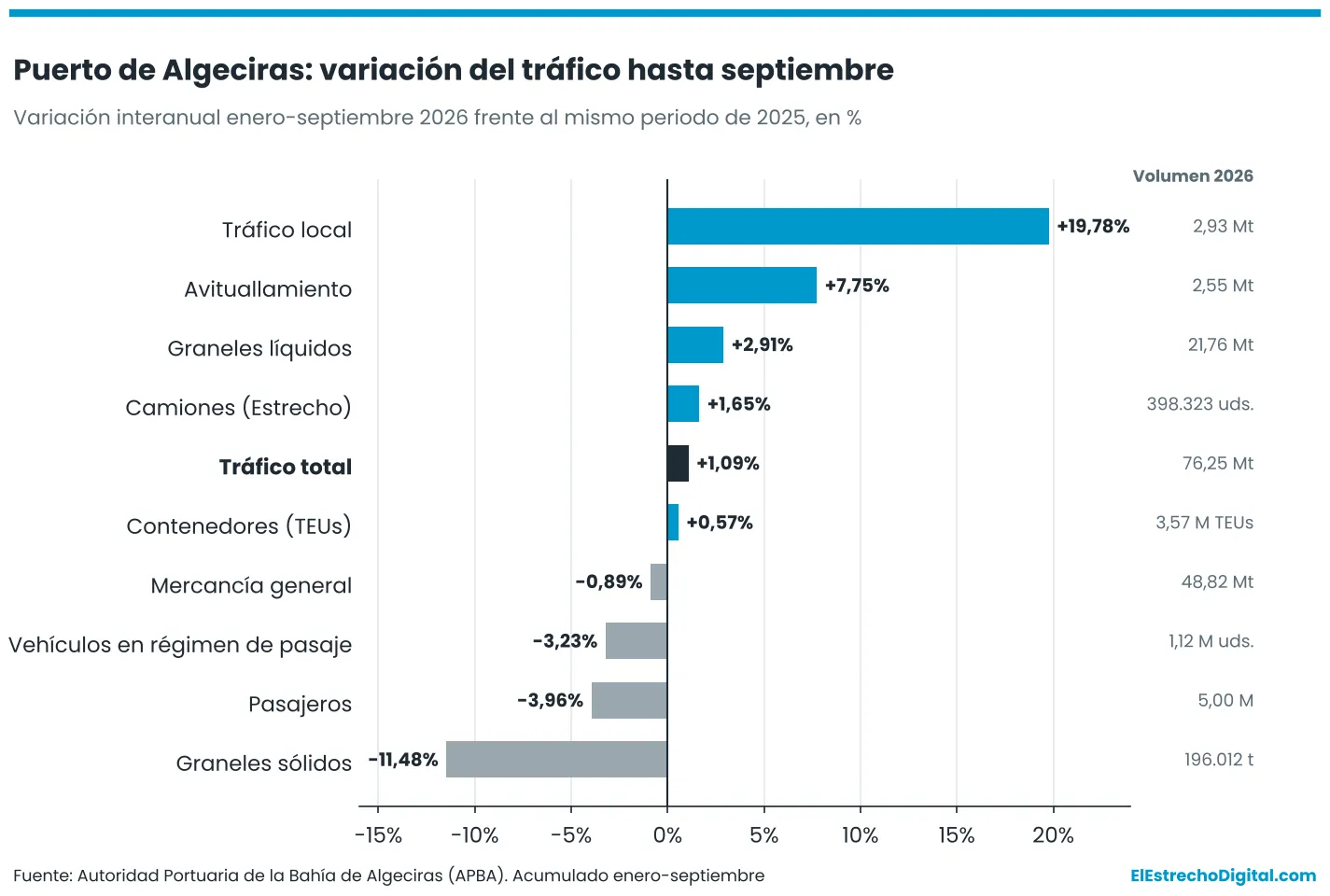
The Port of Algeciras handled 76,251,629 tonnes between January and September 2026, 1.09% more than in the first nine months of 2025, when it recorded 75,432,389 tonnes. The difference, just over 819,000 tonnes, enables the Strait’s docks to fully offset February’s decline in activity, caused by a succession of storms, and enter the final quarter of the year with a positive year-to-date total, according to data from the Port Authority of the Bay of Algeciras (APBA).

The turnaround is underpinned by a September that saw double-digit growth in several traffic categories. In that month alone, the port handled 8,681,544 tonnes, 11.55% more than in September of the previous year. Liquid bulk cargo totalled 2,347,848 tonnes (+11.98%). Discharges rose 24%, to 1,545,292 tonnes, while loadings fell 5.63%. Dry bulk cargo reached 18,714 tonnes (+11.17%). The supply of petroleum products to ships grew 38.2%, to 377,162 tonnes: bunkering at berth rose 78.4%, and at anchorage, 28.18%. General cargo in September stood at 5,474,534 tonnes (+7.59%), and local traffic at 451,109 tonnes (+53.51%). A total of 39,061 trucks used the Strait routes during the month, up 9.25%, with increases of 29% on the Ceuta route and 7.68% on the Tanger Med route.

Over the first nine months, general cargo remains the largest category, at 48,815,560 tonnes, or 64% of the total, although this is down 0.89% from 2025. It is followed by liquid bulk cargo, at 21,762,920 tonnes (+2.91%). This growth comes from discharges (+4.55%), as loadings remain virtually unchanged (+0.04%). Ship supplies total 2,550,449 tonnes (+7.75%), of which 2,435,325 tonnes are petroleum products (+7.13%). Three out of every four tonnes of fuel are supplied at anchorage. Local traffic totals 2,925,987 tonnes (+19.78%), while dry bulk cargo falls 11.48%, to 196,012 tonnes.

Container traffic exceeds 3.5 million TEUs, reaching 3,566,055 units, 0.57% more than a year earlier, although the number of physical containers falls 0.91%, to 2,057,134. International transit—the transshipment of cargo between ships that neither originates nor ends in Spain—accounts for 78% of activity, at 2,778,151 TEUs, and grows 3.8%. By contrast, domestic transit falls 19.61%, to 306,689 TEUs. Import containers increase 2.45% (254,550 TEUs), while export containers decrease 5.34% (226,665 TEUs), with a 12.24% decline in full export containers. Containerized cargo totals 39,146,824 tonnes, down 1.83%. September closed with 410,478 TEUs, 1.49% fewer than in the same month of 2025, despite a 2.46% rise in international transit for the month.
The Port of Algeciras handles more than 76 million tonnes through September, offsetting February’s decline

Container statistics by origin and destination for import and export cargo through September rank China as the leading source, with 51,369 TEUs. Shanghai is the top origin port, with 23,073 TEUs, ahead of Moín (Costa Rica), Chittagong (Bangladesh), Ningbo and Callao. For exports, the United States is the leading destination, with 15,100 TEUs, followed by the Philippines, Morocco, China and South Africa. By port, Manila tops the list with 5,904 TEUs, followed by Tanger Med, Jeddah and Busan.

Truck transport on the Strait routes is close to 400,000 units, with 398,323 commercial vehicles, up 1.65%. The Algeciras–Tanger Med route carries 93.6% of this traffic, with 373,012 trucks (+1.37%), while the Algeciras–Ceuta route accounts for 25,146 (+5.95%).

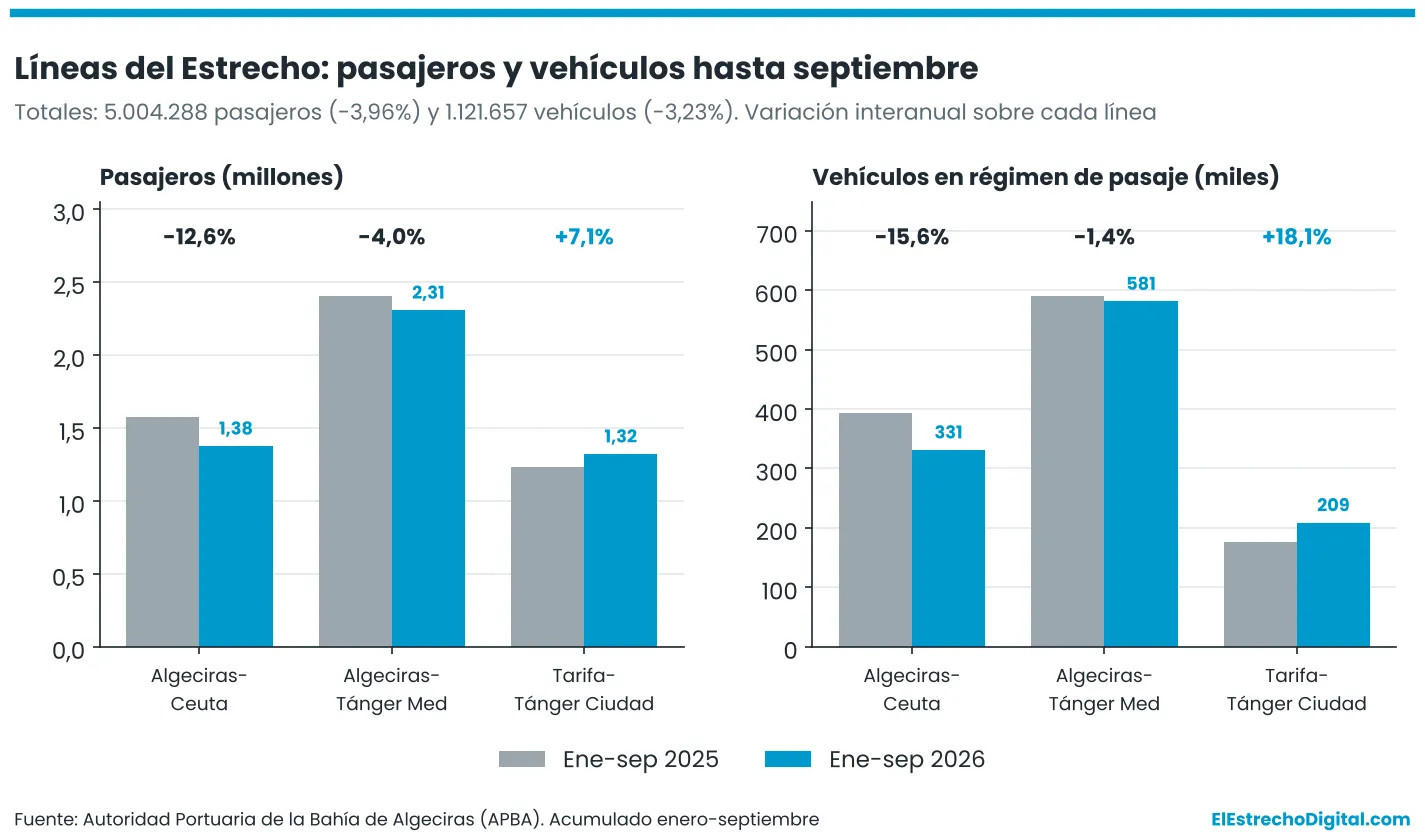
Passenger and vehicle traffic on ferry services, by contrast, shows moderate declines. Through September, 5,004,288 people used the ferry routes, down 3.96%. The Algeciras–Ceuta route lost 198,288 passengers, ending at 1,375,987 (-12.6%). The Algeciras–Tanger Med route, which accounts for 46% of the total, recorded 2,306,533 passengers (-3.96%). The Tarifa–Tangier City connection was the only one to grow, with 1,321,768 passengers (+7.06%). Vehicle figures are similar: 1,121,657 in total (-3.23%). The Ceuta route falls 15.58% (331,346), and the Tanger Med route, 1.41% (581,439). The Tarifa–Tangier City route grows 18.13%, reaching 208,872 vehicles, 32,050 more than a year earlier.

A total of 22,873 ships entered the port, down 2.08%, with a combined gross tonnage of 398.9 million GT (-2.5%). By type, calls by tankers (1,927, +5.59%) and other vessels (3,709, +7.91%) increased, while calls by container ships (2,341, -4.21%) and passenger ships (14,896, -4.84%) declined.

With these figures, the Port of Algeciras enters the final quarter of 2026 with total traffic above 2025 levels. Container traffic is growing slightly, supported by international transit, and more trucks are using the Tanger Med and Ceuta routes. Passenger traffic, on the other hand, is down on the Ceuta route and up on the Tarifa route.

The Port of Algeciras handles more than 76 million tonnes through September, offsetting February’s decline

Newsletter

The maritime briefing, every morning at 8:00

Ports, logistics and shipping essentials in your inbox, Monday to Friday, before the day starts.

By subscribing you accept the privacy policy. About the newsletter

- A D V E R T I S I N G -

Share

Related content

You may also be interested in

NEXT TOTAL SOLAR ECLIPSEAugust 2, 2027

Totality returns to the Strait of Gibraltar

In less than a year, the Moon's shadow will sweep across southern Spain with over 4 minutes of total darkness over Algeciras, Tarifa, and Gibraltar.

---Days
--Hours
--Mins
--Secs
Explore Eclipse Special (in Spanish)