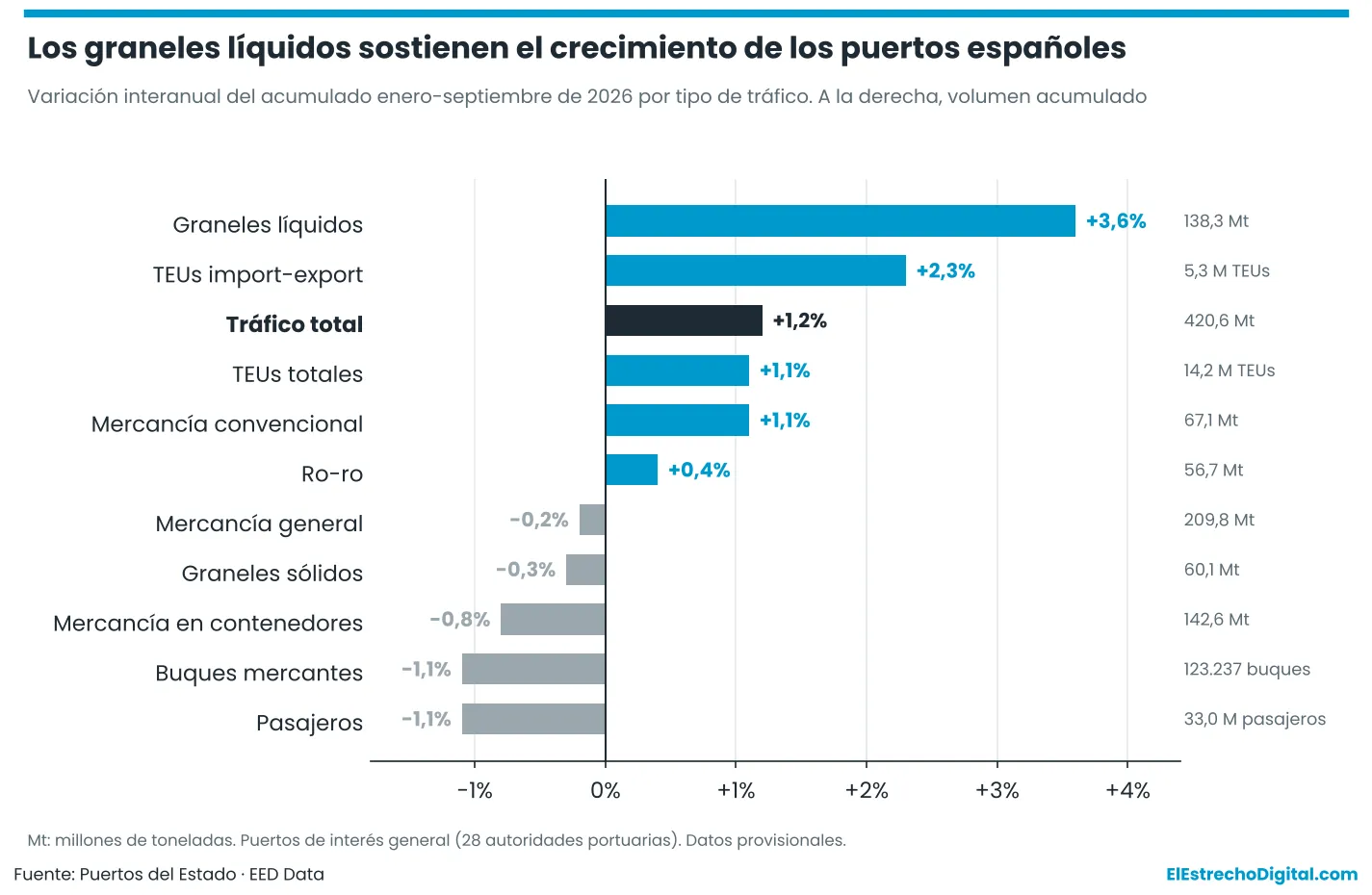
Cargo traffic at state-owned ports reached 420,623,593 tonnes between January and September 2026, up 1.2% on the same period of the previous year, according to data released this Thursday by Puertos del Estado. In September alone, the 28 port authorities handled 47.4 million tonnes, 1.5% more than a year earlier. This figure comes from Puertos del Estado’s monthly statistics, compiled by EED Data, El Estrecho Digital’s data platform.
Puertos del Estado places this result in a context of rising fuel prices and geopolitical uncertainty. According to the agency, these are two factors that continue to shape the evolution of maritime traffic.
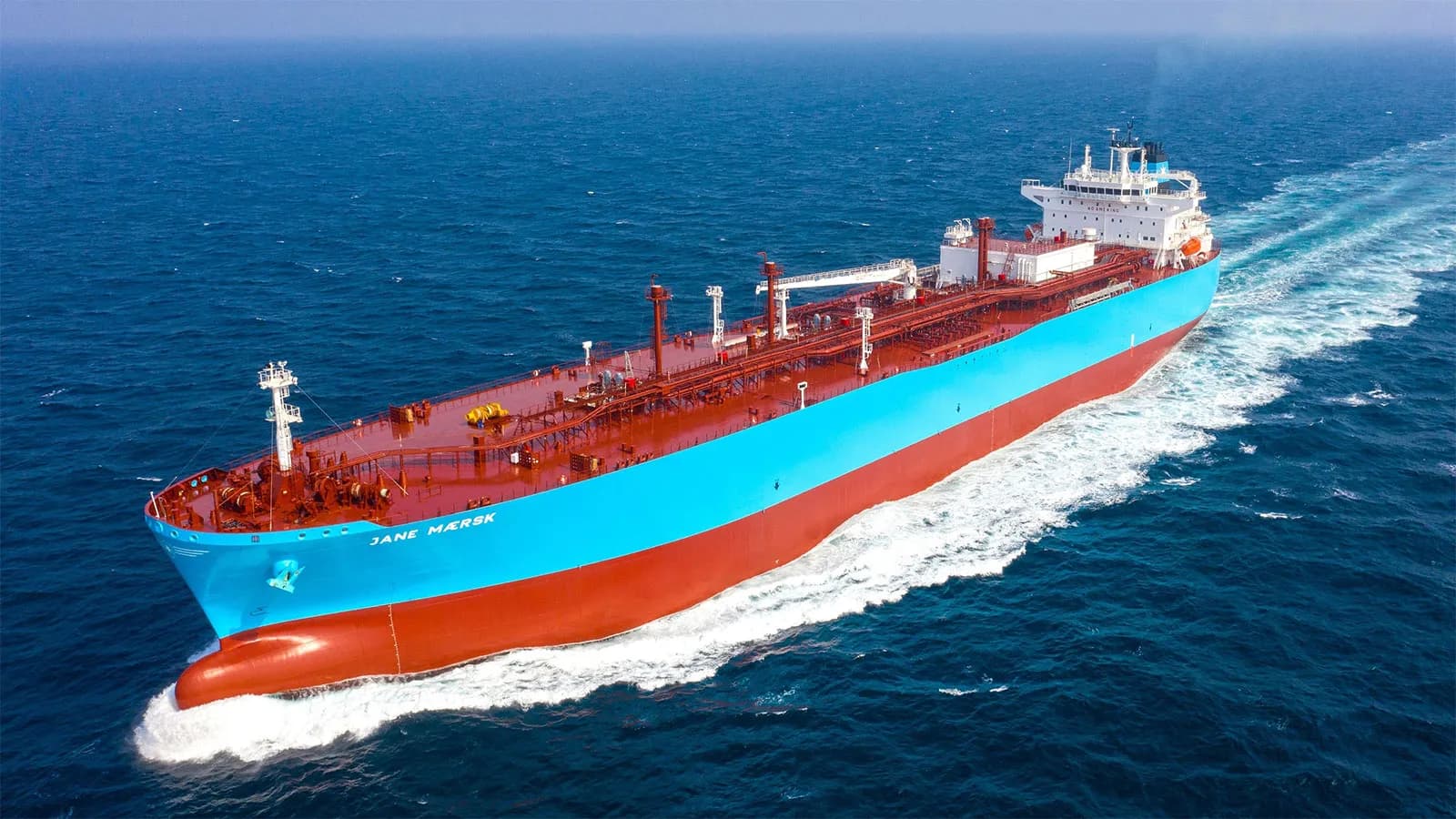
Liquid bulk cargo is the best-performing cargo group. It totaled 138.3 million tonnes in nine months, up 3.6%, thanks to gasoline and chemical products, according to Puertos del Estado. That accounts for almost one in every three tonnes handled by the system. By port authority, the Port of Algeciras ranks first in this traffic, with 21.8 million tonnes (+2.9%). It is followed by Cartagena, with 19.2 million (-0.6%), and Huelva, with 17.3 million (+4.6%). Bilbao, with 16.3 million, recorded the highest growth in this group, at 14.9%, while the Port of Tarragona handled 14.9 million, up 6.1%. In September alone, Huelva increased this traffic by 31.8%.
General cargo, which accounts for half of the system’s traffic, is moderating its decline. Through September, it was down 0.2%, compared with -0.6% in August and -0.8% in July, with more than 209 million tonnes. Of that total, 142.6 million tonnes were containerized cargo, down 0.8%, and more than 67 million tonnes were conventional cargo, up 1.1%. Valencia (54.6 million tonnes), Algeciras (48.8 million) and Barcelona (35.9 million) together handle two-thirds of the country’s general cargo.
Container traffic exceeded 14 million TEUs, 1.1% more than in the first nine months of 2025. Growth came mainly from import and export containers, which rose by 2.3%. According to the monthly statistics compiled by EED Data, transit TEUs totaled 7.27 million, slightly more than half of the total, and remained virtually stable (-0.2%). These are containers transferred from one vessel to another without leaving the port area.
Valencia is Spain’s leading port for containers, with 4.25 million TEUs (-0.8%). It is followed by Algeciras, with 3.57 million (+0.6%); Barcelona, with 2.82 million (-0.4%); and Las Palmas, with 1.21 million (+4.7%). In Algeciras, 86.5% of containers are in transit, totaling 3.08 million TEUs. Valencia, by contrast, handles 2.30 million import and export TEUs, up 6.5%, while its transit traffic is down 9.2%.
Solid bulk cargo saw a slight decline of 0.3%, to 60.1 million tonnes. By port, Gijón totaled 7.6 million tonnes, down 24.4%. Cartagena grew by 31.7% to 6.4 million, while Tarragona (6.6 million) and Castellón (6.5 million) increased by 8.7% and 9.6%, respectively.
Ro-ro traffic increased by 0.4%, to 56.7 million tonnes. The Balearic Islands (11.9 million), Valencia (10.5 million), Algeciras (9.5 million, +2.4%) and Barcelona (9.2 million) account for more than two-thirds of this traffic.
The number of merchant ships calling at Spanish ports fell by 1.1%, to 123,237, while gross tonnage grew by 0.6%. There were fewer port calls, but by ships with greater combined capacity. The Balearic Islands, with 35,057 calls, and Algeciras, with 22,477, are the port authorities with the most ship calls.
Passenger traffic came close to 33 million movements (32,998,746), 1.1% less than in the same period last year. According to data compiled by EED Data, the decline was concentrated in scheduled services, with 22.6 million passengers (-2.4%). Cruise passengers totaled 10.4 million, up 2.1%. The Balearic Islands handled 8.0 million passengers, followed by Santa Cruz de Tenerife (5.4 million), Algeciras (5.0 million, -3.7%) and Barcelona (4.8 million, +4.5%). Barcelona is also the leading cruise port, with 3.3 million passengers, up 6.9%.
The seven Andalusian port authorities handled 118.1 million tonnes through September, 28.1% of the system’s total, with combined growth of 2.1%, according to EED Data’s own analysis. The Port of Algeciras ranks first in Spain by volume, with 76.2 million tonnes (+1.3%), or 18.1% of the state-owned ports’ total. It grew by 11.7% in September. Huelva totaled 23.3 million (+5.0%), Málaga grew by 9.3%, and Motril fell by 13.5%.
Algeciras, Valencia and Barcelona account for 44.9% of the system’s tonnage. Valencia is down 2.0% overall, while Barcelona is up 1.0%. Among ports handling more than 20 million tonnes, the highest growth rates were recorded by Bilbao (+6.3%), Tarragona (+5.9%), Cartagena (+5.6%) and Huelva (+5.0%).
With three months left in the year, liquid bulk cargo has gained close to 4.8 million tonnes, accounting for almost all of the system’s increase. Containerized cargo, solid bulk cargo and passenger traffic remain below the figures for the same period in 2025. The complete series by port can be viewed at PortStats.
Newsletter
The maritime briefing, every morning at 8:00
Ports, logistics and shipping essentials in your inbox, Monday to Friday, before the day starts.