The Port Authority of Algeciras Bay (APBA) has participated in the international round table "Who Governs the Oceans? Rethinking Access & Equity," organized by the Observer Research Foundation (ORF) on the occasion of World Oceans Day 2026. Luis Núñez, head of the Strategy and European Projects Department of the APBA, was the representative of the port of Algeciras at a meeting that brought together experts from different regions and disciplines to address one of the major challenges of the moment: ensuring that ocean governance is effective, inclusive, and equitable in a context of geopolitical, environmental, and economic transformation.
In his remarks, Núñez emphasized that the most urgent challenge in ocean governance is not the absence of rules, as there is already a solid international framework supported by the United Nations Convention on the Law of the Sea (UNCLOS) and the work of the International Maritime Organization (IMO). The real challenge, he proposed, lies in achieving coordinated and equitable evolution of the growing number of environmental, commercial, security, and industrial policies.
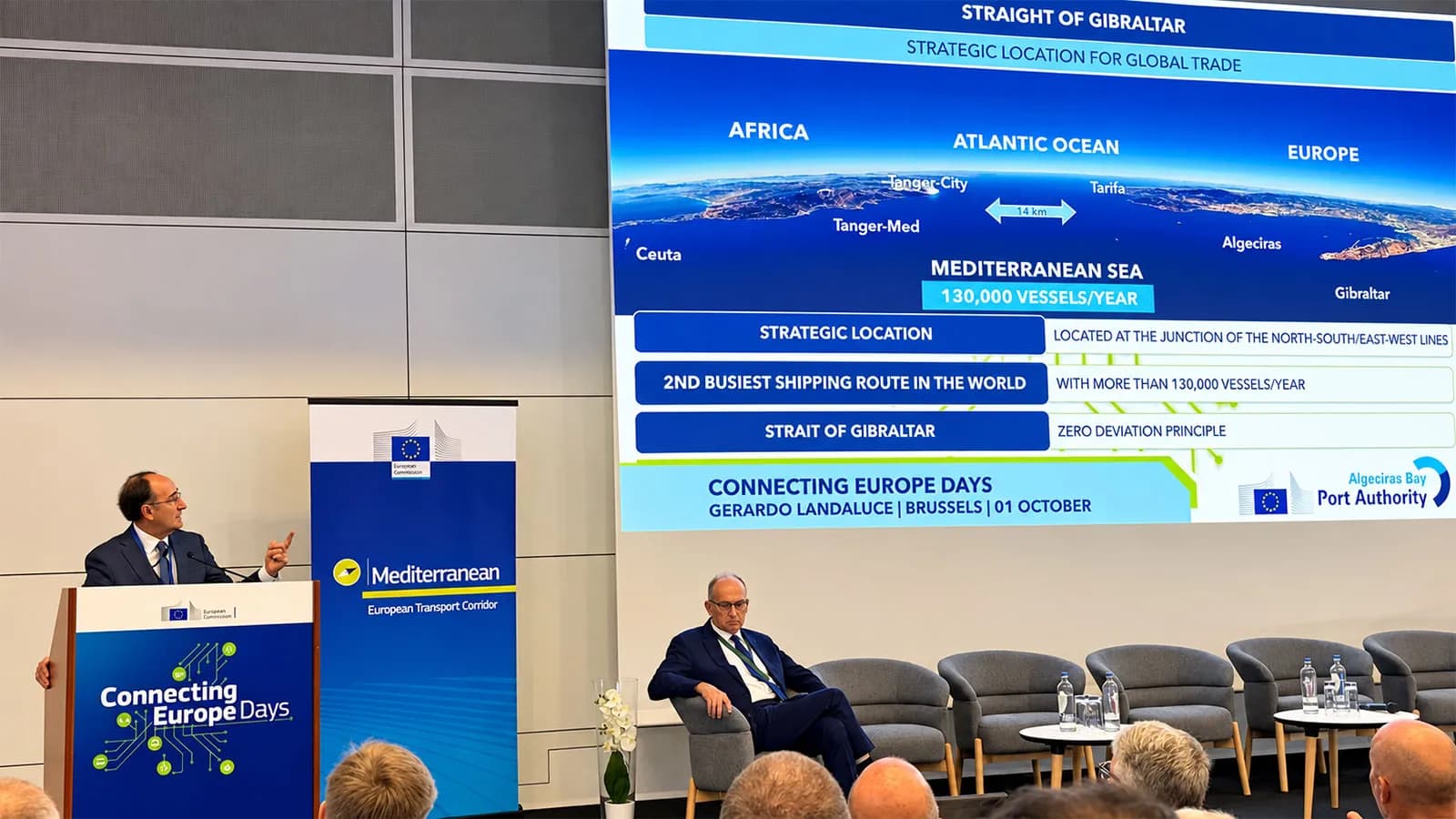
From the perspective of the Port of Algeciras, located at one of the world's main maritime crossroads, the APBA representative pointed out that decisions made in various political spheres increasingly shape ocean governance. Climate policies such as the European Union's Emissions Trading Scheme (ETS), geopolitical tensions, disruptions in supply chains, digital regulations, and security concerns simultaneously influence maritime transport.
Núñez warned about the risk of regulatory fragmentation: if regions, countries, or blocs develop disconnected normative approaches, both the efficiency and equity of the system could be unintentionally undermined. "Maritime transport is intrinsically global. A ship sailing between Asia, Africa, Europe, and America cannot operate under fundamentally different rules at each stage of its journey without generating distortions and unintended consequences," he noted.
The APBA representative stressed that ocean governance must not become a system in which the strongest economies set the standards that others are limited to follow. Governance frameworks, he argued, must guarantee meaningful participation, shared responsibility, and practical pathways for implementation.
Regarding the energy transition, Núñez acknowledged that the decarbonization of maritime transport is essential and that the sector must contribute to global climate goals, but he warned that this transition must be accompanied by investment in infrastructure, technology transfer, capacity building, and access to financing. Otherwise, there is a risk of creating a two-speed maritime economy, where some regions lead the transition while others face higher costs and lower competitiveness.
Núñez also pointed out that maritime corridors can be part of the solution. Well-designed digital green corridors can connect ports, governments, financial institutions, and private actors around common goals, functioning as innovation laboratories and ensuring that benefits are distributed among regions rather than concentrated in a few locations. For the Algeciras representative, effective ocean governance in the 21st century requires three elements: international cooperation, regulatory coherence, and equity. Governance systems that preserve the global nature of maritime transport as a common good, strengthen the resilience of supply chains, support climate action, and above all, ensure that no region is left behind in the transformation of the blue economy are needed. "Oceans connect us all. Their governance should do the same," Núñez concluded.
The round table, moderated by Anusha Mishra from the ORF, was structured around several thematic axes that allowed for addressing ocean governance from multiple complementary perspectives to those presented by the APBA representative.
Deepak Shetty, former secretary and director-general of Navigation of the Ministry of Ports, Navigation and Inland Waterways of the Government of India and senior advisor to the Maritime Anti-Corruption Network, opened the debate with a strong diagnosis of the state of the international legal framework. Shetty pointed out that there is widespread non-compliance with UNCLOS, not only in its spirit but even in the letter of the law, and that the rule-based order is nearing collapse. He also mentioned that the rulings of the International Tribunal for the Law of the Sea, based in Hamburg, show a history of systemic non-compliance in their implementation. Shetty also warned about the challenges posed by seabed mineral extraction and signs that the International Seabed Authority (ISA) increasingly questions its authority.
Pierre Leroy, an OECD representative, provided an analysis focused on the economic dimension. According to the data he presented, the ocean economy has doubled in the last 25 years to reach $2.6 trillion. However, Leroy identified three fundamental tensions: 60% of major marine ecosystems are degraded or exploited unsustainably; many developing countries capture a very small portion of ocean added value and remain excluded from the fastest-growing sectors, such as marine renewable energies, aquaculture, or marine biotechnology; and the need to build resilience in ocean value chains following disruptions caused by COVID-19 and tensions in maritime corridors and chokepoints. Leroy pointed out, however, that there is potential to combine protection, economic development, and resilience, with opportunities in areas such as blue food, offshore wind energy, floating solar, marine biofuels, algae industries, and blue technologies applied to pharmaceuticals, biomaterials, and alternatives to plastic.
Sylvia Guini, head of Strategy and Programs for the ocean agenda at the World Economic Forum, agreed with Núñez's diagnosis of fragmentation as a central problem. Guini pointed out that governance systems remain sectoral when pressures on oceans are increasingly systemic: climate change, biodiversity loss, food security, energy, trade, and coastal development are interconnected, but decision-making remains fragmented among institutions, sectors, and ministries. From her experience working with the private sector, she noted that companies increasingly recognize that ocean health is material to their resilience and long-term competitiveness, but they need clearer metrics, stronger incentives, and greater alignment between policies, finance, and markets to act and scale their initiatives.
Khaled Al Saki, dean of the Faculty of International Transport and Logistics of the Arab Academy for Science, Technology, and Maritime Transport in Egypt, approached governance from the perspective of logistics corridors and supply chains. Al Saki raised a question he considered central: do the multimillion-dollar investments in new maritime corridors, such as China's Belt and Road Initiative or the IMEC, build resilience or simply create new dependencies? He recalled that recent tensions in the Strait of Hormuz highlight that global trade and energy systems continue to depend on a small number of critical maritime chokepoints. The Egyptian academic proposed what he termed NOGUS (New Ocean Governance for the Global South), an approach in which maritime corridors are not only conceived as transportation routes but as governance systems that integrate strategic and operational coordination, institutional alignment, information exchange, legal frameworks, and collective decision-making.
Ingrid Erg, senior director of Market Innovation of the Aspen Institute's Energy and Environment Program and chair of the Zero Emission Maritime Buyers Alliance, focused her remarks on the energy transition of maritime transport. Erg pointed out that the sector almost exclusively relies on fossil fuels and that the penetration of biofuels is below 1%. While she acknowledged their role as part of the energy mix, she warned of the scalability limitations of biofuels: biogenic residual feedstock is insufficient to meet the decarbonization needs of all sectors. As alternatives with greater scalability potential, Erg highlighted electrofuels, produced with clean energy, and the electrification of short-distance maritime transport, which represents approximately 30% of the global maritime emissions footprint. She announced that by 2027, the first commercial deployments of voyages with e-ethanol across the Pacific and the first deployment on a containership with e-ammonia in northern Europe are expected.
Balak Krishna Pisupati, head of the United Nations Environment Programme (UNEP) in India, contributed the perspective of biodiversity frameworks. He recalled the existence of 18 regional sea agreements, 14 of which are managed by UNEP, and highlighted that the agreement on Biodiversity Beyond National Jurisdiction (BBNJ), negotiated over 20 years, has already been adopted and is in force. Pisupati emphasized that India has taken a proactive role, with a draft legal instrument from the Ministry of Earth Sciences that is in the process of inter-ministerial consultation and legal review.
Ariane Steins-Meier, Director of Global Outreach and Engagement of the Ocean Risk and Resilience Action Alliance (ORRAA), addressed the financial dimension. She explained that ORRAA, with over 140 members, has invested $21 million in a pipeline of solutions and has mobilized an additional $139 million, with a multiplier effect of between 1.4 and 1.6 times. Among the piloted solutions, she mentioned blended finance models for marine protected areas, linking carbon finance with algae production in Africa in collaboration with the FAO, and scaling up parametric insurance for coastal communities providing quick payouts after extreme weather events.
Shantan Halder, a researcher at the ORF, analyzed what he termed the "maritime blindness" of many countries, particularly India, and how a gradual transformation is taking place in the way countries define their maritime identity. Halder noted that maritime governance has ceased to be a subset of global governance discourse to assume its own space, mentioning the elevation of Indo-Pacific Maritime Domain Awareness to Indo-Pacific Maritime Surveillance Collaboration as an example of the integration of new technologies.
Malini Shankar, vice-chancellor of the Indian Maritime University, focused on the ocean data gap between nations, which she called a matter of justice. Shankar advocated for four pathways to equity: building shared ocean data infrastructures, investing in human capital through technical scholarships in fields such as artificial intelligence, integrating traditional ecological knowledge from local and indigenous communities, and fully implementing the BBNJ agreement to ensure technology transfers.
Simon Grainge, executive director of the International Seafarers' Welfare and Assistance Network (ISWAN), reminded that nearly 1.8 million seafarers, predominantly from the global south, are essential to the maritime transition but rarely participate in shaping the policies and technologies that define their work. Grainge mentioned the 20,000 seafarers currently stranded in the Gulf as an example of their vulnerability to geopolitical events and noted that the gap between regulation and reality regarding safety, dignity, and protection of maritime workers reflects deep inequities in the design of ocean governance.
Christina Connett Burke, president of the San Diego Maritime Museum and member of the International Council of Maritime Museums, and Katrina de Boo, head of the Navigation and Society program at the German Maritime Museum, highlighted the role of maritime heritage institutions as spaces for public awareness, community development, and citizen participation around the opportunities of the blue economy. Connett Burke described a replicable and scalable model in development together with the Maritime Museum of Genoa, integrating port authorities, indigenous communities, blue technology industries, and naval forces. De Boo, for her part, proposed that blue justice demands questioning who benefits from ocean growth, who bears the costs, and who has a voice in shaping the future of the seas, and reminded that the top 100 companies in the ocean sector account for approximately 60% of revenues.
The representation of small island developing states was led by Jatan, a former parliamentarian from Mauritius, who recalled that her country has the fifth largest Exclusive Economic Zone in the world. Jatan emphasized that for island states, the ocean is not just a resource but their heritage, their present currency, and their future, and that investing in the blue economy is not a luxury but a matter of survival.
Lena Roscher, a researcher at the Institute for Sustainability Research in Germany, addressed marine carbon dioxide removal (MCDR) as an example of emerging ocean activity that poses equity challenges, given that scientific, financial, and technical capacity in this field is concentrated in a small number of countries that also shape the regulatory agenda at the IMO.
The debate organized by the Observer Research Foundation highlighted that ocean governance is at a crossroads where the erosion of multilateralism, the acceleration of the energy transition, the economic concentration of the maritime sector, and the increasing equity demands from the global south converge. The interventions of the panelists, from such diverse angles as international law, port logistics, ocean finance, decarbonization of maritime transport, or seafarers' rights, converged in a shared diagnosis: the international normative framework exists, but its effective implementation, coordination across sectors, and capacity to integrate the most vulnerable actors remain unresolved issues.