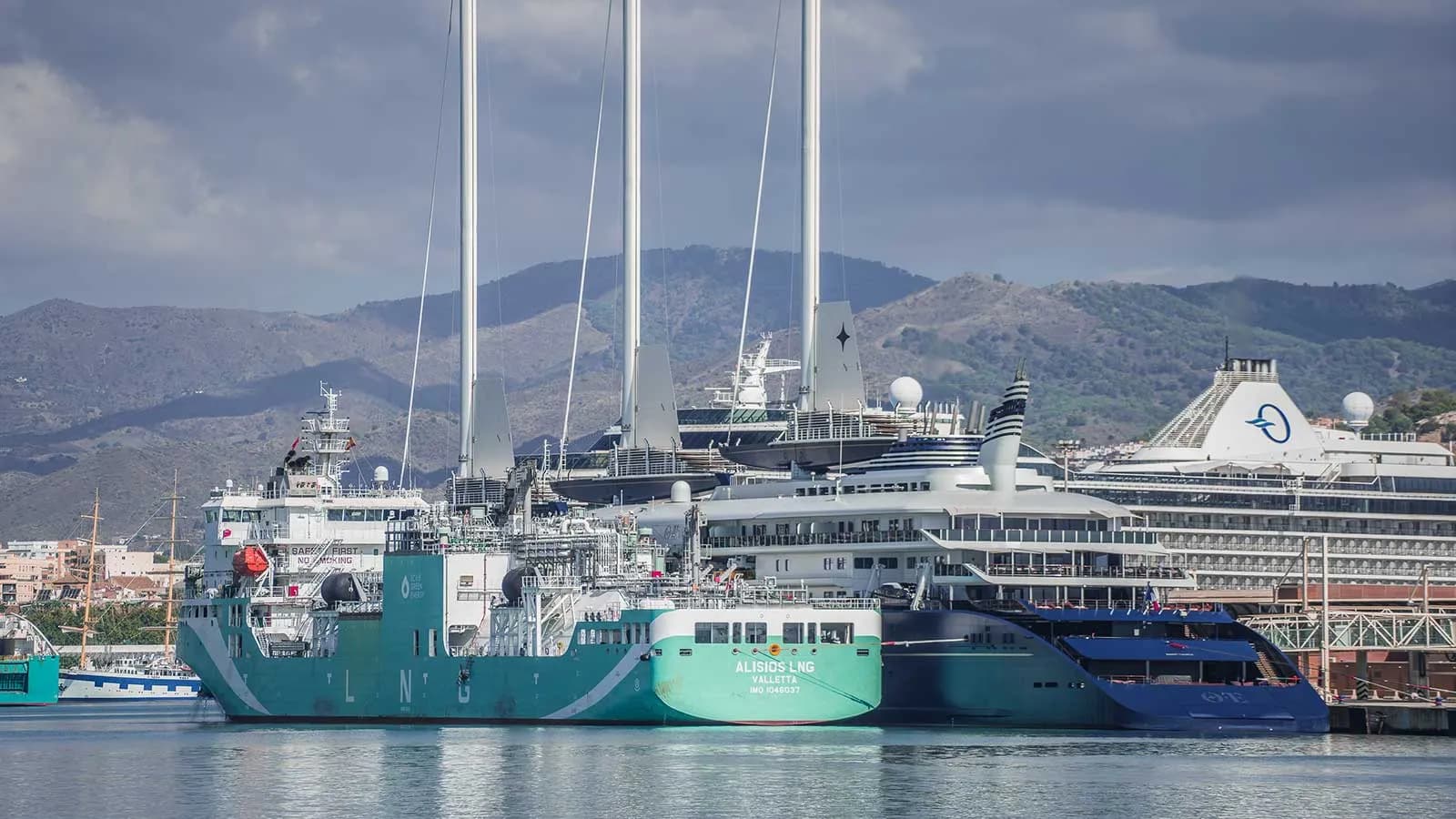
The Port of Málaga has carried out an LNG (liquefied natural gas) supply operation to a cruise ship for the first time, using the ship-to-ship method, which allows fuel to be transferred directly between two vessels. The operation took place last October, with the ‘OE Corinthian’ as the recipient, a vessel from the Orient Express brand that combines hybrid propulsion with sailing technology.
The supply was carried out by the ‘Alisios LNG’, a vessel specializing in liquefied natural gas supply and managed by energy company Axpo, which transferred a total of 300 cubic meters of LNG to the cruise ship in a direct operation between the two vessels.
The 220-meter-long ‘OE Corinthian’ has a hybrid propulsion system powered by LNG and three large rigid sails that make it possible to harness wind energy for navigation when weather conditions are favorable. This configuration combines the use of fuel with wind propulsion.
The operation adds to the alternative fuel supply services that the Port of Málaga has been developing in recent years, both by tanker trucks and by supply vessels.
In November 2023, the port complex carried out its first LNG supply to a cruise ship, the ‘Silver Nova’, using tanker trucks to transport the fuel to the vessel. Later, in March 2025, it hosted the first LNG supply operation to a container ship using the ship-to-ship method, a service also carried out by Axpo, with an MSC Cargo vessel as the recipient.
In September of that same year, the Málaga facilities were the setting for another ship-to-ship supply operation, this time for the container ship ‘MSC Gabon’, which received renewable-origin liquefied natural gas, known as bio-LNG.
These operations are supplemented by regular LNG supplies linked to the maritime connection between Málaga and Melilla, which, according to the Port Authority, have been carried out since 2020 and include the vessel ‘Rusadir’, operated by Baleària.
The availability of different supply methods enables the port complex to meet the needs of vessels with different propulsion systems and operating characteristics, both in the cruise segment and in maritime freight transport.
These actions are part of the Green Port initiative, promoted by the Port Authority of Málaga to incorporate sustainability and energy-efficiency criteria into port activity, as well as to facilitate the supply of alternative fuels to vessels operating at its facilities.