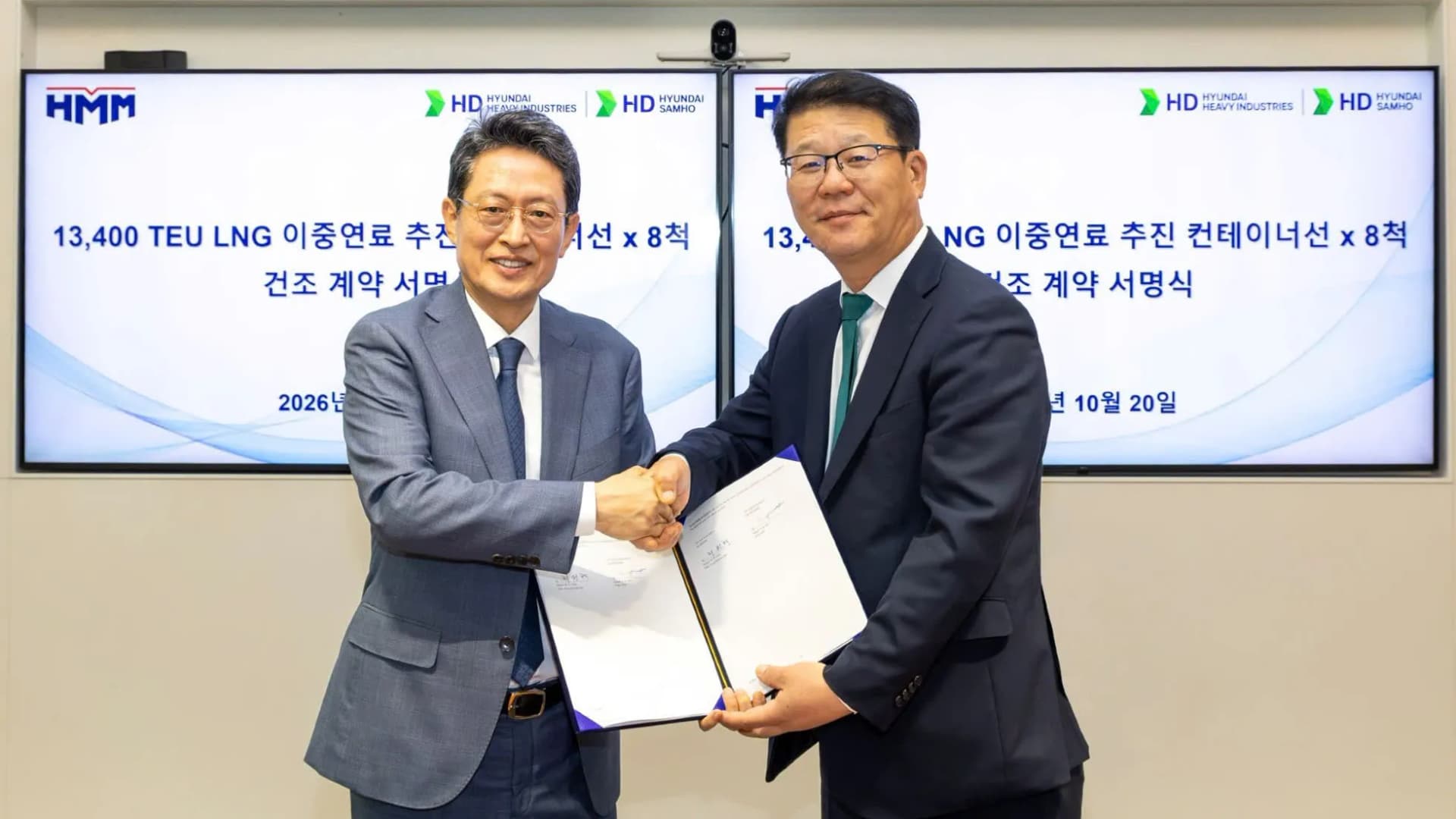
South Korean shipping company HMM has signed a contract with shipbuilding group HD Hyundai to build eight container ships with a capacity of 13,000 TEUs, equipped with dual-fuel liquefied natural gas (LNG) propulsion systems. The deal, announced on Tuesday, October 20, is worth 1.9196 trillion South Korean won, approximately $1.4 billion, and provides for the vessels to be delivered during 2029.
The order will be split between two of the shipbuilding group’s shipyards. HD Hyundai Samho, located in Yeongam, will build six vessels, while HD Hyundai Heavy Industries, in Ulsan, will build the other two. The shipbuilder has confirmed that deliveries will be staggered.
The eight container ships will be 337 meters long, 51 meters wide and 27.9 meters high. They will be equipped with dual-fuel engines capable of using both LNG and conventional marine fuels. They will also feature independent liquefied natural gas storage tanks manufactured by HD Hyundai Ecovina, a company belonging to the same industrial group.
HMM plans to deploy these vessels on its FIM (Far East-India-Mediterranean) service, which connects the Far East, India and the Mediterranean. The addition of the vessels is part of the company’s reorganization and expansion of its shipping capacity on long-distance routes.
The contract with HD Hyundai is part of a broader investment program comprising a total of twelve container ships. In addition to the eight 13,000-TEU vessels, HMM has announced the addition of four other feeder ships through the purchase of vessels currently under construction for other shipowners.
These four vessels will consist of three 2,800-TEU container ships and one 1,700-TEU vessel, which will be deployed on regional routes between major transshipment ports and smaller port facilities.
In total, the twelve vessels will add nominal capacity of 114,100 TEUs, of which 104,000 TEUs will come from the eight large container ships and the remaining 10,100 TEUs from the feeder vessels. HMM’s announced investment in this program amounts to approximately 2.1 trillion South Korean won.
The shipping company is undertaking these operations as part of its service organization strategy known as hub-and-spoke, based on using large vessels for ocean routes and smaller vessels to distribute containers between major port hubs and their regional markets.
According to information released by HMM, its feeder fleet, including both operational and ordered vessels, has grown from twelve vessels in March 2025 to 42 in 2026. The company is deploying some of this capacity to develop regional routes in markets such as Africa and India.
The new vessel orders are part of HMM’s strategic plan through 2030, which provides for investments worth 29 trillion won to expand its maritime operations. The announced targets include a fleet of 166 container ships with a combined capacity of 1.47 million TEUs, and 110 vessels for transporting dry bulk cargo, with a total deadweight tonnage of 13.52 million tonnes.
The company is also allocating resources to modernize its logistics facilities, digitize its operations and incorporate new technologies into its fleet. These initiatives include replacing cranes at the WUT terminal at the U.S. port of Tacoma.
With the new program of twelve container ships, HMM’s committed investments in 2026 exceed 6 trillion won, including fleet expansion, logistics infrastructure and technological development. The shipping company puts its cumulative investments since Choi Won-hyuk became its president in March 2025 at 12 trillion won.
Meanwhile, HD Korea Shipbuilding & Offshore Engineering (HD KSOE), HD Hyundai’s shipbuilding subsidiary, has announced that contracts secured during 2026 total $20.19 billion, covering 182 vessels. This represents 86.6% of the group’s annual contracting target.