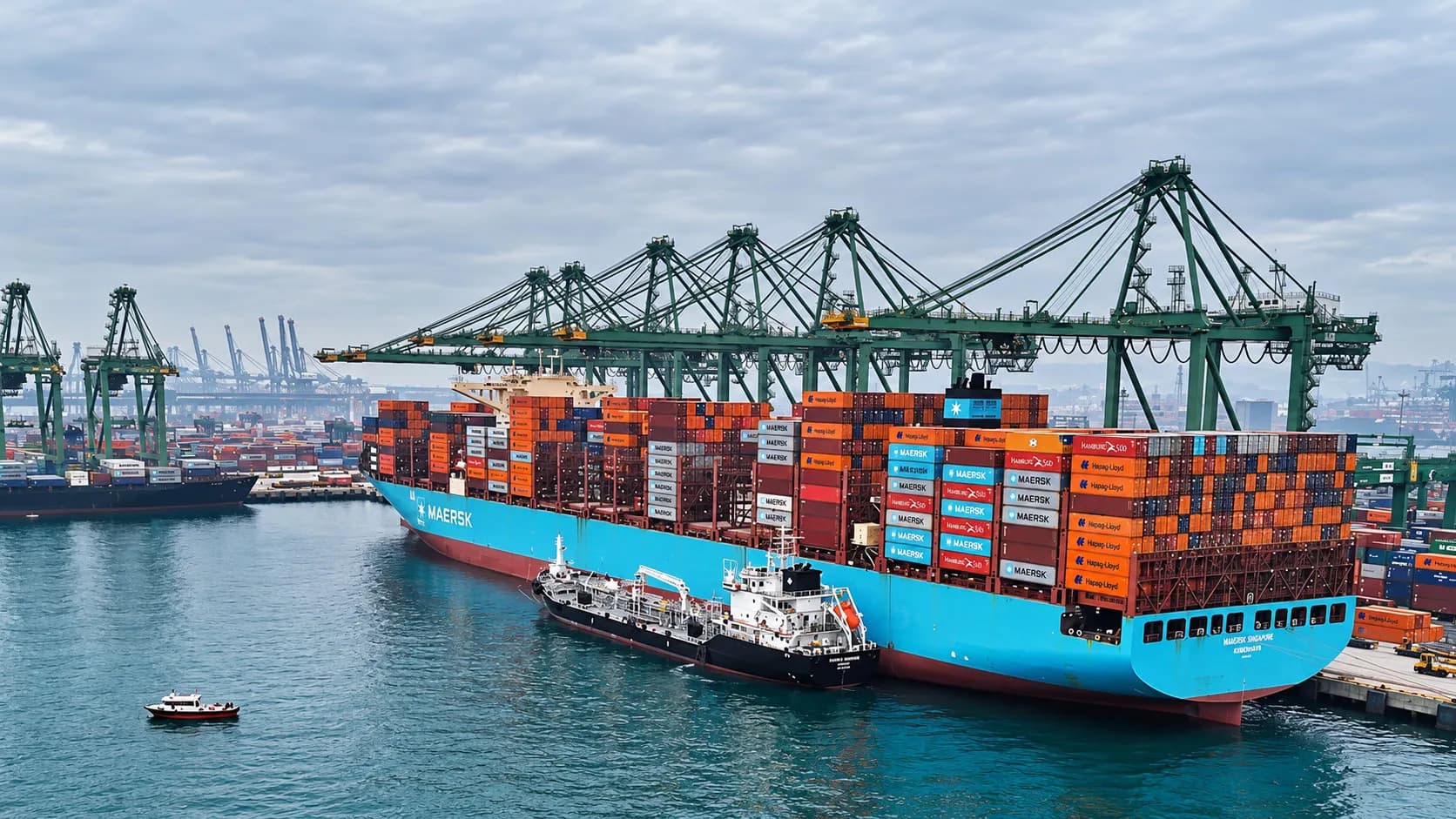
Maersk has completed a bunkering operation in Singapore involving approximately 5,000 tonnes of bioethanol for the container ship Maersk Halifax, the largest volume of this fuel transferred to a vessel in a single operation to date. The bunkering took place on October 17 at the Pasir Panjang terminal, while the ship was simultaneously carrying out cargo loading and unloading operations.
The operation, announced by the Danish company on Monday, marks the first supply of ethanol in Singapore and also the first time a Maersk vessel with an engine system adapted to run on two types of fuel has received it.
The Maersk Halifax, registered under the flag of Singapore, is the first container ship in Maersk's fleet to have been converted to use a dual-fuel propulsion system. This configuration allows it to use alternative fuels instead of the traditional fuels used in maritime transport.
The fuel was supplied by the tanker Golden Centaurus, owned by Golden Island, a company specializing in marine fuel bunkering. The operation involved Maersk, Golden Island and PSA Singapore, as well as the Maritime and Port Authority of Singapore (MPA).
The 5,000 tonnes supplied consisted of bioethanol certified under the international ISCC system, which is used to verify certain sustainability and fuel traceability criteria. Measurement equipment was used during bunkering to monitor the quantity of product transferred between the two vessels.
One distinctive feature of the operation was that it was carried out while the container terminal continued its regular activities. Fuel bunkering and cargo handling took place simultaneously, making it possible to assess the conditions needed to accommodate both activities.
Before bunkering, the participating organizations conducted safety assessments and prepared work procedures. The Maritime and Port Authority of Singapore also oversaw crew training in fuel handling and responses to potential emergencies.
The results of this operation will be used to study how procedures Singapore currently uses for methanol bunkering can be adapted for ethanol. The two fuels have similar characteristics in certain aspects of their handling, although their use requires the appropriate technical and safety conditions.
Maersk considers ethanol one of the alternatives it is examining to reduce emissions associated with maritime transport. Its international availability and the existence of production and distribution networks make it possible to explore its use in engines designed to run on alcohol-based fuels. Emissions reductions depend, among other factors, on the product's origin and manufacturing process.
Emma Mazhari, Maersk's Head of Energy Markets, explained that the company is pursuing a strategy based on a range of fuels, as it believes no single alternative can meet the decarbonization needs of global maritime transport.
The operation in Singapore follows earlier ethanol trials conducted by the shipping company aboard the vessels Laura Maersk, Antonia Maersk and Tangier Maersk. In late September, the latter received a bioethanol supply in the United States as part of the company's trials to study its use in long-distance maritime transport.