The French shipping company CMA CGM and the international logistics operator DSV have signed an agreement to reduce carbon dioxide emissions associated with maritime freight transport by using alternative fuels. The collaboration includes a reduction target of 12,000 tons of CO₂ over a period of two years, through the low-emission transportation solution ACT+, developed by the French shipping group.
The agreement establishes that DSV will use this service to decrease the carbon footprint of the maritime operations contracted with CMA CGM. The expected reductions will be achieved by employing second-generation biofuels based on UCOME, produced from used cooking oils and intended to partially replace conventional marine fuels.
The initiative is part of the commercial collaboration maintained by both companies and their respective strategies for decarbonizing international supply chains. Both CMA CGM and DSV have set the goal of achieving net zero carbon emissions by 2050.
The ACT+ solution allows CMA CGM's customers to contract different levels of emission reductions associated with their maritime shipments, by using less carbon-intensive fuels. According to the shipping company, the system can provide reductions of up to 83% in CO₂ emissions compared to conventional fuels, calculated across the entire production, distribution, and fuel utilization cycle.
This percentage corresponds to the maximum reduction capacity offered by ACT+ and not to a uniform reduction commitment for all shipments included in the agreement with DSV.
The operation of this solution is based on a mass balance system (mass balance), which allows accounting for the amounts of alternative fuels used by the shipping company and assigning the corresponding emission reductions to the services contracted by its customers. In this way, companies can incorporate certified reductions associated with their transport operations into their environmental calculations.
The methodology includes the issuance of official statements about the alternative fuel used and the associated CO₂ emissions from shipments, through a procedure verified by an independent third party. The system is aimed at companies that need to account for and reduce the indirect emissions of their supply chains, including those related to maritime transport contracted to third parties.
Michael Hollstein, Senior Vice President of Global Maritime Product at DSV, has explained that reducing emissions in international supply chains requires collaboration among different operators and solutions that can be applied at scale. According to the executive, the use of ACT+ will expand the lower-emission maritime transport options available to customers of the logistics group.
On behalf of CMA CGM, Amandine Paulet, Vice President and Deputy Commercial Director, has positioned the agreement within the relationship that both companies maintain to develop transport solutions tailored to the environmental goals of their customers.
The ACT+ program is part of the service offering that CMA CGM began to develop in 2020 to facilitate access to lower-emission maritime transport alternatives for shippers and logistics operators. The solution includes the use of different fuels, including second-generation biofuels, liquefied biomethane, and other alternative energy products.
The French company is simultaneously maintaining a fleet transformation program that includes ships prepared to use liquefied natural gas and methanol. This strategy began to take on greater dimension in 2017, when the group decided to incorporate LNG propulsion into its largest container ships.
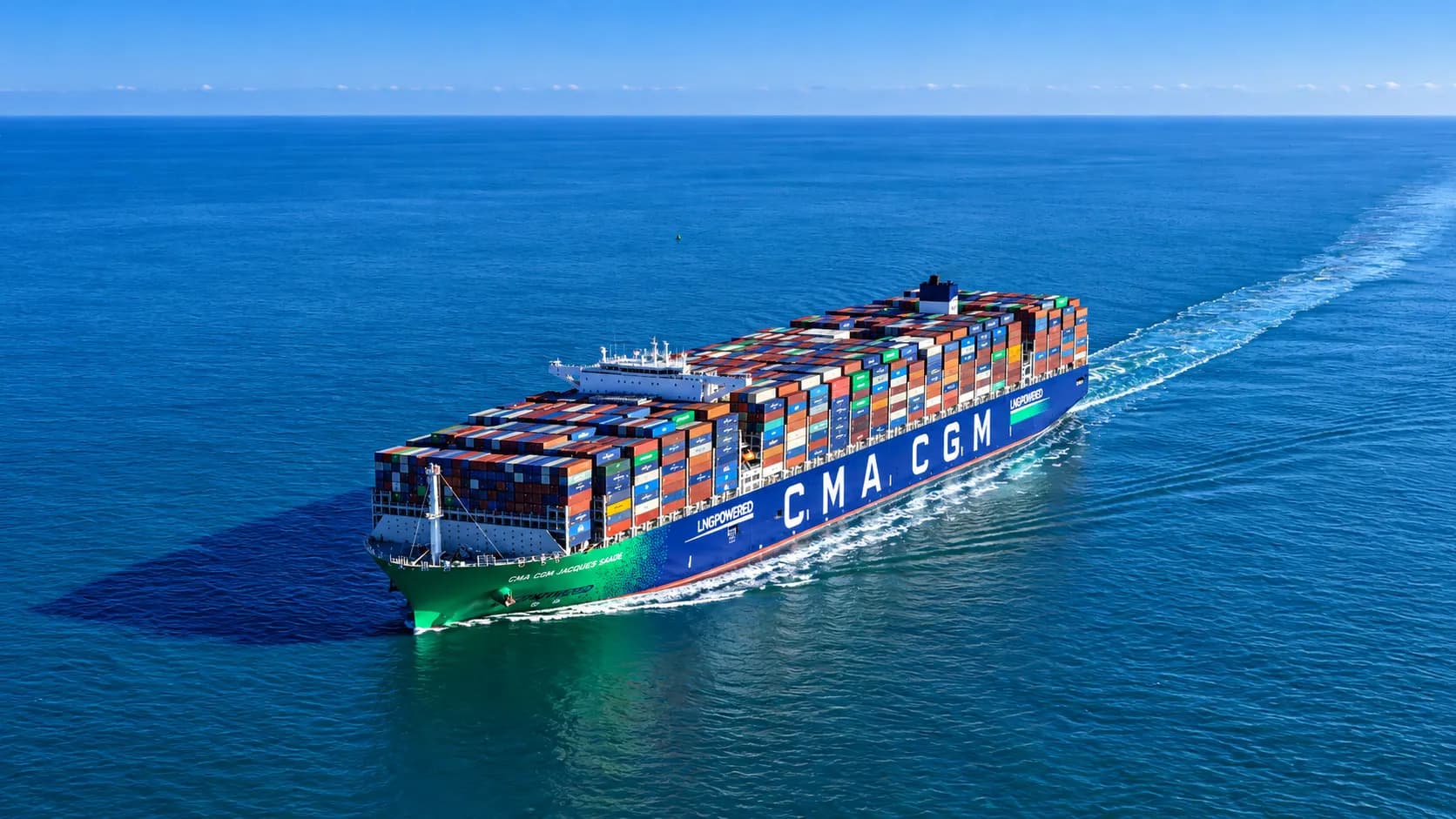
In 2020, the CMA CGM Jacques Saadé entered service, a container ship of 23,000 TEU powered by LNG. More recently, in 2026, the shipping company has incorporated the CMA CGM Notre Dame, the first ship of a series of ten new generation units with a capacity of 24,212 TEU and propulsion through liquefied natural gas.
According to forecasts communicated by the group, CMA CGM expects to operate around 200 dual-fuel ships prepared to use LNG or methanol by 2031, with the capacity to employ lower carbon-intensity energies.
The shipping company places these investments and the commercial agreements related to ACT+ within its strategy to achieve net zero emissions by 2050, which includes measures for energy efficiency, incorporation of alternative fuels, and collaboration with customers and suppliers.
The agreement announced with DSV specifically focuses on the goal of reducing 12,000 tons of CO₂ over the next two years using UCOME biofuels. The communication from both companies does not detail the volumes of goods included, the maritime routes where the program will apply, or the economic investment associated with the operation.