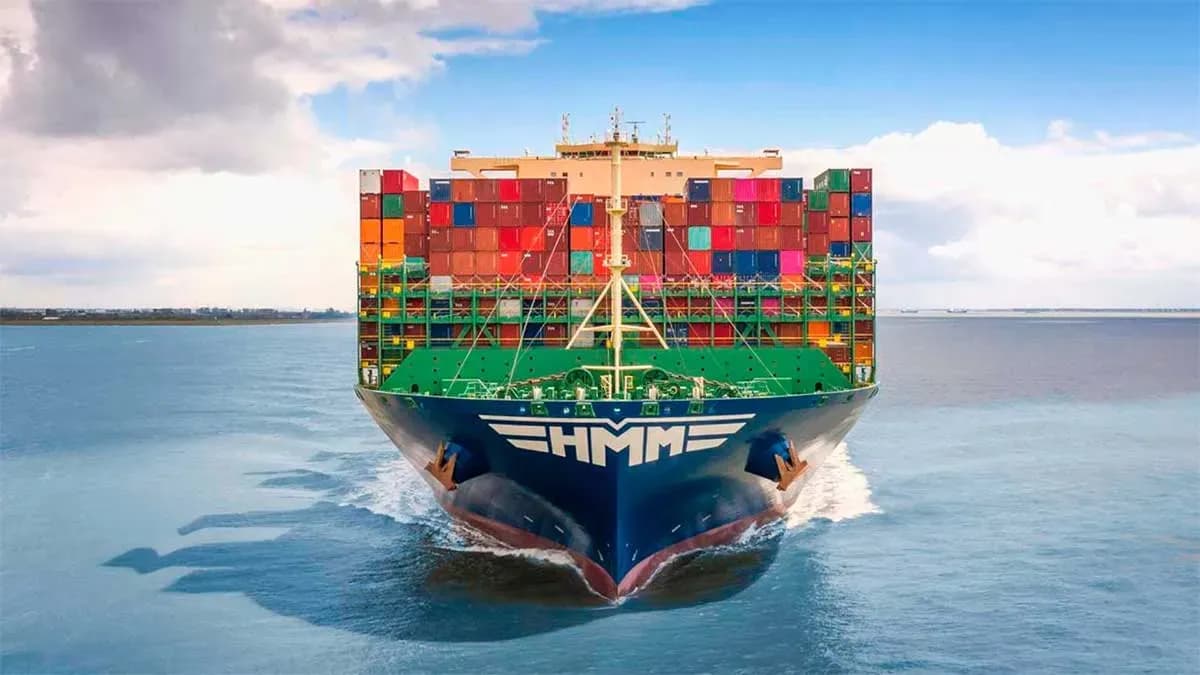
HMM closed the second quarter of 2026 with revenues of 3.402 trillion won, 30% more than in the same period of the previous year, while net profit decreased by 12.7%, to 411.4 billion won. The South Korean shipping company attributes the quarter's performance to the recovery of freight rates since the end of May, in a context conditioned by the conflict in the Middle East and the rise in operating costs.
The improvement recorded between April and June has allowed for a moderation in the decline of accumulated results during the first half of the year. In the first half overall, HMM achieved a net profit of 765 billion won, approximately 537 million dollars, 37% less than the 1.21 trillion won accounted for during the same period in 2025.
Semiannual revenues, on the other hand, increased by 12% year-on-year and reached 6.12 trillion won. The company has thus maintained positive results despite a scenario characterized by disruptions in shipping routes, rising fuel costs, and uncertainty associated with the evolution of international trade.
HMM points out that the conflict in the Middle East, which began in March, has caused losses in revenue and increased costs, especially in fuel. However, transport rates began to recover from the end of May due to the early arrival of the peak season, a circumstance that had a direct effect on the accounts of the second quarter.
The behavior of the freight rates is reflected in the evolution of the Shanghai Containerized Freight Index (SCFI), which recorded an average of 1,957 points during the first half, 15% higher than that corresponding to the same period of the previous year.
The South Korean shipping sector relates this rise, among other factors, to an advance in transport demand due to U.S. tariff policies. Some shippers may have anticipated their shipments to prepare for the commercial campaign extending from Black Friday, at the end of November, to Christmas, reducing their exposure to possible modifications of the tariffs.
U.S. trade policy constitutes, precisely, one of the factors that HMM identifies among the main sources of uncertainty for the coming months. To this situation are added the risks arising from the evolution of the conflict in the Middle East, the operational conditions of the Panama Canal, and the congestion of some of the main international ports.
The shipping company expects that these elements will maintain a high degree of uncertainty during the third quarter and condition both the supply chains and the evolution of costs and maritime freight.
In the face of this scenario, HMM maintains its strategy of optimizing consumption and fuel costs to limit the impact of high oil prices. The company will also continue to apply its operations model based on a 'hub and spoke' strategy, which aims to increase efficiency in the use of its fleet and adapt capacity to the characteristics of different markets.
The capturing of new traffic constitutes another of the axes of its planning. HMM particularly points out demand opportunities in Southeast Asia, a region where it seeks to expand its activity while adjusting the operation of its services to variations in international goods flows.
The investment policy will also continue during the second half of 2026. Between the second quarter of 2025 and the end of the first half of this year, HMM has executed investments close to 10 trillion won over a period of 15 months.
The company links this program to its forecasts about the evolution of the maritime market over the next two to three years and not solely to an increase in its capacity. The strategy contemplates the early acquisition of vessels at a time when international newbuilding prices maintain an upward trajectory.
HMM considers that contracting capacity under current conditions can reduce its exposure to future increases in ship prices. This policy is part of its fleet planning and its investment strategy for the coming years.
The results of the second quarter show, at the same time, a significant difference between the evolution of invoicing and that of profit. While revenues grew by 30%, exceeding 3.4 trillion won, net profit decreased by nearly 13%, reflecting the effect that higher operating costs have had on the company's margins.
The recovery of rates since the end of May has allowed for partial compensation of these pressures. HMM maintains its attention on the evolution of freight rates, the price of fuel, and disruptions in international logistics chains, factors that will determine the behavior of its operations during the second half of the year.