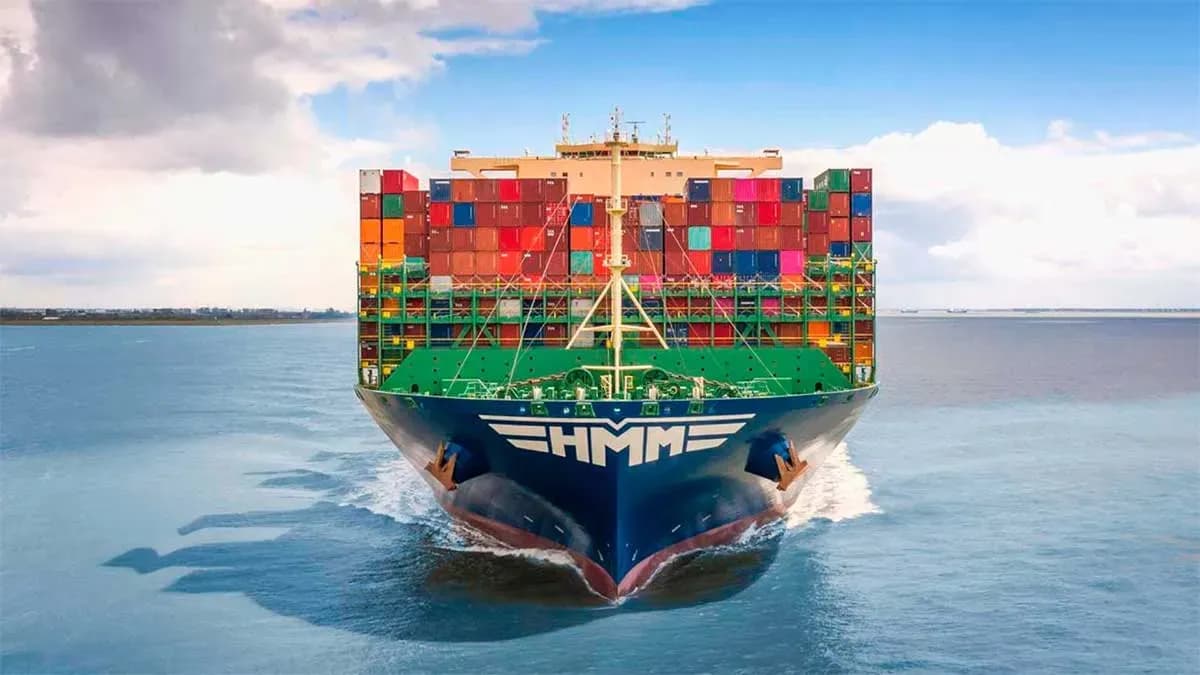
HMM has obtained an AA rating in the 2026 MSCI ESG assessment, as the company itself has communicated. The South Korean shipping company places this result as the highest level achieved among publicly listed maritime companies globally, within a classification that MSCI uses to measure environmental, social, and governance risk and opportunity management.
The company has noted that this rating places it within the group of companies considered 'Leaders' by MSCI, a category associated with a more developed management of ESG factors compared to other companies in its sector. MSCI ESG Ratings' scale encompasses seven levels, from CCC to AAA, so the AA rating represents the second highest degree of the system.
HMM started with a BB rating in 2021 and, according to the information provided by the company, has improved three levels to reach the current AA. This evolution has occurred during a period when maritime transport has been subjected to greater regulatory, financial, and commercial demands concerning sustainability, especially due to the need to reduce emissions and adapt fleets to new fuels and technologies.
The shipping company has indicated that this result has been achieved despite the implementation of a more stringent evaluation framework during this exercise. According to HMM, MSCI has evaluated its performance in the three areas that make up the ESG assessment: environment, social dimension, and corporate governance. The company attributes this improvement to the measures taken in recent years to organize its sustainability strategy and respond to regulatory changes in the international maritime sector.
The recognition comes at a time when HMM maintains an investment strategy aimed at renewing its fleet and aligning it with emission reduction goals. In September 2024, the company presented an investment plan until 2030 for 23.5 trillion won, of which 14.4 trillion won was allocated to sustainable management, lower-emission vessels, and green facilities. The company also communicated its intention to set 2045 as the horizon to achieve carbon neutrality.
As part of this strategy, HMM has contracted new vessels prepared for alternative fuels. The company ordered nine methanol-powered container ships, with deliveries scheduled between 2025 and 2026, intended for services between Asia and North America, Latin America, and India. That contract, awarded to Korean shipyards, was valued at around 1.120 billion dollars. Later, in 2025, a new order for twelve 13,000 TEU dual fuel LNG-powered container ships was reported, along with two VLCC oil tankers, valued at approximately 4 trillion won.
HMM's evolution fits into a broader trend within regular maritime transport, where major shipping companies are reviewing their fleet plans to comply with stricter environmental standards. The International Maritime Organization approved a strategy in 2023 to achieve net zero emissions by around 2050, with interim objectives for reducing carbon intensity and incorporating zero or nearly zero-emission fuels and technologies before 2030.
In Europe, maritime transport is already integrated into the European Union's emissions trading system. The system is applied gradually, with 40% of obligations in 2024, 70% in 2025, and 100% in 2026 for included ships. Additionally, FuelEU Maritime establishes progressive limits on the greenhouse gas intensity of the energy used by ships that dock at European ports.
This scenario has raised the importance of ESG indicators for publicly listed shipping companies, both for their reputational impact and their relationship with access to financing, contracting with international shippers, and risk assessment by investors. In HMM's case, the AA rating from MSCI adds to other external recognitions communicated by the company in terms of sustainability, including assessments from EcoVadis, CDP, and Sustainalytics.
HMM closed 2024 with revenues of 11.7 trillion won, an operating profit of 3.513 trillion won, and a net profit of 3.781 trillion won, in a fiscal year affected by changes in freight rates, route reorganization, and operational tensions arising from the situation in the Red Sea. In the first half of 2025, the company maintained profits with revenues of 5.477 trillion won, operating profit of 847 billion won, and net profit of 1.211 trillion won, despite the year-on-year decline of the SCFI index.
The South Korean company ranks among the world's leading container shipping companies by fleet capacity, with a significant position in east-west traffic and long-distance services. Its AA rating in MSCI ESG now incorporates a new element into its corporate positioning, at a time when environmental adaptation, risk management, and transparency in governance are part of the variables observed by regulators, clients, and investors in the maritime sector.