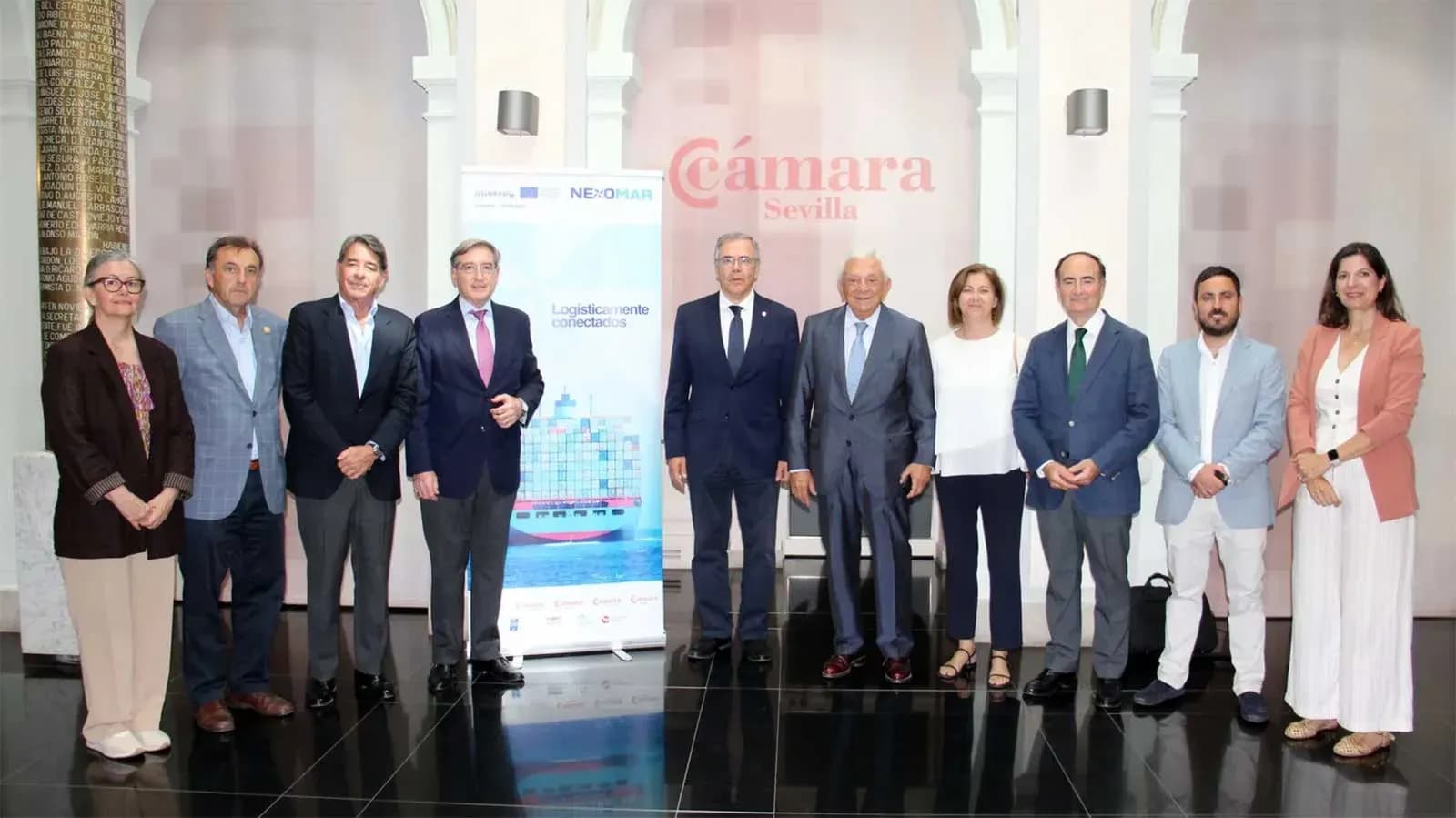
The president of the Port Authority of the Bay of Algeciras (APBA), Gerardo Landaluce, has positioned the ports as critical infrastructures and strategic assets for competitiveness, security, energy transition, and connectivity in Europe, during his intervention at the event "Markets, geopolitics, and maritime routes: keys to the global scenario," held in Seville on June 24. The meeting, organized by the Chamber of Commerce of Seville in collaboration with Cesce and inAtlas and supported by the European program NEXOMAR, brought together professionals from the logistics-port sector, the exporting business fabric, and representatives from various public entities, with the aim of addressing the transformations currently experienced by commercial routes and operational costs.
Landaluce stated that "resilience is no longer an advantage; it is a necessity," referring to land and rail connectivity as a key element for having more efficient, competitive, and resilient logistics chains. The president of the APBA mentioned the joint work of the chambers of commerce and the existing collaboration among the Andalusian ports, a dynamic he considered even more necessary in difficult times for the logistics sector: "we do not compete between ports; we complement each other."
The institutional opening also included the intervention of the president of the Chamber of Commerce of Seville, Francisco Herrero; the president of the Port Authority of Seville, Rafael Carmona; the president of the Chamber of Commerce of the Bay of Algeciras, Carlos Fenoy; and the territorial director of Cesce, Álvaro Portes.
During his intervention, Herrero conveyed the "deep concern of the business fabric in light of the current geopolitical drift, warning that instability in strategic regions and alterations in the main maritime routes are generating notable uncertainty, increasing costs, and severely conditioning business planning." The event noted that tensions in critical maritime corridors such as the Red Sea or the Strait of Hormuz are forcing transit companies and logistics operators to design more complex routes, face changing regulations, and manage a greater documentary load, factors that directly impact operations and the competitiveness of foreign trade.
In order to provide solutions and tangible tools for decision-making, the meeting analyzed the impact of global geopolitics on shipping lines and the reconfiguration of transport flows, presented the new guidelines from the European Sea Ports Organization (ESPO) to adapt community infrastructures to the new global order, and introduced the global geomarketing solution developed by inAtlas and Cesce, an interactive tool designed for importing and exporting companies to identify secure business opportunities in over 200 countries through country-risk data analysis.
Carlos Fenoy emphasized the importance of port connectivity and its impact on the real economy. On his part, Rafael Carmona stated that "in the face of the current uncertainty scenario, where one of the sectors that suffers the most is international trade, from the perspective of the ports we are advancing to improve our infrastructures and to promote the integration of transport modes: ship, train, and truck, moving from multimodal port to synchromodal." The president of the Port Authority of Seville added the technological variable to the diagnosis and explained that "from Seville, we are working on initiatives to virtually connect the entire Port Community with the Prisma project, and in the design of a digital twin of the Eurovia of the Guadalquivir, Guadaltwin, which allows us to simulate and predict the factors influencing inland navigation," with the aim of improving logistic chains.
Álvaro Portes pointed out that the current geopolitical situation highlights the importance of maritime traffic and ports, as well as the appropriateness of organizing meetings of this nature. He further called for shared management among all agents of the risks associated with business operations on a global scale.
The conclusion of the presentations was dedicated to the findings and results of the European NEXOMAR project, presented by the coordination of the Chamber of Commerce of Seville. The initiative's priority goal is to stimulate logistics activity in the port environments of Andalusia and Alentejo-Algarve. By enhancing the organizational and technological capabilities of the port system, the project aims to ensure a solid and efficient framework for the international development of producing and logistics companies in the region. After a space dedicated to discussion and debate among attendees, the meeting concluded with a closing cocktail aimed at fostering institutional contact and developing strategic alliances within the sector.