WinGD has analyzed the economic viability of adapting existing ships for the use of alternative fuels and concludes that conversions to LNG, ammonia, and biometanol can offer lower costs throughout the ship's lifespan than maintaining conventional propulsion with VLSFO. However, the outcome primarily depends on the price and emissions intensity of the fuels, as well as the regulatory framework eventually set by the International Maritime Organization (IMO).
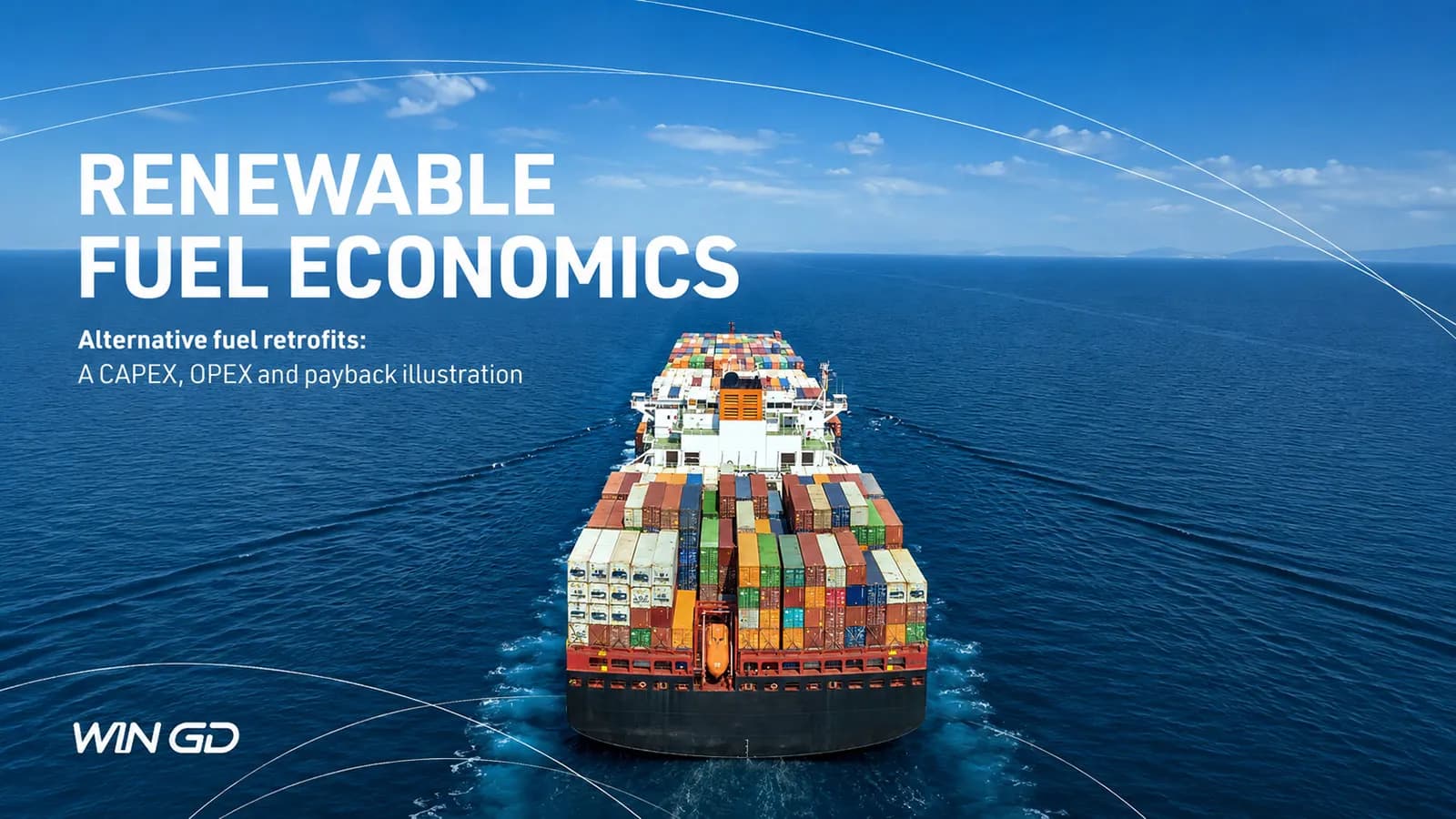
The Swiss marine engine manufacturer has published a new edition of its report Renewable Fuel Economics, focused on capital and operational costs and on the payback periods associated with adapting existing ships. The study uses a reference of a 16,000 TEU container ship equipped with a WinGD X92-1.1 two-stroke main engine and 33,300 kW, with 6,000 annual operating hours.
The scenario contemplates that the conversion will take place in 2030 and compares three alternatives: LNG using an X92DF-HP engine, biometanol with an X92DF-M, and ammonia with an X92DF-A. The conventional ship used as a reference consumes 14,302 tons of VLSFO annually. The estimated additional cost of the transformation amounts to 28 million dollars for both LNG and ammonia, and 24 million for biometanol.
The model is limited to the main engine and the pilot fuel, without including auxiliary engines or hotel consumption. WinGD also keeps the work carried out by the ship constant over the 21 years between 2030 and 2050, with the aim of comparing the differences arising from the fuel and its regulatory treatment.
The results show that LNG presents the most favorable financial performance. In the predetermined low-emission fuel incorporation scenario, the investment achieves an internal rate of return of 22.7% and reaches the payback point in 2036. The net present value compared to maintaining a conventional ship reaches 47.6 million dollars in 2050.
The ammonia alternative offers a return of 15.2% and recovers the investment in 2041, while biometanol reaches a rate of 13.1% and arrives at the break-even point in 2043. In scenarios of minimum regulatory compliance, the calculated returns are 21.3% for LNG, 14.1% for ammonia, and 12.6% for biometanol.
The classification changes when analyzing the reduction of greenhouse gas emissions. According to the factors used by WinGD, a ship operating entirely on low-emission LNG records an intensity of 59.90 grams of CO₂ equivalent per megajoule, 36% less than the conventional reference. Biometanol reaches 31.44 grams, with a reduction of 66%, and green ammonia stands at 31.15 grams, equivalent to a decrease of 67%.
During the period 2030-2050, the LNG scenario avoids 324,000 tons of CO₂ equivalent, compared to 569,000 tons corresponding to ammonia and 572,000 tons of biometanol.
The economic difference largely arises from the considered energy cost. WinGD starts with a price of 700 dollars per ton for VLSFO and 500 dollars for fossil LNG. For low-emission LNG, it contemplates a reduction from 1,000 dollars per ton in 2030 to 500 dollars in 2045. Biometanol decreases from 630 to 475 dollars between 2030 and 2050, and green ammonia from 500 to 400 dollars.
With these assumptions and applying an annual discount rate of 8%, the total updated cost up to 2050 reaches 193.7 million dollars for the conventional ship. The figure drops to 146.2 million with LNG, 167.9 million with ammonia, and 176.8 million with biometanol.
The study attributes a significant part of this difference to regulatory costs. The ship that continues to use VLSFO would accumulate 100.3 million dollars in fuel and 93.4 million in emissions correction units during the analyzed period. In the LNG scenario, the regulatory cost is reduced to 45.5 million, while with ammonia and biometanol it remains at 18.6 and 18.7 million, respectively.
WinGD considers, therefore, that the CAPEX of the conversion has a lesser weight than other variables. The four million dollar difference among the three options does not alter its economic ranking, whereas fuel prices and the treatment of their emissions substantially modify the results.
None of the analyzed alternatives recovers investment in five years without additional support mechanisms. In the minimum compliance scenario, the report calculates that 126 dollars per ton of avoided CO₂ equivalent would be necessary for LNG, 330 dollars for ammonia, and 314 dollars for biometanol. Under the predetermined alternative fuel incorporation strategy, the amounts stand at 95, 174, and 186 dollars, respectively.
The analysis is conducted on a version of the Net-Zero Framework from the IMO similar to the one drafted so far, with decreasing objectives for greenhouse gas intensity and correction units valued at 100 and 380 dollars per ton of CO₂ equivalent. WinGD warns that the outcome could vary depending on the final configuration of the international system and the remuneration mechanisms established for zero-emission or near-zero-emission fuels.
The Strategic Marketing Manager of WinGD, Carmelo Cartalemi, points out that technological availability for conversions is no longer the main constraint. In his view, commercial decisions will be increasingly determined by the price of each fuel, its greenhouse gas intensity, and the treatment it receives within regulation during the remaining operational life of the ship.
The report also reminds that its calculations are illustrative in nature and that any real decision for conversion must be based on a specific study of the ship, verified fuel supply conditions, and independent commercial and legal analyses.