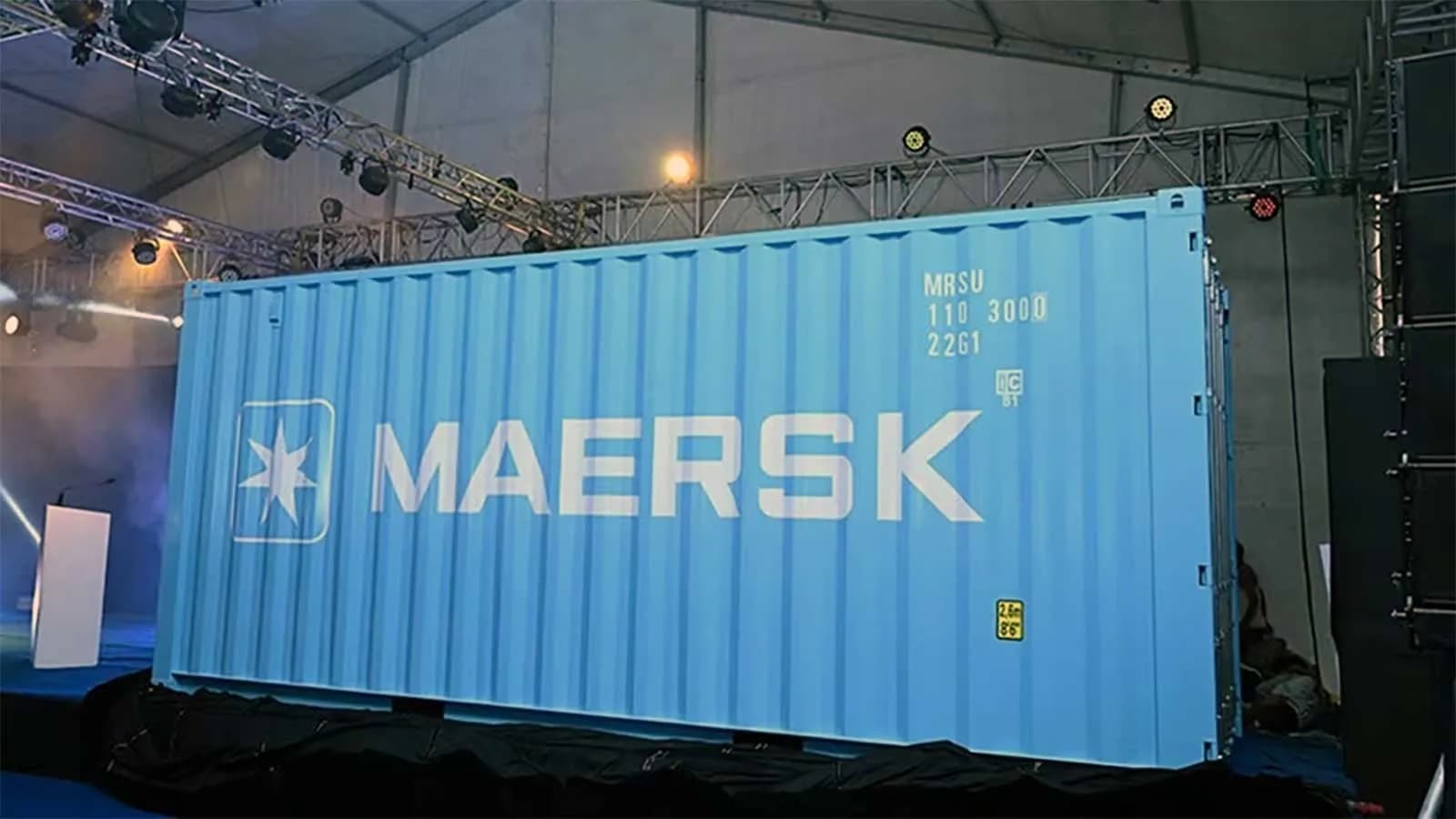
India has taken a step towards its ambition to manufacture containers on a global scale with the unveiling of the first container built under ISO standards for Maersk Line. The event took place at the joint inland terminal of Maersk and Container Corporation of India (CONCOR) in Dadri, in the state of Uttar Pradesh, in the presence of the Union Minister for Ports, Maritime Transport, and Inland Waterways, Sarbananda Sonowal.
The Indian Government and its Ministry of Ports, Maritime Transport, and Inland Waterways have been working since the pandemic on a plan to develop container manufacturing in the country. Maersk joined this initiative in February 2025, when Robert Maersk Uggla, Chairman of the Supervisory Board of Maersk, met in New Delhi with Prime Minister Narendra Modi. According to the shipping company, in that meeting, "the Prime Minister urged Maersk to actively support the development of a world-class container manufacturing industry in India."
The core of India's strategy to compete with the Chinese container manufacturing industry is the Container Manufacturing Assistance Scheme (CMAS), announced in the Union budget for the 2026-27 fiscal year. The program is not yet finalized in all its details, but the budget allocates 10,000 crore rupees, around 1.19 billion dollars, to support domestic manufacturing of one million TEUs of maritime containers over five years.
India already has a container manufacturing industry, although smaller in scale and primarily focused on producing domestic containers for CONCOR. Maersk emphasized that the first unit received is an export and import container entirely manufactured in India under ISO standards, which differentiates it from previous domestic production.
The container was manufactured by DCM Shriram Group at its plant in Dadri, as part of an initial order of 1,000 units. Maersk noted that every container in its fleet must meet the structural and dimensional specifications of the ISO standard, as well as the International Convention on Safe Containers (CSC) and the quality requirements specific to the shipping company. Prototype structural tests were conducted according to ISO 1496, and included stacking, lifting, lateral pull, floor resistance, and tightness tests, under the supervision of a classification society and with the presence of representatives from Maersk. The unit manufactured in India passed all tests and received CSC safety approval.
Maersk Container Industry (MCI), a subsidiary of the shipping company, stopped manufacturing dry containers a long time ago, but the company retains technical knowledge in both manufacturing and operating containers. According to Maersk, this knowledge was shared with the Indian manufacturing partner throughout the development process, and DCM Shriram Group responded with "commitment and capability," resulting in a container that meets the shipping company’s global standards.
Ahmed Hassan, senior vice president of A.P. Moller, valued the joint effort: "We have shared our global standards, deployed the best technicians, and collaborated with Indian manufacturers and the Ministry to make this possible. It is a testament to the fact that India's manufacturing ecosystem is preparing for global demand." Hassan added that, with the right investments in production plants and a supporting ecosystem, they are confident that the industry will reach that level.
For his part, Minister Sarbananda Sonowal highlighted the symbolism of the milestone for the country: "India has long been a nation of traders and navigators. Today we are taking a step as container manufacturers, with international shipping companies acquiring them in our country." The minister described the container as a demonstration of what is possible "when global companies trust in India’s potential," framing it within the Atmanirbhar Bharat program, India's strategy for industrial self-sufficiency.
The question that remains open is whether domestic manufacturers like DCM Shriram will be able to compete with Chinese giants like CIMC. Maersk pointed out that the "Production Linked Incentive" mechanism included in the government budget "has created the conditions for Indian containers to compete globally," and described it as an example of collaboration between government and industry within India's Maritime Vision 2030 and the Atmanirbhar Bharat program.
The shipping company described this first container as the basis for a long-term supply relationship, which is expected to grow in volume as Indian manufacturers consistently demonstrate the capacity to meet global quality standards at competitive costs.
The initial order of 1,000 units positions India as an emerging player in a container manufacturing market historically dominated by China, at a time when the Indian Government is allocating specific public funds to develop this industry within its budget plan for the upcoming five years.