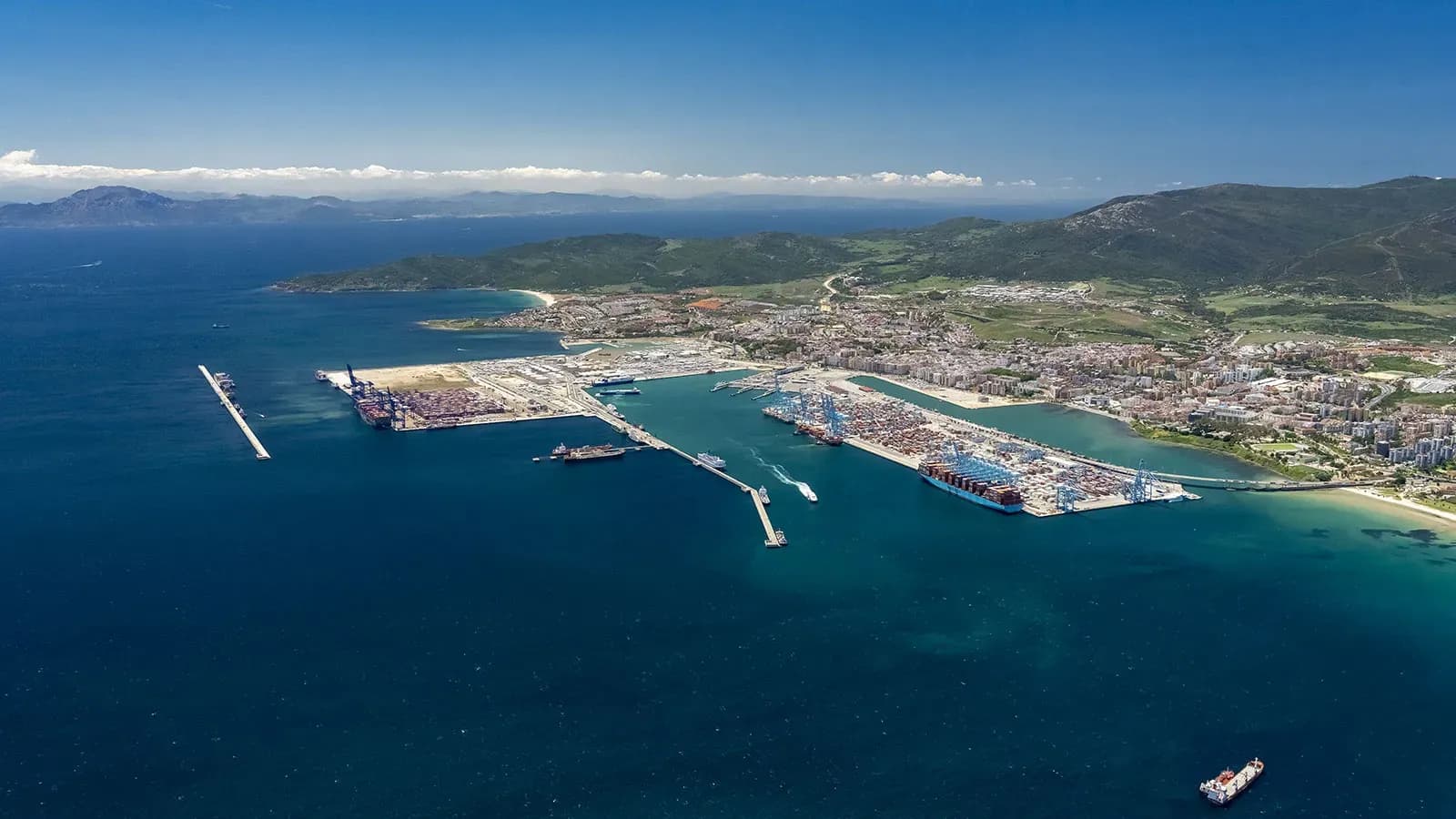
The Port Authority of the Bay of Algeciras (APBA) has initiated the tender for the maintenance and evolution contract of the PMS 2.0 (Port Management System), the platform on which the entirety of the maritime operations of the Port of Algeciras is based. The base budget for the tender is set at 432,000 euros excluding taxes (522,720 euros including VAT), although the estimated value of the contract, including possible extensions, reaches 1,080,000 euros.
It is a system that APBA itself qualifies as a critical element of its digital ecosystem. Through PMS 2.0, the complete life cycle of the more than 30,000 calls registered each year in the waters of the Bay of Algeciras is managed, from the processing of the call request by the consignee to the billing of the corresponding services, passing through the coordination of maritime maneuvers in real-time. A failure in this system could, according to the justifying report of the contract, jeopardize the port operations and even cause a halt in maritime traffic.
The PMS operates as a coordination hub among all the agents involved in port operations: consignees, service providers, pilots, moorers, tugs, and the Maritime Operations Department of the APBA. Its current version, called PMS 2.0, is an evolution of the original system that has been progressively eliminating dependencies on third-party or outdated applications from a technological point of view.
The contract will have an initial duration of two years, with the possibility of extending for an additional three years, and the work is scheduled to begin on September 17, 2026, as it involves the replacement of a maintenance service already in operation. The award will be processed through an open procedure under the protection of Article 82 of Royal Decree-Law 3/2020.
The scope of the contract is structured into three differentiated services with their corresponding annual budget allocation. The first is a remote support service with 24x7 attention, operational 365 days a year for the telephone management of critical incidents, equipped with 45,000 euros annually. The second covers corrective, preventive, and evolutionary maintenance of low complexity during 8x5 hours, with an allocation of 90,000 euros per year. The third is dedicated to the development of new functionalities, with an estimate of 1,800 annual working hours for frontend and backend developers, and an annual cost of 81,000 euros.
The proper functioning of the platform also depends on its integration with the VTS (Vessel Tracking System) of the APBA and other third-party applications. This information exchange is channeled through an enterprise service bus (ESB), developed on Apache ServiceMix, which connects the PMS with the EDI messaging platform, billing systems, Port Community Systems (PCS) for vessel service management, and the technical-nautical service systems of pilots, among others. The maintenance of this ESB is part of the contract's object.
Regarding the human team, the technical specifications document establishes high specialization requirements. A senior full stack developer with a minimum of 15 years of professional experience in the technology sector is required, of which at least 10 must have been dedicated to the development and maintenance of PMS systems for maritime operations management. This profile must demonstrate experience in EDI messaging management, integration with port authority billing systems, integration with Port Community Systems, and with technical-nautical services. The team is completed with two frontend and backend developers and three 24x7 support technicians, all with a minimum of five years of experience in the technology stack of the system.
From a technical point of view, PMS 2.0 is a custom development built with Spring Boot 3.4.5, Java 21, and SQL Server database on the backend, and Angular 20.3 on the frontend. All developments and deployments are executed on Kubernetes via the APBA's continuous integration and deployment platform.
The award criteria assign a weight of 60% to price and 40% to qualitative criteria. Of these last, 25 points correspond to the quality and technical value of the offer and 15 points to the experience of the personnel assigned to the contract. Offers that do not exceed a minimum threshold of 20 points in the qualitative assessment will be excluded from the process.
The specifications set strict service level agreements, with resolution times of one hour for critical incidents (with a compliance objective of 95%), five hours for high-priority incidents, two days for medium-priority incidents, and five days for low-priority incidents. The penalty regime provides for a deduction of 5% of the monthly fee for non-compliance with service levels in one month, 10% if the non-compliance extends for two consecutive months, and the possible cancellation of the contract without compensation if the third consecutive month of non-compliance is reached.
The file also includes a one-month transition phase before the contract starts and a return phase of the same duration at the end of it, periods designed to ensure knowledge transfer and operational continuity in the event of a change of provider.