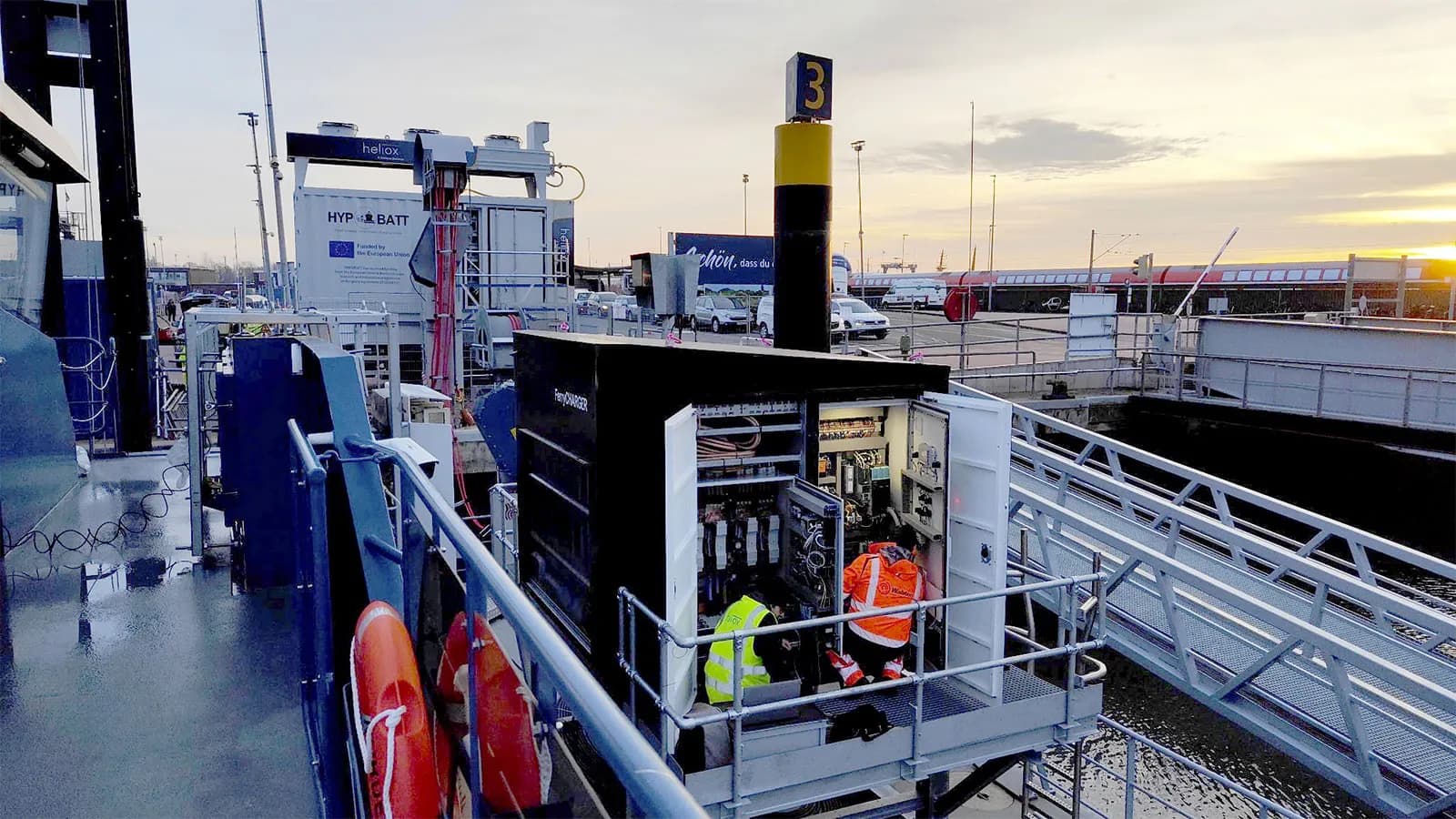
The Valenciaport Foundation has participated in the development and validation of a new ultra-fast battery charging system for vessels, capable of reaching power levels of up to 2.25 megawatts (MW). The technology was developed as part of the European project HYPOBATT (Hyper Powered Vessel Battery Charging System), which has concluded after completing operational tests on a 1 MW pilot installation at the Port of Friesland, in Germany.
The initiative, co-funded by the Horizon Europe program, has enabled the development of the so-called Marine Megawatt Charging System (M-MCS), a technological solution designed to facilitate the charging of electric vessels’ batteries during port calls. The project addresses one of the main operational challenges of maritime electrification: supplying large amounts of energy within short periods without disrupting the scheduled operating times of vessels.
Tests conducted in Germany have made it possible to verify the system’s performance under real port operating conditions, using both automatic and manual connections. According to the results reported by the consortium, the pilot has demonstrated the technical feasibility of both fast-charging modes, with an installed capacity of 1 MW.
The M-MCS system features a modular, scalable architecture designed to adapt the power supply capacity to the needs of different vessels. Although the installation used during the tests operated at a power level of 1 MW, the technology’s design provides for the possibility of reaching 2.25 MW, a capacity intended for vessels with greater energy requirements.
This solution is designed to facilitate charging operations while vessels are in port, particularly when available time is limited. The combination of high power and automated connection systems is one of the technical aspects studied within HYPOBATT, together with adapting installations to different port environments.
The Valenciaport Foundation’s participation has focused on studies of the technology’s replicability and technical and economic feasibility. The organization has led the work aimed at analyzing the conditions required to transfer the developed system to other ports, taking into account the characteristics of the installations, operational requirements, and the different business models associated with providing electric charging services.
These studies have examined the possibilities for deploying the technology in different scenarios, with the aim of identifying the technical and economic conditions that should be considered before incorporating this type of infrastructure into port operations.
One aspect of the project has been the evaluation of solutions that can adapt power supply systems to the needs of maritime operators. In this area, the availability of high-power equipment and the ability to automate connections are among the factors examined to facilitate the use of battery-powered vessels.
The results of HYPOBATT will also contribute to the development of the future international standard IEC/IEEE 80005-4, intended to establish common technical requirements for direct-current electrical connections between vessels and shore facilities.
The experience gained during the tests will serve as a reference for work on drafting this standard, which will address the conditions for electrical connections between vessels and shore. The inclusion of the project’s results in this process will make it possible to incorporate information from an experimental installation that has operated under real-world conditions.
Standardization is one of the areas covered by HYPOBATT, given the need for common technical specifications for charging equipment and its connection systems. The development of IEC/IEEE 80005-4 is part of this process of defining requirements for future direct-current power supply installations intended for the maritime sector.
Once the project is complete, the Valenciaport Foundation will share its technical knowledge and the results obtained with the port community and the business sector, with the aim of facilitating the assessment and possible adoption of these solutions at other installations. This knowledge-transfer activity will continue the organization’s work on replicability and economic feasibility studies.
HYPOBATT brought together an international consortium coordinated by Ikerlan S. Coop, with participation from industrial companies, technology centers, research organizations, and entities connected to maritime transport and energy systems.
Alongside Ikerlan and the Valenciaport Foundation, the consortium included Heliox BV, Rina Services SPA, Reliability and Safety Technical Center, Brussels Research and Innovation Center for Green Technologies, Fundación Centro Tecnológico Soermar, Flanders Make, Imecar Elektronik Sanayi Ve Ticaret Limited Sirketi, and Commissariat à l'Énergie Atomique et aux Énergies Alternatives.
The project also included RHOE, Stemmann-Technik GmbH, Technische Hochschule Ingolstadt, Fundacja Motus, Aktiengesellschaft Reederei Norden-Frisia, and Damen Research Development & Innovation BV.
HYPOBATT’s completion has yielded a high-power charging system tested in a port environment, studies on its potential application at other installations, and technical documentation that will contribute to the development of international standards for supplying power to vessels.