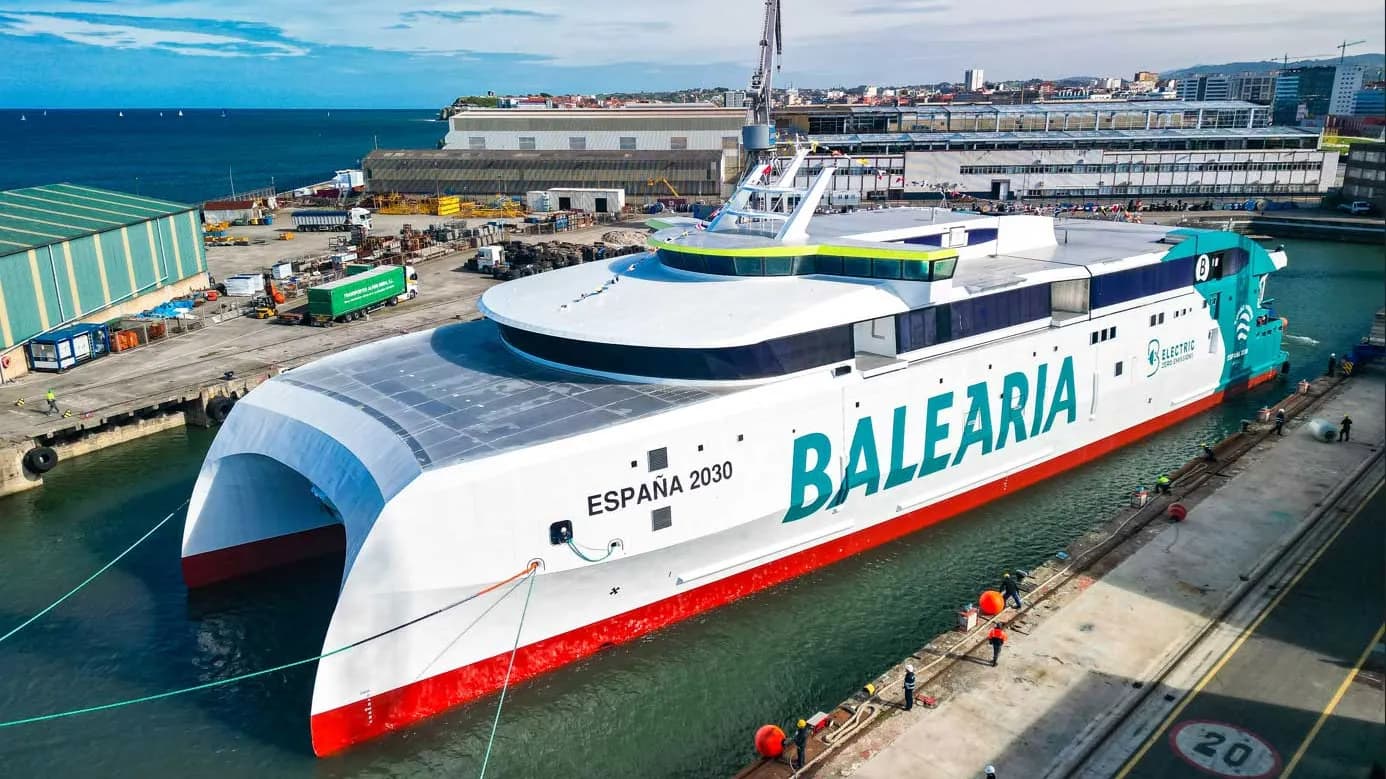
Baleària has completed the launching of its first fully electric-propulsion fast ferry at the Astilleros Armón shipyard in Gijón. The catamaran is intended to serve the maritime connection between Tarifa and Tangier City starting in the summer of 2027, while a second vessel, currently under construction, will join the same route after the summer season.
The two vessels will form part of the first all-electric passenger maritime corridor between Spain and Morocco, a project that also includes adapting the port infrastructure needed to supply power to the vessels. The combined investment in the construction of the catamarans and the electrification of the ports of Tarifa and Tangier City exceeds 200 million euros.
Baleària president Adolfo Utor said that the launch marks another step in the project's implementation schedule, with operations due to begin in 2027. Utor linked the addition of these vessels to the company's decarbonization goals and the application of new technologies to passenger maritime transport.
For his part, Astilleros Armón CEO Laudelino Alperi referred to the industrial collaboration between the two companies and the involvement of their technical teams in developing the vessels.
The catamaran launched is the fifth vessel built by Astilleros Armón for Baleària. According to the shipyard, the simultaneous construction of the two new vessels generates more than 300 direct jobs per day at its facilities, a figure that varies depending on the different stages of construction. This activity is supplemented by the involvement of support companies linked to the shipbuilding industry.
The first vessel is 87 meters long and has an aluminum structure, designed to reduce the hull's weight while maintaining the strength required for its operation. Its electric propulsion system will be powered by batteries with an energy storage capacity of 14 MWh.
This technology will enable the vessels to make crossings without direct combustion gas emissions while underway, as well as reducing the noise and vibration associated with conventional propulsion systems.
The vessel was launched by gradually flooding the dry dock until it reached the level needed for the catamaran to become buoyant. The operation presented a special challenge because both vessels are being built simultaneously and share a single dock, which can accommodate one complete vessel and part of the second.
During the operation, the assembled structure of the second catamaran also became afloat, although it did not leave its position within the facility. Once the operation is complete, the dock will be drained again so that construction work on the second vessel can continue in dry conditions.
Meanwhile, the first fast ferry will continue its outfitting process, including interior fitting-out work, the installation of outstanding equipment, and the gradual commissioning of its auxiliary systems.
Before final delivery, the vessel will have to pass the corresponding sea trials, designed to assess the vessel's performance, the operation of its equipment, and compliance with the safety and operational reliability requirements for entering regular service between the two shores of the Strait of Gibraltar.