The European Maritime Ports Organization (ESPO) and the European Federation of Inland Ports (EFIP) have made available to the port sector the Green Innovation Compass platform, a knowledge tool that brings together technical information, research results, and practical experiences related to innovation in European ports. The resource, available from this October 14 through the websites of both organizations, is aimed at maritime and inland ports, as well as companies and other stakeholders linked to port activities.
The initiative aims to facilitate access to information about technologies and solutions applicable to the energy and digital transition processes of port facilities. To this end, it concentrates in a single environment knowledge coming from research projects, operational experiences, and technological demonstrations developed by ports, companies, and European institutions.
Green Innovation Compass has its origins in the European project MAGPIE (sMArt Green Ports as Integrated Efficient multimodal hubs), funded through the Horizon 2020 program of the European Union. Authorities, private companies, knowledge centers, and public administrations have collaborated in this initiative to develop and analyze solutions aimed at transforming port operations and their integration into multimodal logistics chains.
One of the aspects identified during the development of MAGPIE was the dispersion of available information on port innovation. The results of research, technological tests, and application experiences were dispersed among different projects and organizations, making it difficult for other ports interested in incorporating similar solutions to consult them.
The new platform aims to gather these contents in a single consultation space, organized to facilitate their use by those responsible for planning, management, and innovation of port facilities.
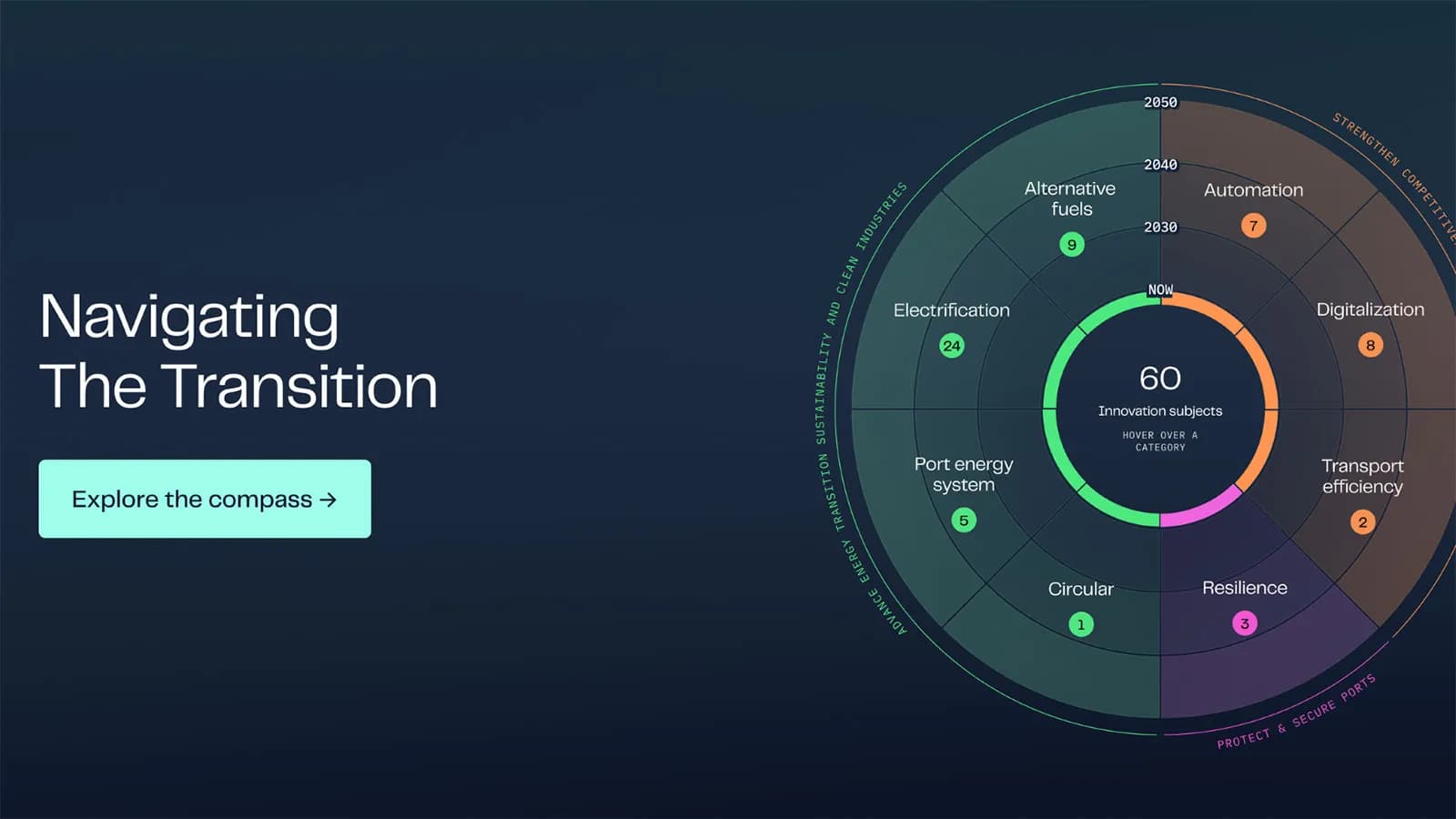
Among the subjects it addresses are electrification, alternative fuels, automation, infrastructure resilience, and digitalization. For each technology or solution, Green Innovation Compass provides information on its possible applications, the necessary conditions for its implementation, the expected effects, and the factors that may facilitate its development.
The system also allows filtering the contents according to the priorities, needs, objectives, and timelines of each port. In this way, organizations can consult experiences related to their operational circumstances and their level of technological development, without the platform establishing a unique transformation model applicable to all facilities.
The incorporation of practical cases allows knowing projects developed in other European port locations and examining the conditions under which certain technologies have been applied. This information is intended to serve as a reference for organizations studying new investments or modifications of their operational processes.
The General Secretary of ESPO, Isabelle Ryckbost, has explained that the organization seeks to combine its activity of representing port interests before European institutions with the exchange of knowledge among its members.
Ryckbost has noted that Green Innovation Compass responds to this function of ESPO as a knowledge network, in which professionals in the sector can share experiences, practices, and solutions. She has also invited associated ports to periodically consult the tool and provide information that may be useful for other facilities.
The ESPO representative has linked this collaboration to the energy and digital transformation processes facing European ports, considering that the exchange of experiences among organizations can contribute to the adoption of new technologies.
For his part, the director of EFIP, Turi Fiorito, has referenced the difficulties that inland ports encounter when developing innovation projects and the usefulness of knowing initiatives previously executed in other facilities.
He explained that the platform allows locating case studies related to the needs of each port and accessing information about solutions that other operators have already put into practice. EFIP believes that this exchange can facilitate the analysis of new actions in the field of transport and inland logistics.
The joint participation of ESPO and EFIP allows incorporating into the platform experiences from both maritime and inland ports, two areas of activity that participate in European goods transport and distribution chains and face technological needs related to energy transition and digitalization.
Green Innovation Compass is designed as an open platform to new contributions, so its contents can be expanded by incorporating knowledge, experiences, and practical examples provided by the users and participating organizations themselves.
To maintain the continuity of the resource once the MAGPIE project has concluded, the platform will have the participation of ALICE (Alliance for Logistics Innovation through Collaboration in Europe), which will take on the role of collaborative entity responsible for continuing the knowledge generated.
The tool can be consulted through the spaces enabled by ESPO and EFIP, which will offer access to contents about technologies, experiences, and projects related to innovation in European ports.