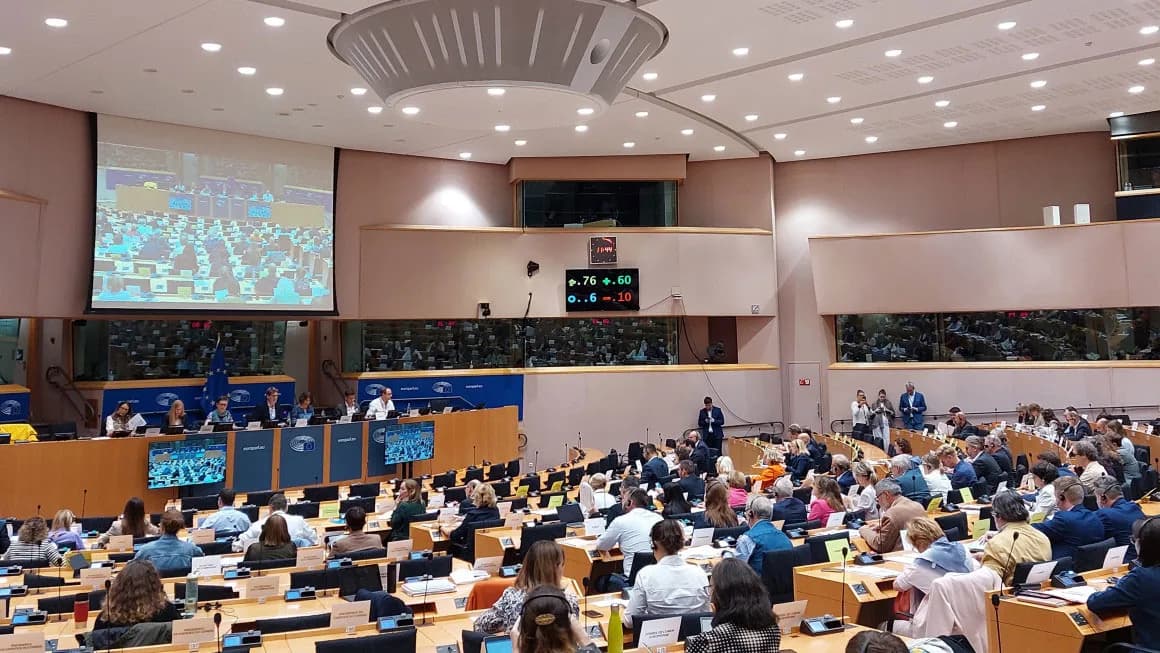
FEPORT has requested the European Parliament specific changes in the review of the European Union Emissions Trading System (EU ETS) to reduce the risk of transshipment traffic being relocated from community ports to third-country enclaves. The organization has raised these modifications before the discussion of the file in the Committee on Environment, Climate and Food Safety (ENVI), whose rapporteur is the German MEP Peter Liese.
The review is part of the proposal presented by the European Commission on July 17, 2026, to modify the operation of the EU ETS. Maritime transport has been included in the system since January 1, 2024. The regime covers 100% of emissions from trips between EU ports and emissions produced during port stay, as well as 50% of emissions from journeys between one community port and another located outside the Union. For affected ships, the obligation to surrender allowances has been applied gradually: 40% of emissions for 2024, 70% for 2025, and 100% of declared emissions from 2026.
FEPORT believes that the community proposal and Liese's draft report contain measures aimed at reconciling climate objectives with industrial competitiveness, but argues that protection against the transfer of transshipment requires additional changes. The federation links this risk to the possibility that shipping companies may alter calls or networks to carry out certain transshipment operations outside the EU and thus reduce their exposure to carbon costs.
The Commission has incorporated a measure based on the load for certain container ships in its proposal. According to the documentation analyzed by FEPORT, Article 12.3-g allows a reduction of the surrender obligations for certain inbound trips to the EU for container ships of at least 10,000 TEUs, depending on the proportion of containers that subsequently continue to destinations located outside the Union.
The federation asks that this mechanism also applies to the outbound leg of trips and that it includes vessels with a capacity between 5,000 and 10,000 TEUs. FEPORT argues that restricting the provision to inbound trips and to larger units may exclude services likely to reorganize their schedules or operate with vessels below the specified threshold.
The use of revenues generated by the EU ETS constitutes another of the points raised by the organization. FEPORT supports that part of those resources be allocated to the decarbonization of maritime transport, but requests that port operators be able to access financing when undertaking projects related to the electrification of equipment and terminal operations or to the installation of electrical supply systems to ships from land. The Commission's own proposal includes support for investments in the maritime sector, including ports, shipping companies, sustainable fuels, and propulsion technologies.
The federation also proposes that aids linked to the production of lower-emission maritime fuels have an effective relationship with supply in European ports. Its proposal is that the funding allocated to these fuels take into account their supply and use within the EU port network, so that investments associated with the energy transition also reach bunkering activities and the necessary infrastructures in the ports.
The third block of proposals refers to the relationship with third countries. The Commission has included in the review a mechanism called 'ETS as a service', designed to facilitate the application of pricing systems for emissions in non-EU countries. In the maritime context, this instrument could apply to the portion of emissions from trips between the EU and third countries that currently falls outside the European obligation.
FEPORT proposes to condition the access of third country ports to resources from the EU ETS on their being in jurisdictions with a carbon pricing system equivalent to the European one. The federation links this proposal to its objective of preventing funds originating in the European emissions market from benefiting port facilities subject to a different environmental cost regime.
The Secretary General of FEPORT, Lamia Kerdjoudj, has asked ENVI members to consider the risk of transshipment relocation during the processing of the file and has linked this issue to terminal activity and port employment. The organization has also indicated its willingness to maintain dialogue with MEPs during the legislative process to convey its proposals regarding the decarbonization of maritime transport and the competitive conditions of EU ports.