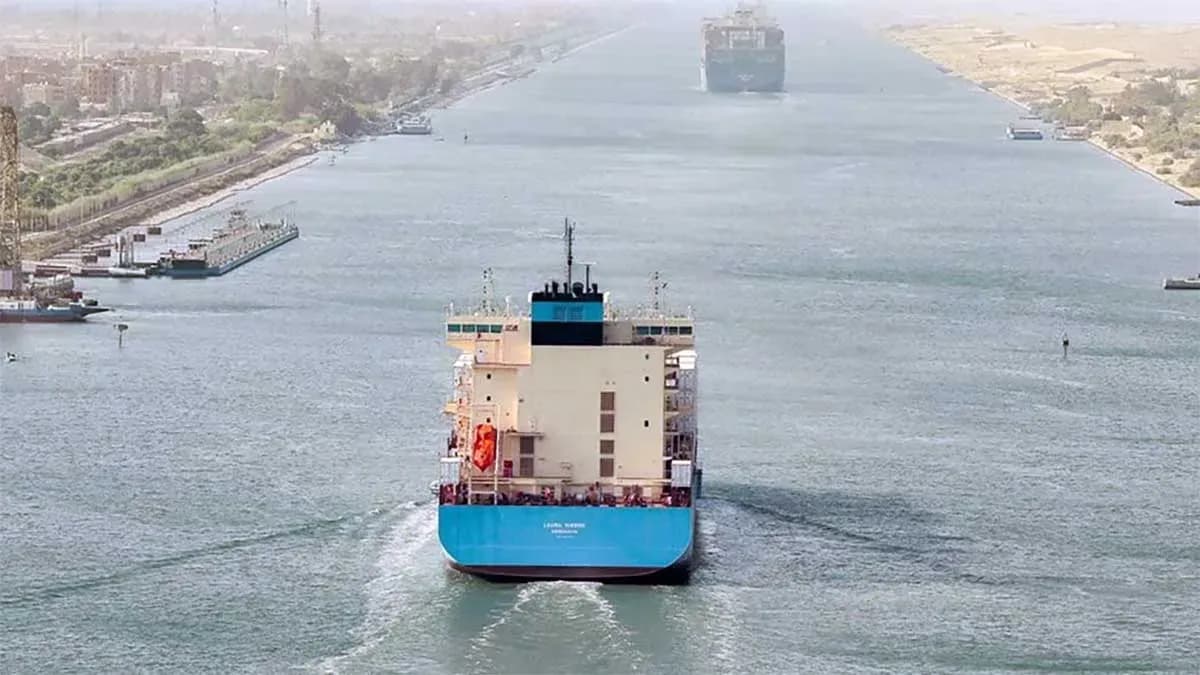
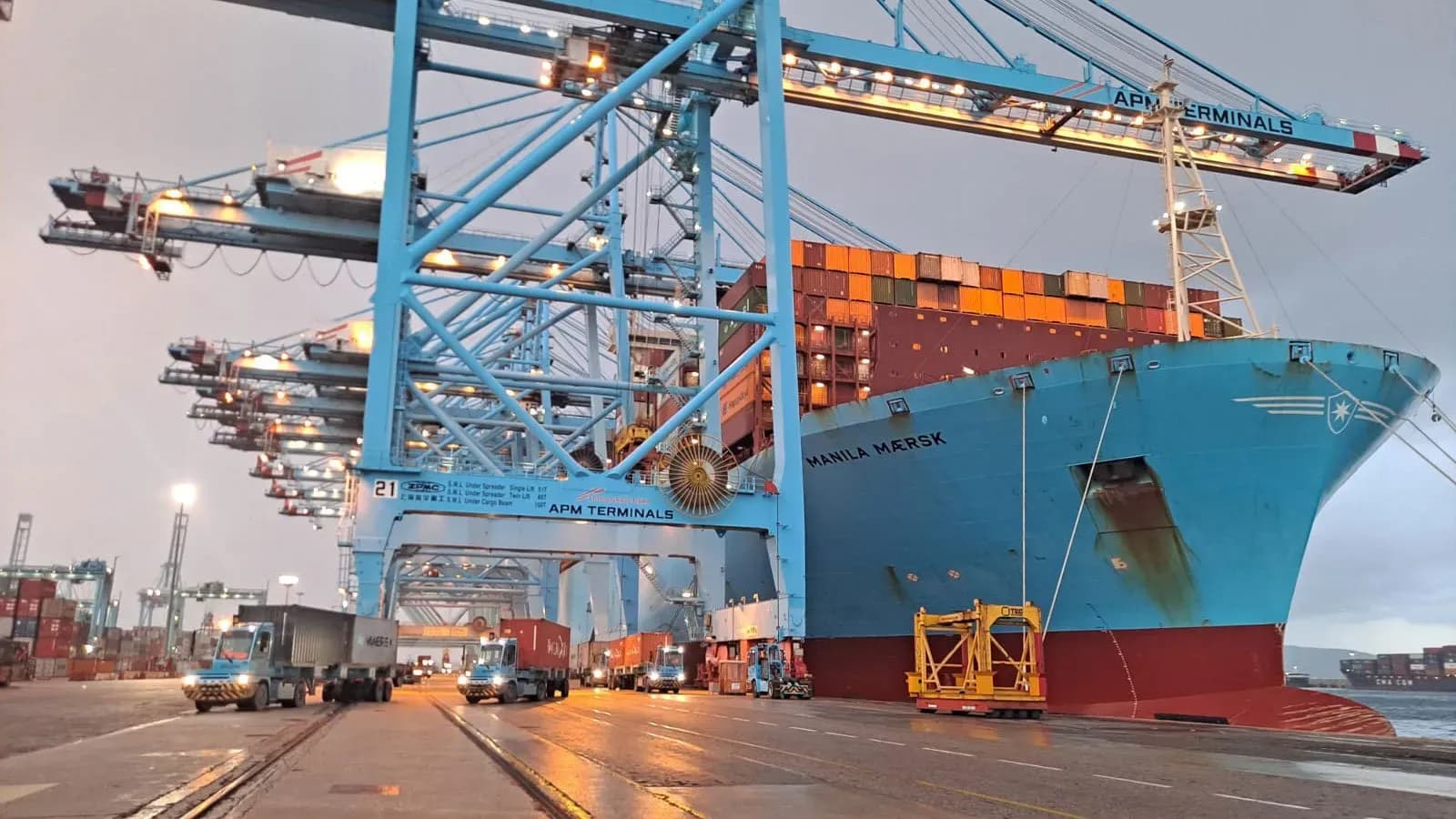
Maersk and Hapag-Lloyd have decided to temporarily modify several services in their joint network between Asia, Europe, and the Middle East as a consequence of the deteriorating security in the region. The two companies have communicated the suspension of the AGX and IMX services, the removal of the stop at Jebel Ali on the IOS service, and the initiation of a new rotation, called SE4, to maintain connectivity between the Far East, the Mediterranean, and Jeddah.
The measure comes after a new operational and risk review in the midst of escalating conflict in the Middle East. This scenario affects commercial navigation in the Gulf region and forces shipping companies to rebuild part of their network to sustain the stability of their stops and the transshipment links between Asia, Europe, and the Middle East.
As part of this reorganization, the new SE4 service will connect Tianjin Xingang, Qingdao, Busan, Ningbo, Shanghai, and Tanjung Pelepas with a hub in the western Mediterranean, another in the eastern Mediterranean, and the Saudi port of Jeddah, before returning via Singapore to Tianjin Xingang. Although the companies do not officially identify which ports will act as nodes in the Mediterranean, the scheme opens the door for Algeciras to once again become a relevant piece within the western Mediterranean in the transshipment operations linked to the Gemini network. The first announced voyage will be that of theMaersk Elbaon its voyage 611W, with an estimated arrival at Tianjin Xingang on March 13, 2026.

The adjustment implies the withdrawal from circulation of two relevant services within the Gemini scheme. In the case of the AGX, the link between the Far East and the Middle East is temporarily suspended. In parallel, the IMX service, which connected the Middle East, India, and the Mediterranean, will also be temporarily halted, with theAstrid Maersk609W being the last planned voyage for the time being, departing from Salalah on March 19, 2026.
The other immediate modification affects the IOS. This service will no longer call at Jebel Ali and will maintain a revised rotation with Mundra, Nhava Sheva, Salalah, a hub in the western Mediterranean, Rotterdam, Wilhelmshaven, Hamburg, London Gateway, again the western Mediterranean hub, Salalah, and return to Mundra. In this new arrangement, Algeciras emerges, along with Tangier Med, as one of the locations with the greatest options for channeling connection cargo in the western Mediterranean, given its position in the flows between Asia, Europe, and North Africa.

The redesign of this shared network arrives at a time of increasing pressure on maritime services linking the Far East with Europe and the Middle East. The need to avoid higher-risk areas forces companies to modify stops, redistribute ships, and reorganize logistics corridors to maintain the continuity of supply chains.
Operationally, the SE4 allows for the preservation of a direct long-distance maritime connection between northern and central China, South Korea, Malaysia, the Mediterranean, and Jeddah, while the IOS focuses on India, Oman, and northern Europe without entering Dubai. For the Straits ports, and especially for Algeciras, these changes return the Andalusian enclave to the center of the sector's forecasts in the face of any reorganization of services that require transshipment nodes in the western Mediterranean.