Five years after a scientific study quantified the impact of maritime pollution on health in the Iberian Peninsula, regulation has changed. But in places like the Strait of Gibraltar, it remains necessary to answer one question: what part of the air we breathe comes from the boats?
When we think about the pollution from boats, probably the first word that comes to mind today is CO₂.
It's logical. The fight against climate change has placed the decarbonization of maritime transport at the center of international and European policies. There is talk of new fuels, energy efficiency, electrification, hydrogen, methanol, or ammonia.
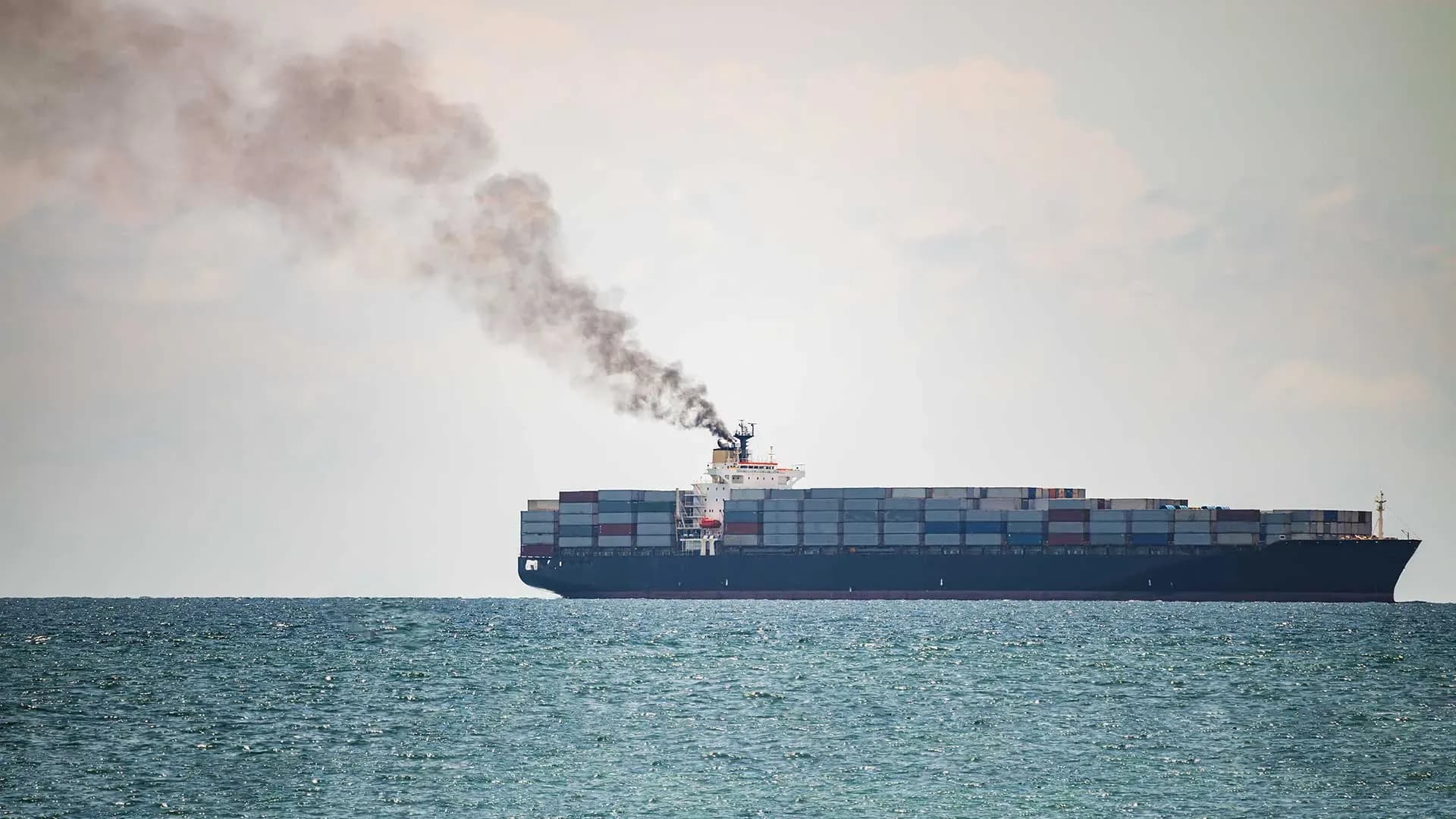
But there is another type of pollution from ships that has a much more immediate connection with the people living in port cities and along major maritime routes: nitrogen oxides, sulfur oxides, and particles.
They are pollutants we don't see, but that we breathe.
And five years ago we already had scientific evidence that their effects were not negligible.
What we discovered in 2021
In 2021, a group of researchers from Spain, Portugal, and Finland published in the scientific journal Environment International a study on the health and economic burden of atmospheric pollution associated with maritime transport in the Iberian Peninsula.
The work analyzed ship emissions during 2015 and estimated their effects on mortality and morbidity, as well as the associated economic costs.
The results were significant.
Maritime emissions of fine PM₂.₅ particles were associated with an estimated increase of 7.7% in premature mortality from all causes in the Iberian Peninsula compared to the counterfactual scenario without contribution from maritime transport.
The study also estimated that the health impact associated with nitrogen dioxide, NO₂, was of a magnitude similar to that of PM₂.₅ particles.
When these health effects were translated into economic terms, the figures were also relevant: the annual cost associated with mortality and morbidity due to PM₂.₅ and NO₂ was estimated at approximately 9.1 billion euros using the statistical value of a life approach, and around 1.825 billion using the value of a year of life.
But perhaps one of the most interesting results of the study was another.
The researchers analyzed what would have happened if the regulations known as CAP2020 had been in effect in 2015. The result indicated that approximately half of the mortality associated with maritime emissions of PM₂.₅ and around 30% of that associated with NO₂ could have been avoided.
The conclusion was clear: reducing emissions from boats is not just a climate issue. It is also a public health issue.
The Strait: a natural laboratory
Few areas in Spain allow for a better visualization of this issue than the Strait of Gibraltar.
Thousands of vessels pass through this international maritime corridor every year, located next to one of the largest industrial and port concentrations in Andalusia.
The Bay of Algeciras brings together port activity, maritime traffic, industry, roads, and population centers in a relatively small space.
This makes the area particularly interesting for studying the relationship between emissions and air quality.
A specific study on the Strait of Gibraltar, using an emissions model and another for atmospheric dispersion, estimated that emissions from maritime transport could have a relevant contribution to the levels of various pollutants in the analyzed receptors. In some cases, the contribution of maritime emissions to certain levels of particles and other pollutants reached 20-25%.
The study also identified the Bay of Algeciras as one of the areas where higher concentrations associated with maritime emissions were recorded.
This does not mean, of course, that all the pollution measured in Algeciras or any other municipality in the Bay comes from the boats.
Precisely that is one of the most interesting scientific problems.
In an area where maritime traffic, industry, road traffic, and other emission sources coexist, knowing how much pollutant there is is not enough. We also need to know where it comes from.
What has changed since 2021?
A lot.
One of the most important changes occurred even before our study, when in 2020 the global sulfur limit of the International Maritime Organization came into effect.
The maximum sulfur content allowed in marine fuels outside special areas of control dropped from 3.5% to 0.5%.
This measure had significant consequences on sulfur oxide emissions.
And in 2025 another particularly relevant change occurred for us: the Mediterranean officially became a sulfur emissions control area.
As of May 1, 2025, ships operating in this area must use fuels with a maximum sulfur content of 0.1%, compared to the general limit of 0.5%.
It is an important improvement and it is to be expected that it will help reduce SOx emissions and part of the particles associated with these compounds.
But here arises a fundamental question: not all pollutants behave the same way.
While SOx emissions from European maritime transport have decreased significantly, NOx emissions have not followed the same trajectory. Between 2015 and 2023, NOx emissions from maritime transport in the EU increased by approximately 10%.
Therefore, reducing sulfur does not mean having solved the problem of atmospheric pollution from ships.
The new data should make us look at the Strait
In 2025 a new study was published on the evolution of maritime emissions in the Iberian Peninsula that allows for comparison between the progress made and the challenges we still face.
The work found significant improvements in air quality associated with the regulations introduced, especially around the Strait of Gibraltar.
It also analyzed the possible effect of providing electricity from land to ships during their stay in port, a measure that can prevent auxiliary engines from running while the ship is docked.
But the study also proposed a future scenario that deserves attention.
Even assuming an improvement in the efficiency of the ships and the application of new technologies, the growth of maritime traffic and especially demographic changes could mean that the health impact of these emissions continues to be significant.
It is a relevant warning.
Technology can reduce the emissions of each ship. But if the number of ships increases, or the exposed population increases, or both happen simultaneously, the health problem does not necessarily disappear.
Ports are hot spots
This issue has also gained importance at the European level.
The European Environment Agency recently published a specific analysis of air quality around large European ports and airports.
The results show that NO₂ levels are generally higher in port areas than in their surrounding areas.
And there is a particularly striking fact for us: among the analyzed ports, Algeciras presented NO₂ concentrations in the port area approximately four times higher than those in the surrounding regions in the air quality maps used by the Agency.
Moreover, when the measuring stations were analyzed considering wind direction, the NO₂ concentrations recorded in Algeciras increased by 77% when the wind came from the port sector compared to other directions.
These results should be interpreted with caution. In a port area, there are multiple sources of pollution and these analyses do not allow for automatically attributing the entire increase to the boats.
But they do point to something that seems hard to dispute: ports need air quality monitoring systems capable of properly characterizing their environment.
And the European Environment Agency itself points out that the current coverage of monitoring networks is still insufficient in many ports.
What is happening in the Bay of Algeciras?
In this area, advances have also been made.
The Andalusian Government is developing an Air Quality Improvement Plan for the Industrial Zone of the Bay of Algeciras.
The plan includes measures related to particles, NO₂, and SO₂ and, specifically within the port and maritime area, it includes the development of an emissions inventory for ships in port.
It may seem like a purely technical issue, but having that inventory is fundamental.
If we want to reduce pollution, we first need to know which sources contribute, how much they emit, and under what conditions.
In an area as complex as the Bay of Algeciras, this means being able to differentiate, as much as possible, the emissions from ships from those coming from other industrial activities, land traffic, or other sources.
Only then can we know which measures really have the greatest effect.
Decarbonizing is not the same as cleaning the air
Perhaps this is one of the messages we should keep in mind during the energy transition of maritime transport.
Reducing CO₂ emissions is essential to combat climate change.
But reducing CO₂ and reducing local atmospheric pollutants are not exactly the same thing.
A particular technology may offer climate benefits while simultaneously raising questions about its NOx, particle, or other pollutant emissions.
Similarly, a measure that reduces emissions during navigation may have a different effect from another that reduces emissions while the ship is docked next to a population.
That is why the energy transition of maritime transport should be evaluated from multiple perspectives simultaneously: climate, air quality, public health, energy efficiency, and economic activity.
It is not about pitting one goal against another.
It is about ensuring that the solutions we adopt are indeed better in terms of their overall impacts.
Five years later, the question remains open
In 2021 we had scientific evidence showing that emissions from maritime transport had a significant health and economic impact in the Iberian Peninsula.
Since then, there have been important changes: stricter sulfur limits, new emission control areas, new European policies, technological advances, and new scientific studies.
We have made progress.
But we have also learned that the problem is more complex than it might seem.
It is not enough to know how much CO₂ ships emit.
We need to know what pollutants they emit, where they emit them, how they disperse, who is exposed, and what measures actually reduce that exposure.
And this is especially important in places like the Bay of Algeciras, where one of the major international maritime routes coexists with a population that lives, works, and breathes just a few kilometers away.
Perhaps the question we should ask ourselves now, five years after that study, is not only how much we have succeeded in decarbonizing maritime transport.
We should also ask ourselves:
How much have we managed to improve the air that people living near our large ports and maritime corridors breathe?
Because every ton of CO₂ that we stop emitting will help protect the climate of the future.
But every ton of atmospheric pollutants that we manage to avoid near our cities can also contribute to protecting the health of the people living there today.
Pr. Dr. Juan Moreno Gutiérrez
Researcher Group of Research "Energy Efficiency in Maritime Transport (RNM 920)". University of Cádiz.
Pr. Dr. Vanesa Durán Grados
Director of the RNM920 research group