Only 5% of the tonnage corresponding to ships registered or owned in Europe that were dismantled between 2019 and 2025 was recycled in facilities located in the European Union, despite these having sufficient authorized capacity to accommodate the ships sent for scrapping during that period. This is stated in a study published by NGO Shipbreaking Platform and Transport & Environment (T&E) regarding European naval recycling capacity.
The report analyzes 706 ships registered and/or owned by European shipowners that reached the end of their useful life during those seven years, with a combined tonnage of approximately 6.7 million light displacement tons (LDT). Of these, 153 units, 22% of the total, were recycled in EU facilities. However, these ships accounted for only 5% of the tonnage studied, a difference that reflects that larger ships were mainly dismantled outside the EU territory.
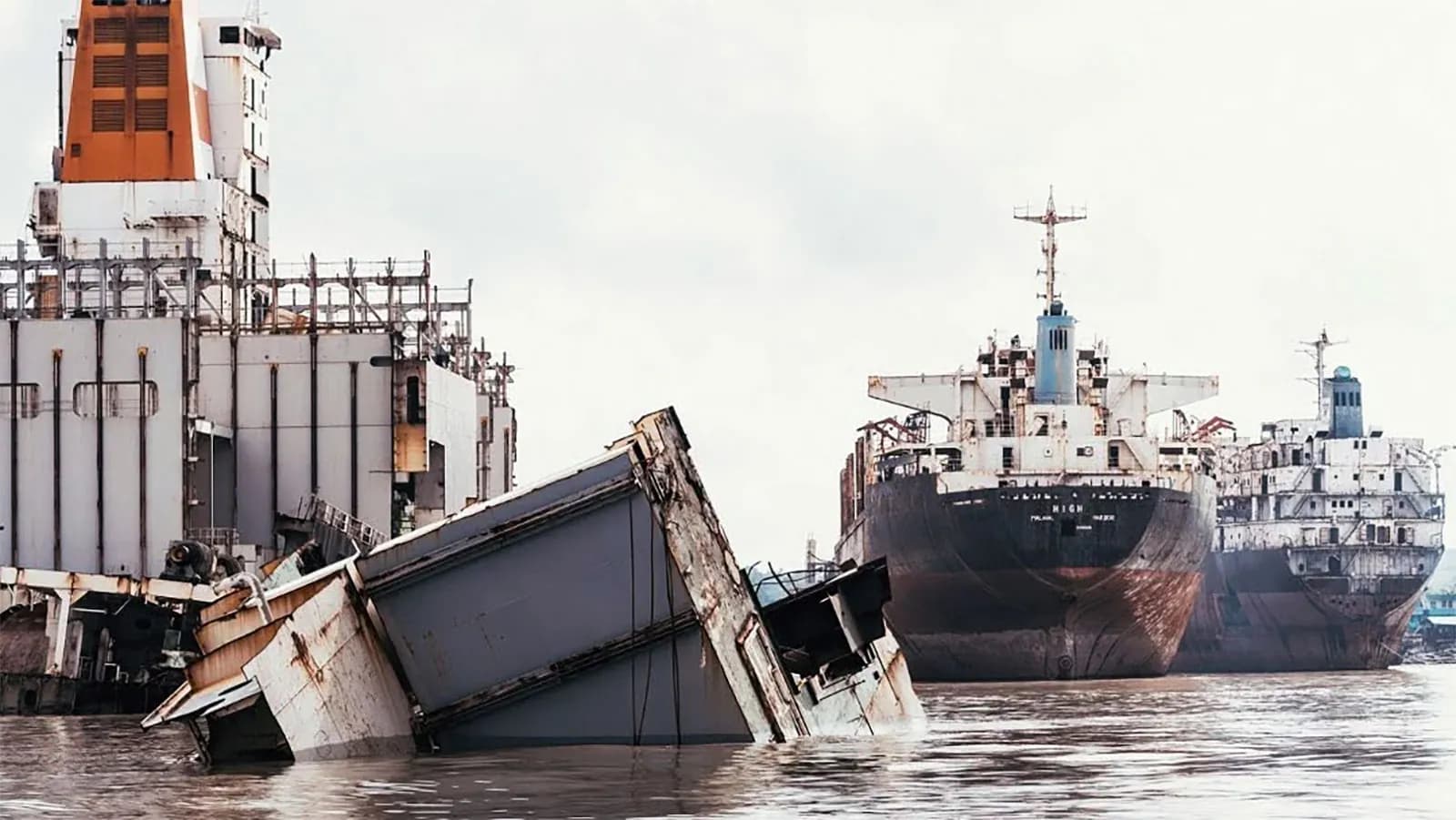
In the opposite direction, 345 ships, equivalent to 49% of the analyzed units, ended up in facilities in India, Bangladesh, and Pakistan that use the beached or beaching. These ships accounted for 66% of the total tonnage. The remaining units were dismantled mainly in Turkey.
The study uses a broad definition of the European fleet. It includes ships registered or owned by companies from EU member states, EFTA countries belonging to the European Economic Area, and Switzerland. The latter is included in the analysis due to the size of its controlled fleet, particularly due to the presence of Mediterranean Shipping Company (MSC). According to data collected in the document, European shipping companies controlled 34.5% of the world tonnage in 2025, with 570.5 million gross tons distributed among 22,403 ships, while approximately 15% of the world fleet sailed under the flag of an EU member state.
The EU framework establishes two regulatory paths for the end of ships' useful life. The EU Ship Recycling Regulation requires that units with a community flag be recycled in facilities included on the European list. On the other hand, the Waste Shipment Regulation prevents ships that acquire the status of waste in European waters from being exported for treatment to non-OECD countries.
NGO Shipbreaking Platform and T&E identify, however, flag changes before the last voyage of certain ships. The study counts 102 ships that replaced their European flag with one from outside the EU shortly before being dismantled, thus falling outside the scope of the European regulation on naval recycling.
One of the main elements analyzed is whether the available capacity in Europe would have allowed for absorbing those traffics. To make this calculation, the authors use the theoretically authorized capacity of the facilities included in the European list and not their historical activity volume. They argue that this latter indicator only reflects the maximum recycled by each facility during the previous ten years and does not necessarily reflect their authorized technical capacity.
The report uses 2020 as a reference for being the year with the highest volume of dismantled ships. That year, European facilities had a combined capacity to recycle 2.104 million LDT, while the European-owned ships sent for scrapping totaled 1.369 million LDT, equivalent to 65% of that capacity. Despite this, 71% of the European-owned tonnage dismantled that year ended up on the beaches of India, Bangladesh, and Pakistan.
The document also examines whether the dimensions of large ships constitute a limitation for European shipyards. The authors compared the dimensions of each European-owned unit sent to facilities in India, Bangladesh, and Pakistan between 2019 and 2025 with the characteristics of the facilities included in the EU list.
By 2020, when 89 European ships were dismantled on the beaches of South Asia, the study estimates that ships up to 162 meters could be received by 23 European facilities. For a ship of 182 meters, there were 17 facilities available and for units up to 207 meters, 16. Even the largest ship sent that year to a beach, the tanker Gema, at 333 meters, could be accommodated, according to the analysis, by six European facilities. Before its dismantling in Bangladesh, this tanker from the Greek company Angelicoussis Group replaced its Greek flag with that of Comoros.
The available capacity has varied over the last few years. The fifteenth edition of the European list of naval recycling facilities, adopted on February 27, 2026, lists 30 facilities located in Europe with an approximate combined authorized capacity of 1.367 million LDT. The document notes that some facilities have abandoned this activity for commercial reasons or have not renewed their authorizations.
The report also differentiates the current capacity from the needs that could arise over the next decade. Based on a sample of 11,902 European-owned ships over ten years old, the projections used place the highest concentration of dismantlings in the 2030s. The models contemplate annual maxima of between 600 and 700 units and a generation of between 12 and 15 million tons of steel for recycling per year, with a greater concentration between 2033 and 2037.
In light of these predictions, European facilities had an average capacity of approximately 1.96 million LDT annually during the studied period. The authors believe that this volume can currently address the recycling of ships with a European flag but acknowledge that it would be insufficient given the future simultaneous arrival at the end of their useful life of a considerable part of the fleet controlled by European shipowners.
The study links this issue with the recovery of steel from ships. According to its authors, up to 95% of a ship's weight can be recycled in the form of quality steel scrap, which can subsequently be used in steelmaking processes based on electric furnaces.
NGO Shipbreaking Platform and T&E therefore propose that the EU keep facilities that use the beaching off its list, close the regulatory paths related to flag changes at the end of the operational life of ships, and allocate resources to expand European facilities. The document mentions projects in the Netherlands, Norway, Germany, Belgium, and Scotland related to new technologies, facility expansions, or reuse of steel from ships.