Spain and Canada sign a memorandum to create a green maritime corridor

Óscar Puente and his counterpart Steven MacKinnon agree to work on a decarbonized route connecting Canadian ports with Spain and other European countries

Spain and Canada sign a memorandum to create a green maritime corridor
Add us as a preferred source on Google

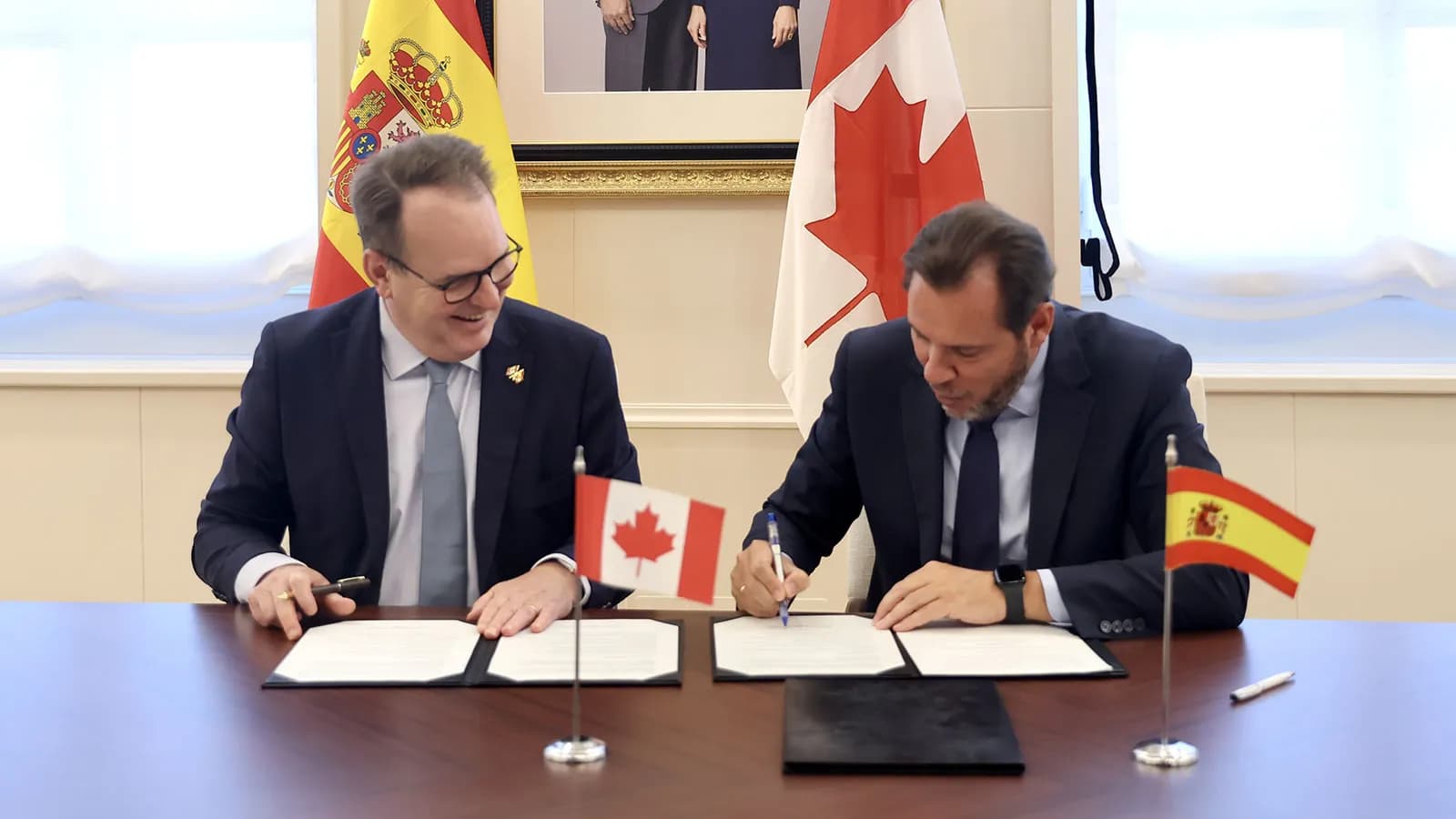
The Minister of Transport and Sustainable Mobility, Óscar Puente, and his Canadian counterpart, Steven MacKinnon, signed this Thursday in Madrid a Memorandum of Understanding (MoU) under which both governments commit to connecting the ports of Spain and Canada through a green maritime corridor across the Atlantic. The agreement, sealed during a bilateral meeting, defines the context and scope of the future corridor, its structure, and the steps that both countries must take to implement it.

The memorandum establishes that the Atlantic route will prioritize the use of decarbonized fuels and propulsion systems that do not add greenhouse gases to the global system throughout their entire life cycle, from production to consumption. The approach encompasses the operation of ships, the source of fuel, and the associated logistics chain, without being limited to the emissions produced by a ship during its voyage.

During the meeting, Puente expressed Spain's commitment to the decarbonization of transport, which in his presentation involves the development of integrated public policies impacting infrastructure, public transport, urban planning, digitalization, clean energies, and citizen movement patterns. The minister emphasized the mutual interest of Spain and Canada in establishing a decarbonized corridor across the Atlantic that connects Canadian ports with Europe, particularly with Spain.

The so-called green maritime corridors are trade routes between two or more ports in which the involved parties—shipping companies, port authorities, fuel suppliers, and administrations—agree to operate with low or zero-emission technologies and fuels. The concept took international shape from the Clydebank Declaration, adopted during COP26 in Glasgow in 2021, in which a group of countries committed to establishing at least six corridors of this type before 2025. Since then, various governments and organizations have designed pilot routes that serve as testbeds for technologies still in the deployment phase.

Maritime transport is responsible for a significant part of global greenhouse gas emissions and operates in an increasingly demanding regulatory environment. The International Maritime Organization (IMO) approved in 2023 a revised strategy that sets the goal of achieving net zero emissions in international maritime transport by around 2050, with intermediate milestones in 2030 and 2040. The European Union, for its part, has included maritime transport in its emissions trading system (EU ETS) since 2024 and applies the FuelEU Maritime regulation, which requires a progressive reduction in the greenhouse gas intensity of fuels used by ships operating in community waters.

In this context, the agreement with Canada continues the line of bilateral agreements that Spain develops in matters of transport and sustainability. State ports and Spanish port authorities participate in various projects for electrical supply to berthed ships, provision of alternative fuels, and adaptation of terminals for liquefied gases, ammonia, methanol, or hydrogen, options considered as potential substitutes for heavy fuel oil in long-distance navigation.

The signed MoU does not detail the list of ports that will be part of the corridor nor the specific timeline for its implementation. The agreement sets the framework for cooperation and the joint work lines that both ministries will develop in the coming months to finalize the route. It will be up to the technical teams of both countries to later define which fuels will be used, what supply infrastructure will be needed at the origin and destination, and what financing mechanisms will accompany the transition.

- A D V E R T I S I N G -

Share

Related content

You may also be interested in

NEXT TOTAL SOLAR ECLIPSEAugust 2, 2027

Totality returns to the Strait of Gibraltar

In less than a year, the Moon's shadow will sweep across southern Spain with over 4 minutes of total darkness over Algeciras, Tarifa, and Gibraltar.

---Days
--Hours
--Mins
--Secs
Explore Eclipse Special