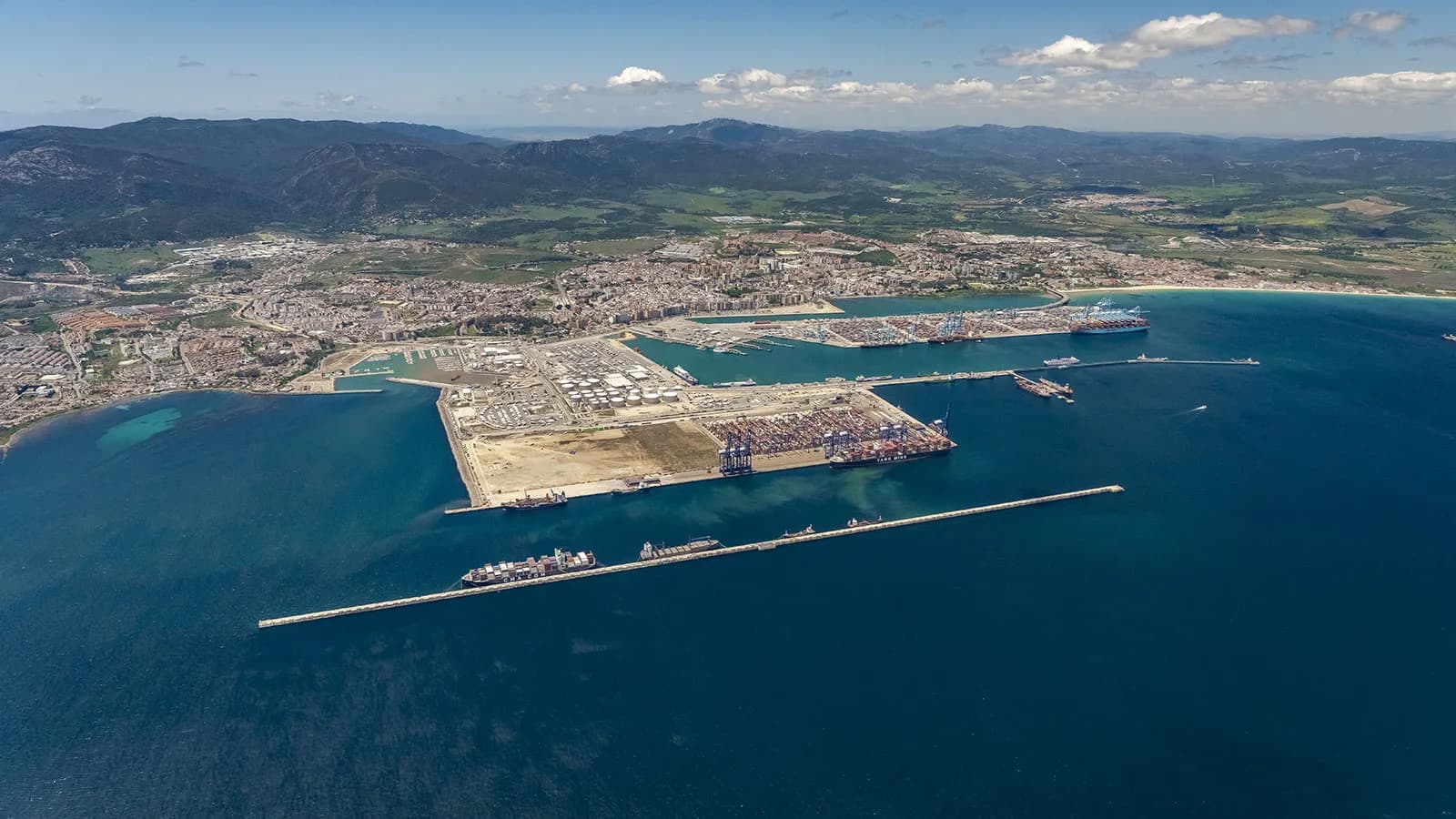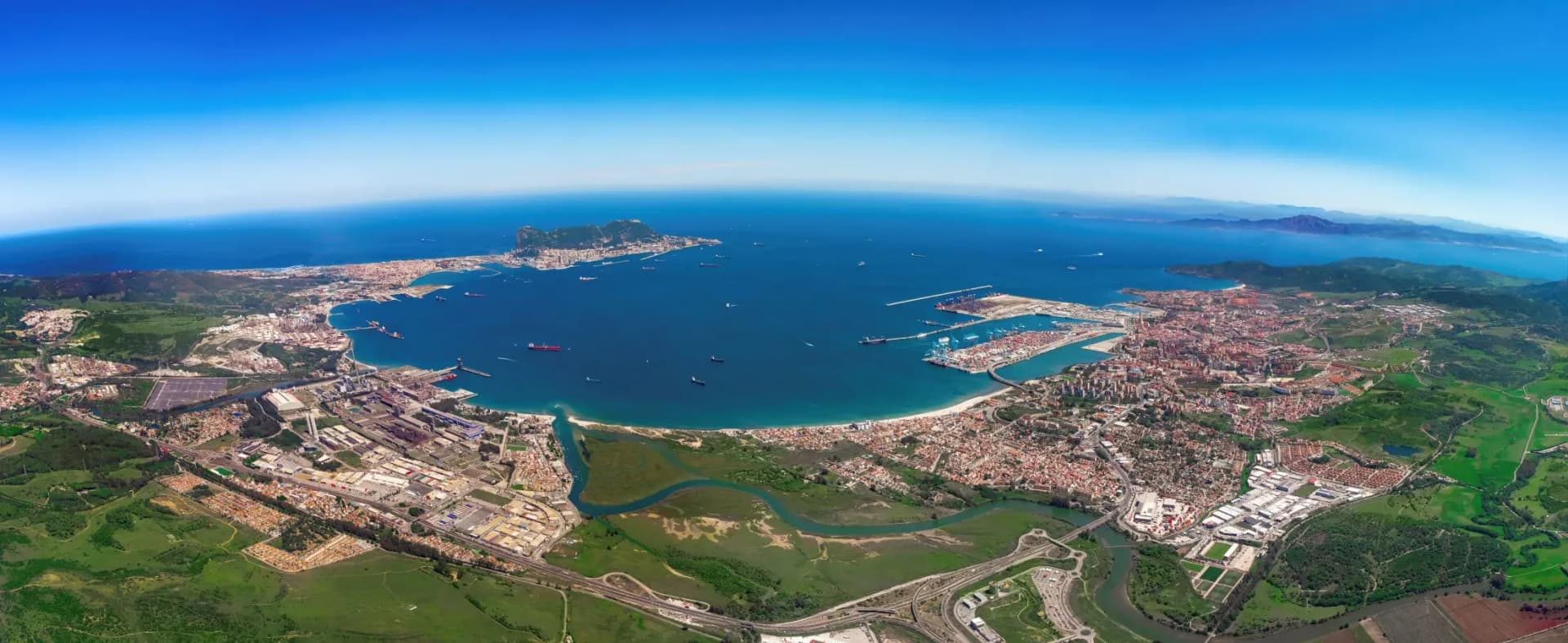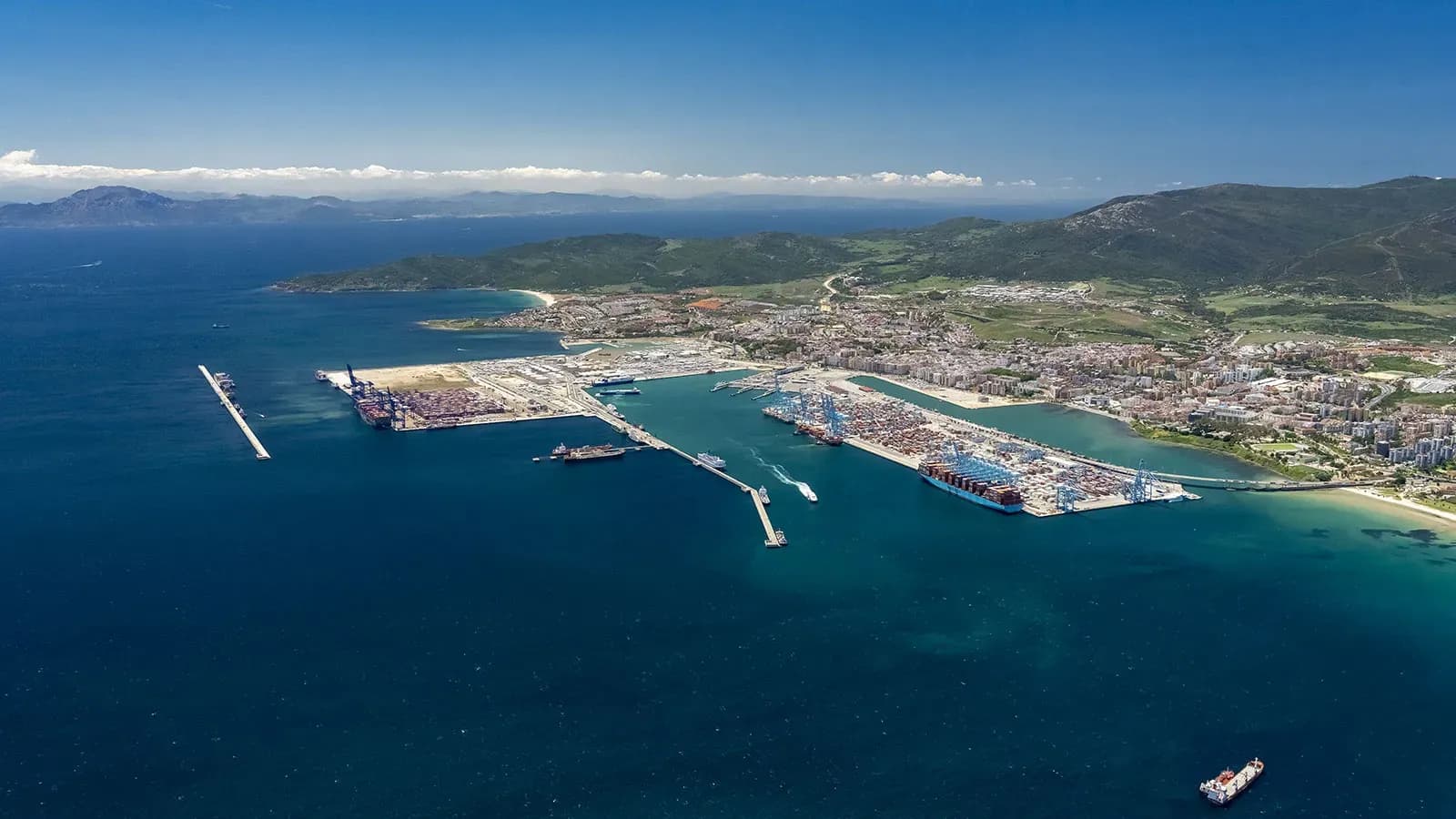
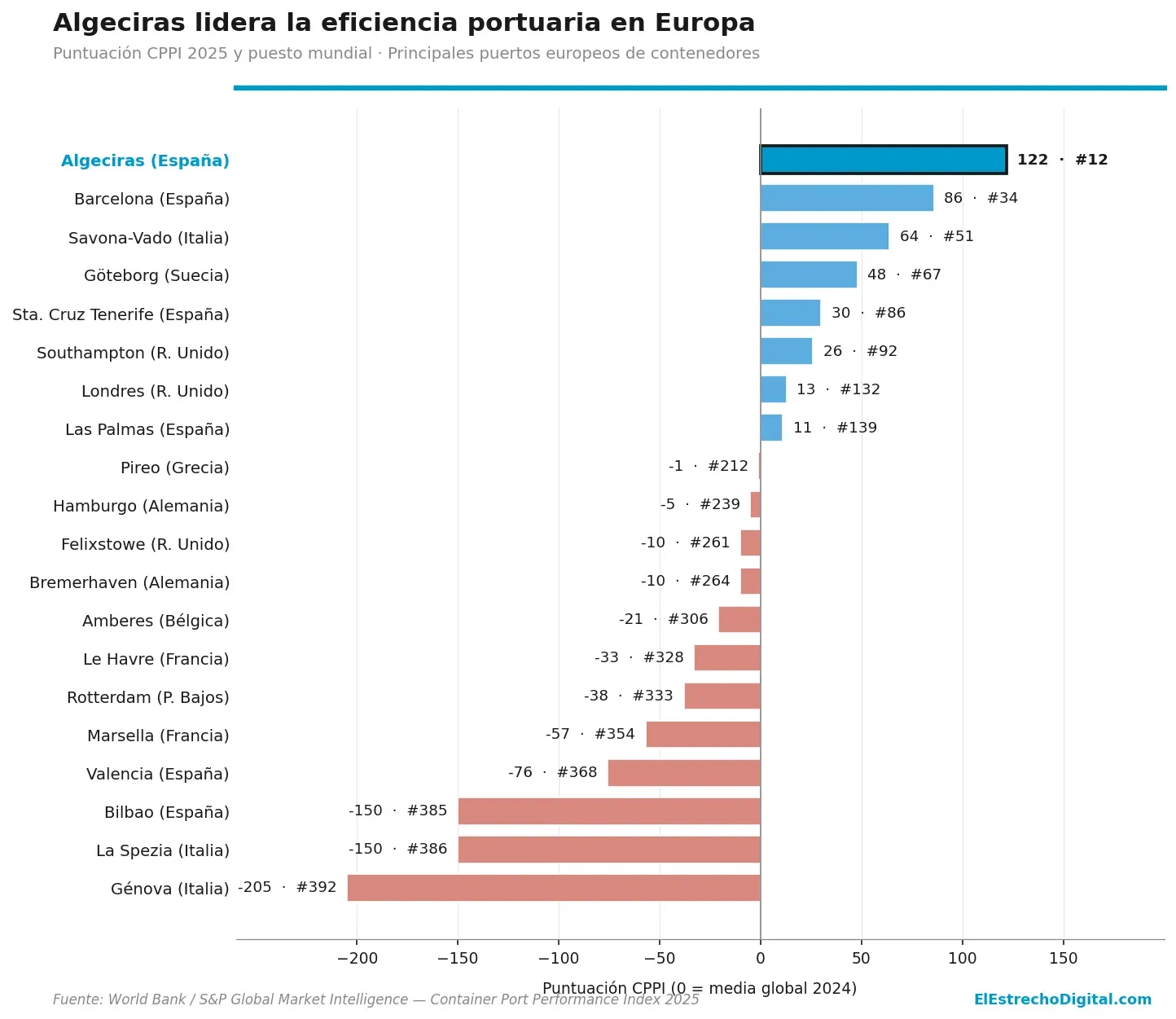
The Port of Algeciras Bay has become the most efficient container port in Europe according to the Container Port Performance Index (CPPI) 2025, the annual operational performance index of container terminals jointly prepared by the World Bank and the market intelligence division of S&P Global. The facility managed by the Port Authority of Algeciras Bay has achieved a score of 122 points, the highest of all those recorded by European ports in the sixth edition of the study, and ranks 12th in a global classification evaluating 405 container ports worldwide. This figure represents an improvement of thirteen points compared to the 109 recorded in 2024.
The European leadership of Algeciras is evident when examining the position of other major ports on the continent. Barcelona, the second Spanish port in the ranking, occupies the 34th position globally with 86 points, thirty-six below the Andalusian port. The Italian Savona-Vado is in 51st place with 64.1 points, the Swedish Gothenburg in 67th with 48.2 points, the Spanish Santa Cruz de Tenerife in 86th with 30.2 points, and the British Southampton in 92nd with 25.8 points. No port in continental Europe ranks above position 100 with a score higher than that of Algeciras.
The major hubs of northern Europe, traditional references for container traffic on the continent, show negative results or results far removed from those of the Andalusian facility. The port of Rotterdam, the largest in Europe by volume, ranks 333rd with -38.3 points. Hamburg occupies 239th with -4.6 points, Antwerp 306th with -21.2 points, Bremerhaven 264th with -10.4 points, and Le Havre 328th with -32.9 points. Felixstowe, the main British container port, ranks 261st with -9.5 points, Gdansk 339th with -42.3 points, and the Greek Piraeus, the main Mediterranean hub of COSCO Shipping, 212th with -0.9 points.
Only Tangier Med surpasses Algeciras in the immediate geographical environment, but the Moroccan port belongs to the African continent. The facility managed by Tanger Med Port Authority scores 134 points and occupies sixth place globally. The difference between both ports in the Strait has been narrowed from twenty-seven points in 2024 to twelve points in 2025, placing Algeciras in its best relative position against the Moroccan port since the historical series began in 2020. Port Said, in Egypt, ranks 15th globally with 117 points and also belongs to the African continent.
The sixth edition of the report, published this week under the title The Container Port Performance Index 2025: A Comparable Assessment of Performance based on Vessel Time in Port, maintains the methodology applied since the previous edition, ensuring direct comparability of scores for the entire 2020-2025 series. The indicator measures the total time that container ships spend in port — from their arrival at the anchorage or port limits until the moment they leave the berth — adjusted for the size of the vessel and the number of container movements made at each call. The main source of the data is the AIS (Automatic Identification System) records from S&P Global Market Intelligence, complemented with proprietary information from terminals. Only observed calls with at least one container movement are included.
The calculation combines two complementary methods whose results are averaged to produce the final score. The first, called ‘administrative’, systematically aggregates the normalized indicators of time in port across different vessel size and call categories, comparing each port with the global average. The second, the ‘statistical’, jointly analyzes all the available information for each port and gives greater weight to the signals that consistently manifest across different indicators. The convergence between both methods reinforces the robustness of the index. In the case of Algeciras, the administrative index stands at 170.3 and the statistical at 73.5, with a final aggregated score of 122.
The sample of Algeciras in the 2025 edition amounts to 1,904 calls, one of the highest figures in the Mediterranean and a reflection of the facility's weight as a transshipment node in the main east-west and north-south services. 77% of the total time that vessels spend in the port area is dedicated to berthing operations, according to the ‘berth in % of port hours’ data collected in the annex. This indicator, incorporated in the 2025 edition for diagnostic purposes, allows distinguishing between changes arising from dock operations and those generated by arrival patterns, delays at anchorage, or congestion prior to berthing.
The historical series of the port across the six editions of the CPPI shows a stable trajectory in the high range of the ranking, with moderate fluctuations contrasting with the volatility observed in other major European ports. Algeciras scored 116 points in 2020, 113 in 2021, 104 in 2022, 126 in 2023, 109 in 2024, and 122 in 2025. The improvement of thirteen points in the last interannual exercise places the port in its second-best record of the series, only behind the peak of 126 points reached in 2023. The average for the Europe and Central Asia region of the World Bank, which includes Spain, has been -8.1 points in 2025, while the average for the Mediterranean maritime region has been -10.4 points. Algeciras therefore stands 130 points above the average of its natural maritime environment and 130.1 points above the regional average of the World Bank.
The global leadership in the 2025 ranking corresponds to five Asian ports and one Arab port. Leading the classification is the Chinese port of Fuzhou, with 145 points, followed by Dalian (141), also Chinese; Oman's Salalah (136); and three more Chinese: Mawan (135), Chiwan (134), and Ningbo (130). In sixth place is Tangier Med (134). Rounding out the top 10 are Qatar's Hamad Port (129), Hong Kong (123), and Japan's Kobe (123). Algeciras shares the twelfth position with Cai Mep in Vietnam, and only one point below lies Haiphong, also Vietnamese. Completing the top 20 are Xiamen (China, 121), Port Said (Egypt, 117), Tianjin (China, 115), Kaohsiung (Taiwan, 114), Tanjung Pelepas (Malaysia, 111), Khalifa Bin Salman (Bahrain, 106), and Posorja (Ecuador, 104).
The trajectory of Tangier Med has shown scores of 133, 128, 125, 139, 136, and 134 in the six editions of the CPPI, with notable stability in the high range. The sample of calls at the Moroccan port amounts to 3,473 in 2025, almost double that of Algeciras, and its berthing time percentage is 85%, eight points above that recorded by the Spanish facility. The MENAAP region (Middle East, North Africa, Afghanistan, and Pakistan), in which the World Bank classifies the Moroccan port, recorded an average score of 19 points in 2025, substantially higher than that of the ECA region which includes Spain.
Among the Spanish ports included in the 2025 CPPI, Algeciras leads the national ranking by a wide margin over the next port. Barcelona occupies the 34th global position with 86 points from 736 analyzed calls, which represents an improvement from the 52 points in 2024. Santa Cruz de Tenerife is in 86th place with 30.2 points, recovering after the -1 recorded in the previous edition, with 91% of the time spent in berthing operations, one of the highest percentages among Spanish ports. Las Palmas is ranked 139th with 11.3 points and the Port of Málaga at 140th with 11.1 points. Arrecife de Lanzarote ranks 158th with 7.2 points.
The Spanish Mediterranean ports present a heterogeneous profile. The Port of Castellón is in 168th place with 5.6 points, while Sagunto occupies 245th place with -5.6 points. The Port of Cádiz ranks 194th with 2.7 points from 76 analyzed calls. Seville is in 223rd place with -2 points, Alicante 237th with -4.1 points, and Huelva 296th with -17.7 points. In the Cantabrian and Atlantic façade, Gijón scores 4.2 points in 178th place, Vigo is in 224th place with -2.1 points, and Ferrol drops to 378th place with -116.6 points from a sample of 68 calls, a significant regression compared to the 5 points in 2024.
The most adverse results among the Spanish ports correspond to Valencia and Bilbao. The Valencian port drops to 368th place with -75.8 points, compared to -18 points in 2024 and 27 in 2023, from a sample of 1,095 calls. The World Bank report dedicates a specific section to Valencia and attributes the decline to the pressures arising from the Red Sea crisis, which has led the facility to absorb additional calls and transshipment volumes. The document indicates that "despite effective operational responses, sustained external pressure has eventually affected the fluidity of the system," with a drop in the time spent at berth from 64% in 2024 to 49% in 2025. Bilbao, for its part, plummets to 385th place with -149.5 points, compared to -36 points in 2024, 3 in 2023, 3 in 2022, 11 in 2021, and 4 in 2020.
Throughout the Mediterranean, the report notes a high heterogeneity among the different enclaves. Ahead of Algeciras, only Tangier Med among the Mediterranean ports is listed. Following are Port Said (15th position, 117 points), Barcelona (34th position, 86 points), the Turkish Iskenderun (50th position, 65.2 points), the Italian Savona-Vado (51st position, 64.1 points), and the also Turkish Yarimca (54th position, 62.3 points). Marsaxlokk, in Malta, is in 173rd place with 5.2 points, and the Greek Piraeus ranks 212th with -0.9 points.
The major ports of northern Mediterranean show clearly inferior results. Genoa is in 392nd position with -205.3 points, La Spezia in 386th with -149.9 points, and Trieste in 382nd with -130.7 points. Marseille occupies 354th place with -57.3 points, Koper (Slovenia) in 355th with -58.6 points, and Casablanca (Morocco) in 365th with -74.2 points. Rijeka, in Croatia, presents the worst Mediterranean record in 397th position with -238.9 points, while Bejaia (Algeria) ranks 388th with -165.6 points.
The report attributes the high heterogeneity observed in the Mediterranean to a combination of structural and cyclical factors. The Red Sea crisis, arising from the Houthi attacks in the Bab el-Mandeb strait since late 2023, has caused the diversion of numerous services between Asia and Europe via the Cape of Good Hope, with increases of 10 to 14 days in transit times. These diversions have altered the arrival patterns of ships, generated episodes of temporary concentration of calls, and shifted additional pressure to certain facilities that have operated as relief nodes. The document describes these episodes as 'burst congestion', a phenomenon characterized by sudden peaks of activity after periods of apparent stability, caused by the simultaneous arrival of multiple ships out of schedule.
The global average of the CPPI registers a slight deterioration in 2025 compared to 2024, indicating longer stay times across all analyzed ports. The document indicates that this aggregated result does not reflect a uniform change globally, but rather a sum of divergent evolutions among regions and individual ports. The reliability of regular liner shipping schedules, which in periods prior to the pandemic stood near 80%, fell to 36% in 2021 and remains below historical levels.
The CPPI methodology distinguishes five categories of vessel size — feeders (less than 1,500 TEUs), intra-regional (1,501 to 5,000 TEUs), intermediate (5,001 to 8,500 TEUs), neo-panamax (8,501 to 13,500 TEUs), and ultra-large container carriers (more than 13,500 TEUs) — and ten size ranges for calls, from fewer than 250 movements to more than 6,000 movements per call. This segmentation allows for the comparison of ports with different operational profiles without penalizing those that receive smaller vessels or have smaller calls. The decomposition of time in port includes three standardized components: arrival time (from anchorage or port limits until the vessel is fully moored), time at berth (from mooring until lines are released, including loading and unloading operations), and time of departure.
The World Bank stresses that the CPPI should be interpreted as a diagnostic and comparative tool, not as a comprehensive assessment of port performance or as a scoring system for management quality. The indicator reflects results — measured through the stay time of vessels — and not inputs or institutional arrangements. The document recommends complementing its reading with complementary indicators such as the Global Supply Chain Stress Index (GSCSI), available quarterly for nearly 400 ports; the Logistics Performance Indicators (LPI), which cover among other parameters the dwell time of cargo in port; and the Liner Shipping Connectivity Index (LSCI) from UNCTAD, which measures each port's position in the global network of regular lines.
The trajectory of Algeciras across the six editions of the CPPI consolidates it as one of the most stable ports in the European context, with all its scores above 100 points and without significant drops in any of the analyzed years. The continental leadership in the 2025 edition, coupled with its second position in the Mediterranean and its twelfth globally, reinforces the profile of the Andalusian facility as a European reference in operational efficiency for container ship calls, in a maritime environment where the regional average has been negative and where some of the traditional big names in continental transshipment — Rotterdam, Hamburg, Antwerp, Valencia, Genoa, La Spezia, Marseille — have recorded significant setbacks.