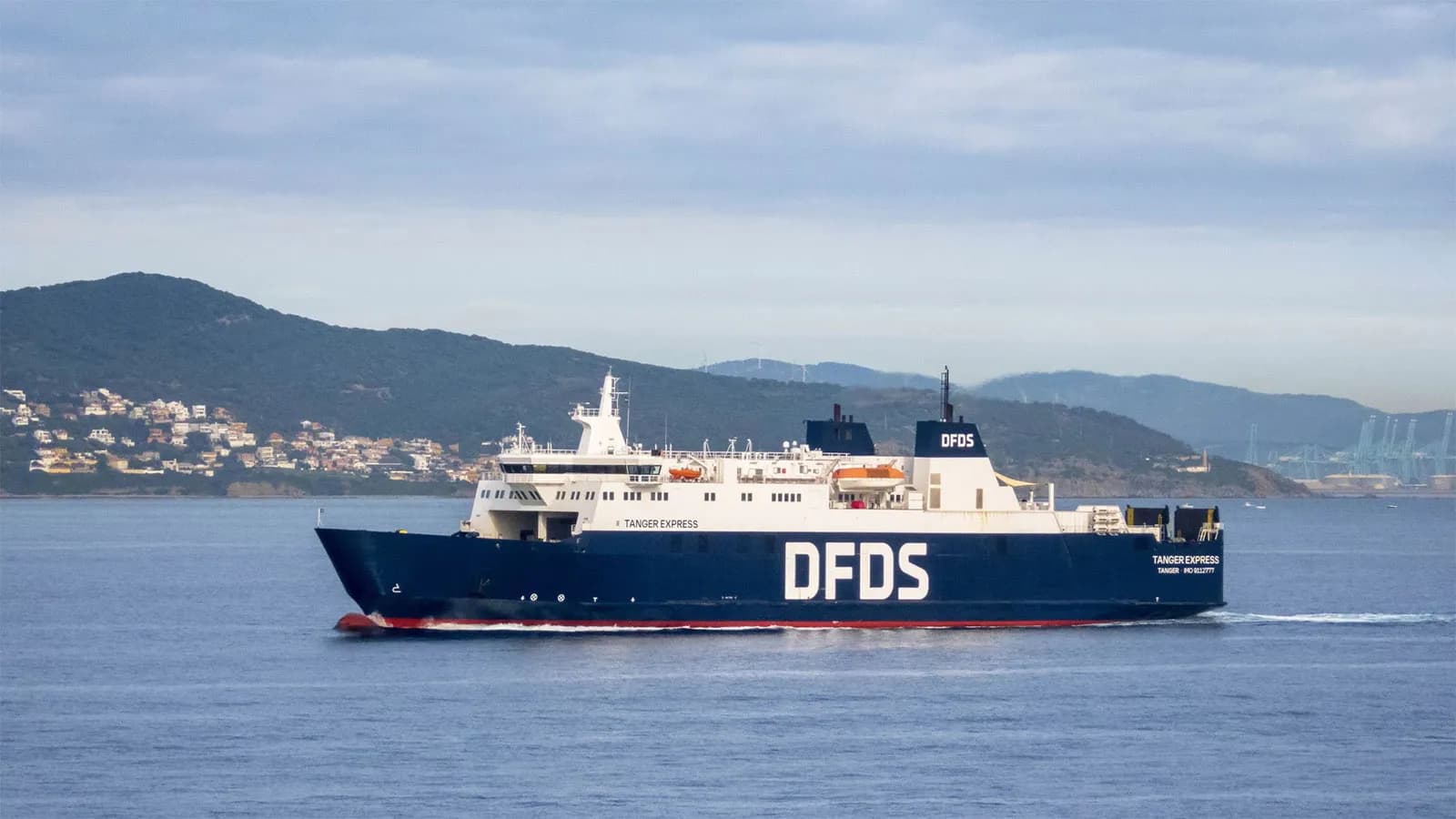
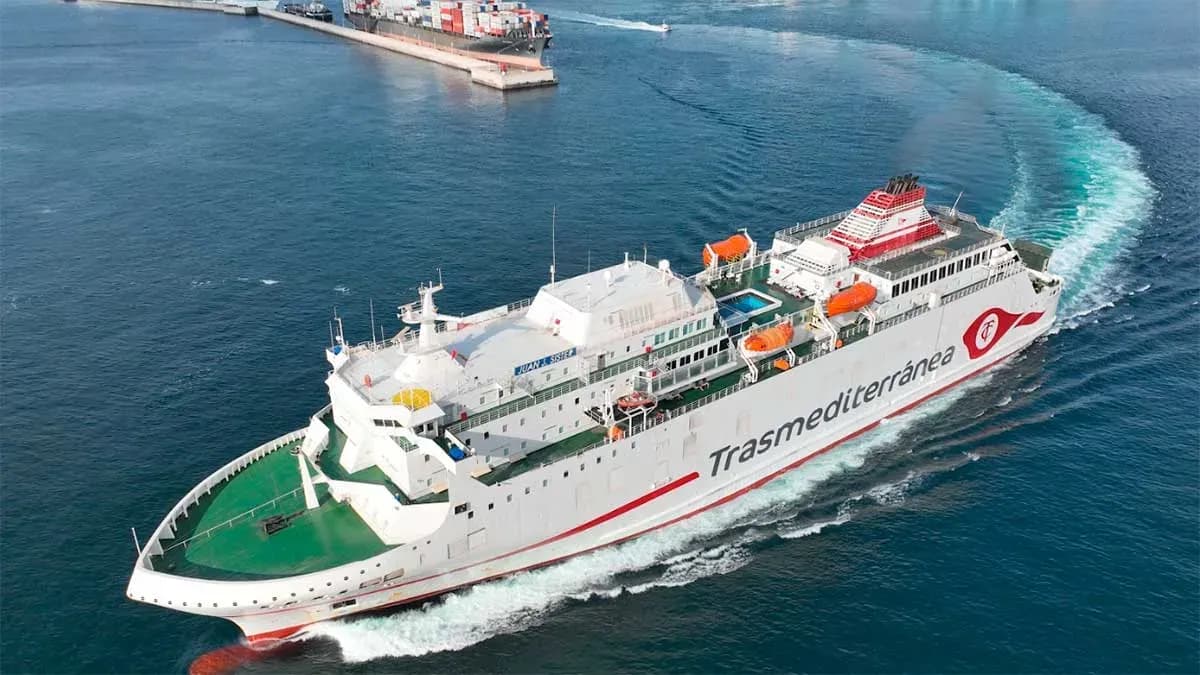
The Danish shipping company DFDS, one of the main operators of cargo and passenger ferries in Europe, has presented the results for the first quarter of 2026 with an improvement in financial performance in its two business divisions and a positive performance of its activity in the Strait of Gibraltar, where cargo volumes grew by 4.3% compared to the same period in 2025 despite having fewer sailings. In the passenger segment, however, adjusted volumes in the Strait fell by 13.2% mainly due to weather disruptions that affected frequencies during the quarter.
The Strait of Gibraltar is one of five geographical areas in which DFDS structures its ferry division, along with the North Sea, the Mediterranean, the English Channel, and the Baltic Sea. The revenues generated from activities in the Strait contribute both to cargo flows between Europe and North Africa and to passenger traffic between both shores. The company is also awaiting regulatory approval for the acquisition of part of the assets of Naviera Armas' operations in the Strait of Gibraltar, for an agreed amount of approximately 32 million euros, a transaction that is not included in the investment forecasts for 2026.
At the group level, DFDS reported 986 million euros in revenue in the first quarter, a decrease of 2% compared to the same period in 2025. EBITDA increased by 7% to 107 million euros, while EBIT improved from a loss of 16 million euros in the first quarter of 2025 to a positive result of 4.4 million euros. Adjusted for route changes and exceptional items, the underlying EBIT increase reached 35 million euros. The adjusted free cash flow was 40 million euros, 22% more than a year earlier.
Karen D. Boesen, CFO and interim CEO of DFDS, noted that "financial performance in both divisions continued to improve in the first quarter of 2026, which, along with our focus on cash flow, also improved financial leverage." The net debt to EBITDA ratio decreased to 3.9 times by the end of the quarter, in line with the goal of keeping it below 4.0 times by year-end.
The ferry division, which accounts for just over half of the group's revenues, reported 531 million euros, a decrease of 0.8% compared to 2025, with EBIT of 16.6 million euros versus losses of 1.2 million the previous year. Total cargo volumes grew by 2.8%, driven by the North Sea (with an adjusted increase of 3.1% due to traffic between the continent and the UK), the Baltic (5% more due to higher flow between Germany and Lithuania) and the Strait of Gibraltar itself. In the Mediterranean, volumes were 1.9% below 2025, as growth between Egypt, Tunisia, and Europe did not offset the decline in routes between Turkey and Europe resulting from capacity adjustments. Nevertheless, the Mediterranean was the business unit that contributed most to the adjusted EBITDA improvement of the division, thanks to a combination of cost cuts and a new pricing model.
The utilization rate of the cargo fleet rose to 68% compared to 64% in the first quarter of 2025. In the passenger segment, adjusted volumes fell by 5.5% year-on-year, with declines in the English Channel (-2.7%), the Baltic Sea (-11.6%), and the Strait of Gibraltar (-13.2%).
The logistics division generated 515 million euros, a decrease of 5.2%, impacted by lower activity levels in some regions of the UK, Ireland, and the Nordic countries, as well as by restructuring activities, including the closure of several national organizations in the Turkey and Southern Europe unit (TES). However, EBITDA in logistics grew by 15.7% to 30.4 million euros, driven by the business units on the continent and in the Nordic countries and by the progress of performance enhancement projects called Boost. EBIT for the division improved by 6.4 million euros to reach -0.9 million.
The rise in oil prices since March 2026, driven by the conflict in Iran and the Gulf, had an initial negative financial impact due to a delay of one to two months in the fuel cost pass-through model to customers. DFDS expects this effect to reverse in the second quarter. The company has not detected significant effects on transport volumes up to April, although it acknowledges a potential downside risk if high energy costs end up affecting demand.
DFDS raised its EBIT forecast for the full year of 2026 in April to a range of 134 to 188 million euros, compared to the previously anticipated 107-148 million and the 70 million recorded in 2025. The ferry division is expected to contribute between 154 and 194 million euros, and logistics between 13 and 27 million. Group revenue is expected to be at levels similar to 2025, while capital investment will remain around 228 million euros. In terms of corporate governance, Torben Carlsen left the CEO position in April and Michael Hansen will join as the new president and CEO on July 1, 2026.