Manuel Cózar, president of ATEIA-OLTRA Bay of Algeciras and vice president of FETEIA-OLTRA, has participated in the XIV Congress of the Spanish Federation of Freight Forwarders, Organization for Logistics, Transport, and Customs Representation, which is taking place in Tenerife from October 1 to 4 under the slogan “A Movie Congress.” The event brings together professionals, companies, representatives from administrations, and specialists linked to transport, logistics, customs, and international trade.
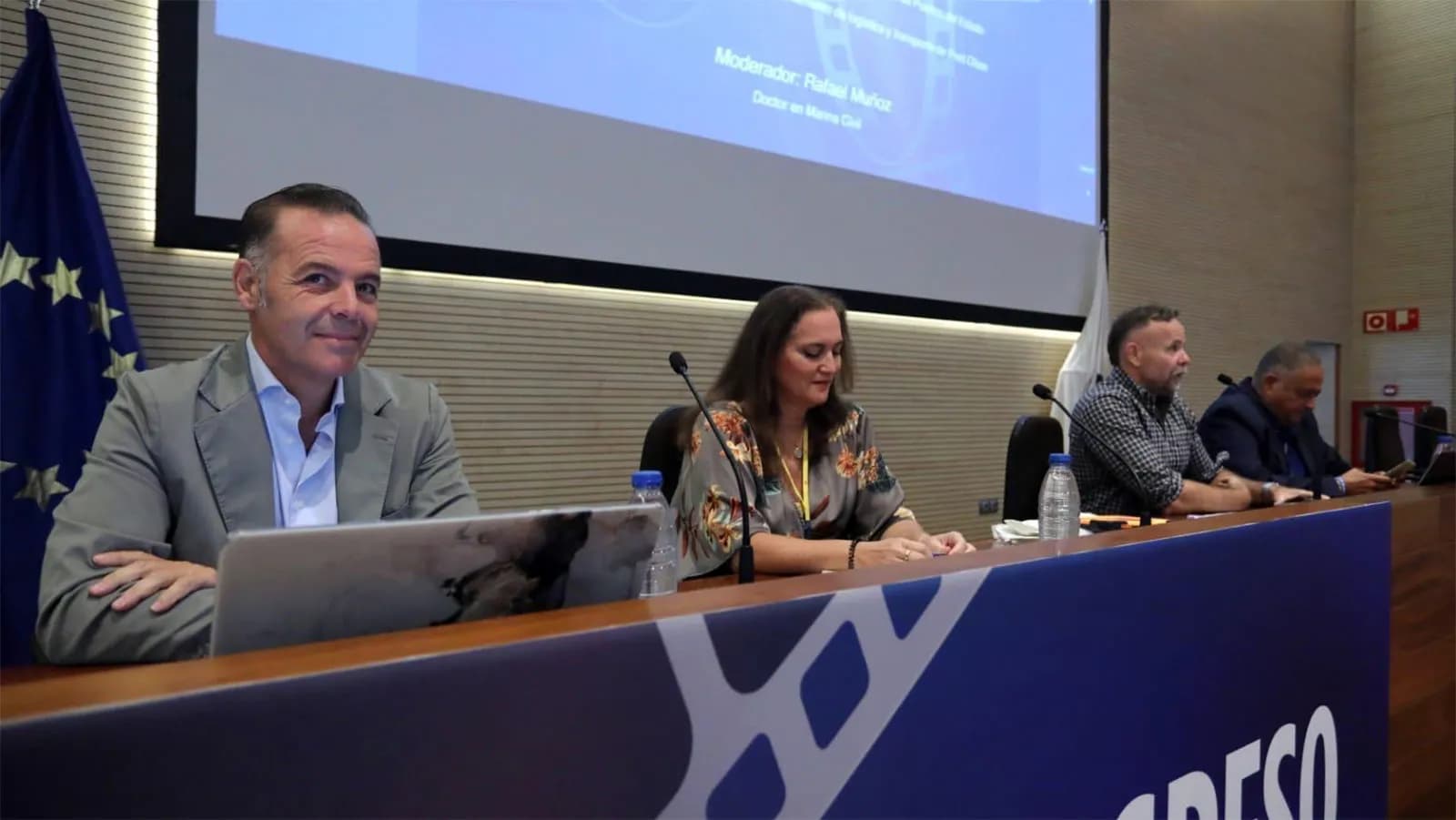
Cozar has been part of the panel dedicated to the future of maritime transport, where he spoke as vice president of the Maritime Commission of FETEIA. The session also included Jaime Luezas, head of the Community Services Area of the State Ports, and Luz Castro, head of the Logistics and Transport department of Fred Olsen, with Rafael Muñoz, PhD in Civil Marine, as moderator.
The maritime debate was incorporated into a professional program that has analyzed issues related to the evolution of international logistics, customs updates, digital transformation, the regulatory framework, and the changes affecting supply chains. The program of the congress specifically placed the future of maritime transport among the sessions of October 3.
Cozar's participation has been accompanied by recognition from the organization, which awarded him a plaque “in appreciation for his participation and support for the XIV Congress FETEIA-OLTRA.” The representative of the freight forwarders of the Bay of Algeciras is currently part of the FETEIA-OLTRA Presidency Committee as vice president and the Executive Committee of the organization as president of ATEIA-OLTRA Bay of Algeciras.
The conclusions drawn from the professional days place the digitization of customs as one of the main issues for the coming years. FETEIA considers that the clearance of goods should begin before their arrival at the border through higher quality information provided in advance. The organization also suggests that artificial intelligence and automation will have an increasing presence in logistics processes, while maintaining the professional judgment of the freight forwarder as a necessary element in the face of incidents, exceptions, and situations that require specific decisions.
Another aspect included in the document is the need to improve interoperability among customs systems, inspection services, ports, and freight forwarding companies. FETEIA links this coordination to the functioning of logistics chains and suggests that ports and airports occupy a central space within foreign trade policies, accompanied by investments in both infrastructure and human capital.
Regarding maritime transport, the Federation notes that the sector operates in a scenario subject to recurring episodes of instability and considers greater collaboration among the various participants in the chain necessary to manage uncertainty. In this context, the conclusions point to an evolution of the role of the freight forwarder from organizing transport to a broader function as a solution provider for foreign trade operations.
The document also reflects the sector's concern over the increase in administrative obligations. FETEIA requests a regulatory framework that allows companies to focus more of their resources on their activities and attributes a crucial role to customs processing in managing international operations.
Sustainability, training, and generational change are also among the issues addressed. The Federation links the future of activity to supply chains with greater traceability and to the incorporation of new professionals specialized in logistics and customs representation. It also proposes the diversification of routes, suppliers, and markets as a business response to the current geopolitical context.
The conclusions also dedicate one of their sections to the Canary Islands, whose position between Europe, Africa, and America is considered by the Federation an element of interest for Spanish logistics. The document concludes by noting FETEIA-OLTRA's intent to maintain dialogue with administrations and European institutions regarding the development of the regulatory framework affecting freight forwarding activities and foreign trade.