The Port of Algeciras remains the sixth European port in maritime connectivity despite a 6.2% drop in the third quarter
The Port of Algeciras adds 486.52 points in the UNCTAD index, its lowest value since 2023, and is the second in Spain and the 36th in the world, 89 points behind Tangier Med
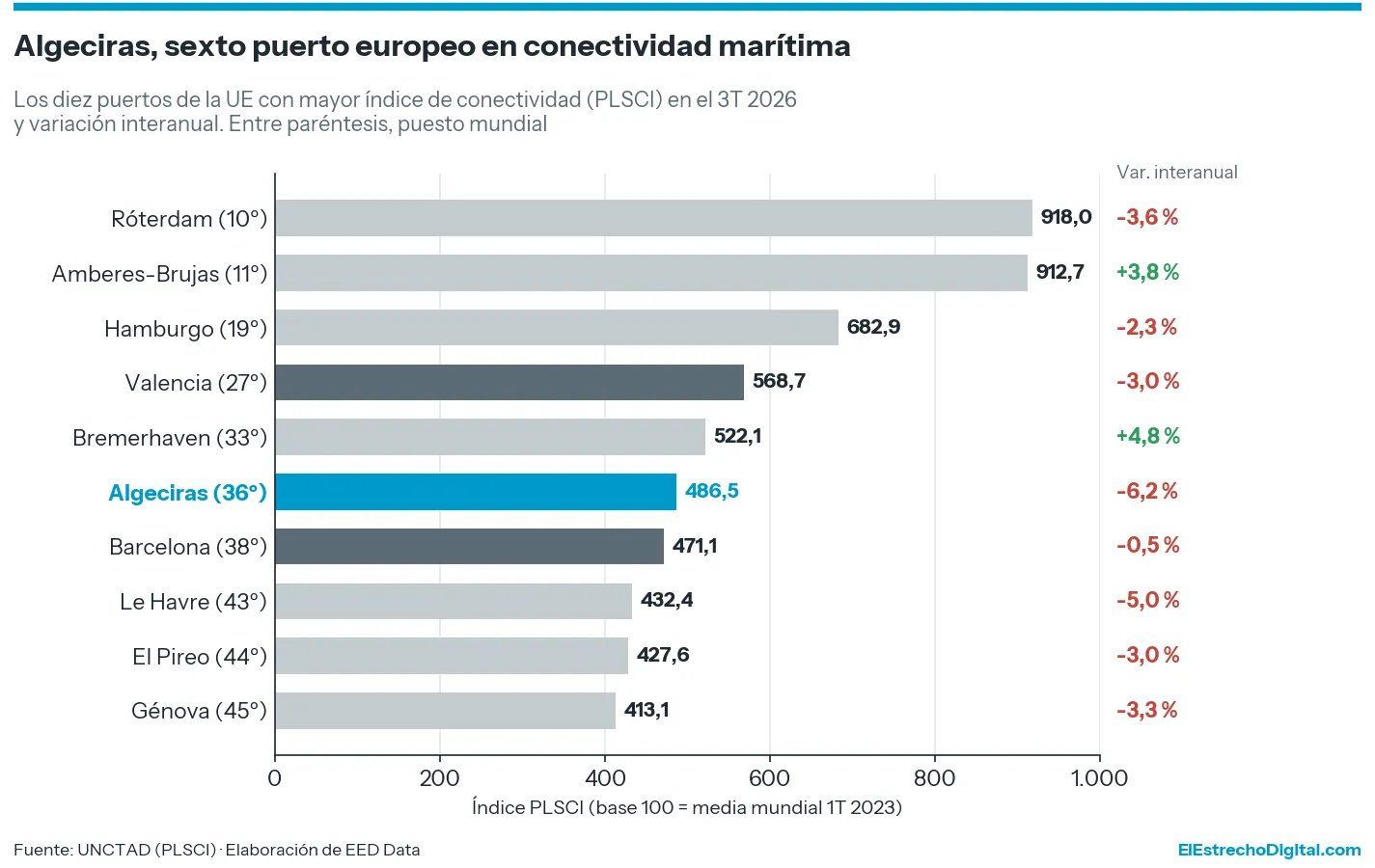
The Port of Algeciras occupies the sixth position among the best-connected European ports to the global network of regular container lines in the third quarter of 2026, according to the Port Liner Shipping Connectivity Index (PLSCI) of the United Nations Conference on Trade and Development (UNCTAD). Its index is at 486.52 points, a 6.2% decrease from a year earlier and 6.3% below the second quarter, placing it in 36th position in the world.
The first European port is Rotterdam, with 918.02 points (-3.6%) and 10th in the world. Very close is Antwerp-Bruges, with 912.74 points (+3.8%) and 11th place, so the difference between the two major northern ports is reduced to just over five points. Next are Hamburg, with 682.9 (-2.3%); Valencia, with 568.73 (-3.0%); Bremerhaven, with 522.07 (+4.8%), and Algeciras, with 486.52 (-6.2%). Lower down are Barcelona, with 471.08 (-0.5%) and 38th in the world; Le Havre, with 432.39 (-5.0%); Piraeus, with 427.6 (-3.0%), and Genoa, with 413.1 (-3.3%). Algeciras and Valencia are the only two ports in southern Europe among the top six in the continent, with the other four being northern ports. The data shows the weight that the Spanish Mediterranean facade and the Strait retain in the European container network.
However, the overall picture is less favorable. Of the ten ports in the European Union listed among the 45 best-connected in the world, eight have decreased in the last year, and the drop of Algeciras is the largest of all. Only Antwerp-Bruges and Bremerhaven improve their index, and both are in northern Europe, where the major final destination ports for Asian cargo are concentrated. In the south, the main transshipment and Mediterranean entry ports are simultaneously declining. This pattern indicates a common problem for the southern European facade rather than a particular circumstance for a single port. The distance between Algeciras and Bremerhaven, the fifth European port, reaches 35.55 points.
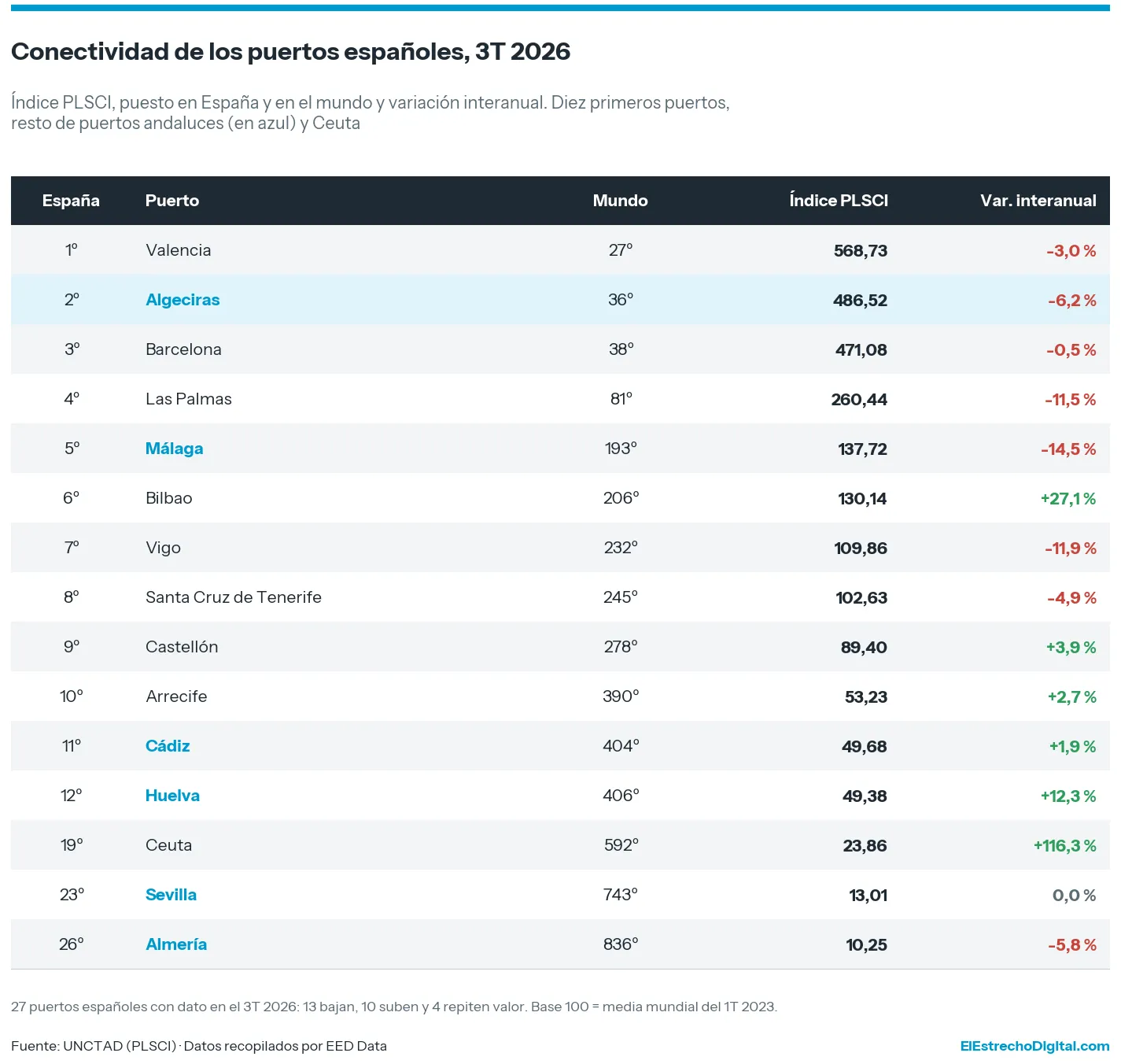
At the national level, Algeciras remains the second Spanish port. The first is Valencia, which totals 568.73 points, holds the 27th position in the world, and falls 3.0% year-on-year, although it grows 0.4% compared to the second quarter. Barcelona is third, with 471.08 points and a year-on-year decline of only 0.5%.
The comparison between the three helps to understand Algeciras' data. Valencia and Barcelona are primarily import and export ports, with cargo linked to their hinterland. Algeciras' activity, on the other hand, largely depends on transshipment, meaning that shipping companies choose it as a point for exchanging containers between ocean routes. The first two hold up better. The distance between Algeciras and Barcelona has reduced to 15.4 points, down from nearly 45 a year earlier, and this approaching is almost entirely explained by Algeciras' decline.
The historical series allows us to measure the extent of the decline. The index for Algeciras registers its lowest value since the first quarter of 2023, when UNCTAD assigned it 485.52 points. Its maximum corresponds to the second quarter of 2024, with 558.43 points, the highest value in the series since 2006, and since then it has accumulated a 12.9% drop. Between the third quarter of 2025 and the second of 2026, the value had stabilized in a narrow range, between 511.86 and 519.21 points. The decline in the third quarter breaks this stability and places the port below the levels it had in the second half of 2023, prior to the Red Sea crisis. The additional connectivity gained in 2024 has been completely lost. For a transshipment port, whose business depends on being included in the rotations of major shipping companies, the index serves as a thermometer for that attractiveness, as it captures the number of services, the capacity deployed, and the destinations with direct connections.
Among the possible causes of the decline, the most documented is the effect of the European emission trading regime (EU-ETS) on transshipment. The second report from the EU-ETS Observatory of the Ports of the State confirms that EU ports are losing connectivity in long-distance container services compared to neighboring countries not subject to European environmental regulations. The same study specifies that the import and export flows of community ports remain stable and that the loss is concentrated in the exchange of cargo from third countries between ocean routes, as reported by El Estrecho Digital in its information on the case of Algeciras. UNCTAD's data aligns with this diagnosis. Spanish ports focused on import and export hardly move, while the main transshipment port drops by 6.2%. On the other side, Tangier Med, outside the EU-ETS scope, rises by 3.3%.
A second possible factor is the reorganization of routes between Asia and Europe. Algeciras' peak, in the second quarter of 2024, coincided with the diversion of much of the services around the Cape of Good Hope due to attacks in the Red Sea, which turned the Strait into the gateway to the Mediterranean for these routes. The return of services to the Suez Canal alters that scheme again, as part of the cargo re-enters the Mediterranean from the east. The Gemini cooperation has returned to Suez three services with a stop in Algeciras. Their new rotations distribute the stops between the two shores of the Strait: some services include Algeciras, others incorporate Tangier Med, and some use either port depending on the route's direction. In the opposite direction, the new ONE and CMA CGM lines to West Africa connect Algeciras and Tangier Med. This type of service may sustain some of the port's connectivity in the coming quarters, although its weight in the index is less than that of the major routes between Asia and Europe.
The comparison with the other shore best reflects the change. Tangier Med reaches 575.61 points (+3.3%) and holds the 26th position in the world, the highest among African ports, with 6.88 points more than Valencia. A year ago, Valencia's index was higher than that of the Moroccan port; El Estrecho Digital previously analyzed the evolution of both in the piece from the previous quarter. The distance between Tangier Med and Algeciras is now 89.09 points, more than double the approximately 39 that separated them in the third quarter of 2025. In just one year, the difference between two ports with practically equivalent geographical positions has shifted from moderate to placing Tangier Med at another scale of connectivity.
The other Moroccan ports with data are Casablanca, with 220.84 points and 104th place; Agadir, with 63.81 points and an increase of 71.1%, and Nador, with 11.25 points and no variation. In Nador, the entry into service of the Nador West Med East Terminal, which has already completed its tests and will add a new transshipment option on the Moroccan Mediterranean coast, is pending. Morocco totals 262.44 points as a country, 4.1% more, and is the 22nd economy in the index. Gibraltar, as an economy, totals 6.84 points, an 8.3% decrease.
The rest of the Andalusian ports offers a mixed balance, with a common characteristic: in smaller ports, the entry or exit of one or two services is enough to move the index strongly, so their variations should be read with more caution.
Málaga, the fifth Spanish port, registers 137.72 points and the 193rd position in the world. Its index falls 14.5% year-on-year but rises 5.0% compared to the second quarter and nearly quadruples that of two years ago, when it was 34.48 points. The leap it made in late 2024 took it out of the marginal position it held in the network. Although it has lost some of the gains, the port is still at a level far superior to its previous trajectory.
Huelva experiences the best moment of its series. Its 49.38 points, 12.3% more than a year earlier, are the second highest value since 2006, only surpassed by the 50.32 of the previous quarter. Two consecutive quarters at highs point to a sustained improvement in its container service offering.
Cádiz totals 49.68 points (+1.9%) and practically equals Huelva; Sevilla remains at 13.01, and Almería drops 5.8% to 10.25. Andalusia has six of the 27 Spanish ports with data, and Algeciras' index is 3.5 times that of Málaga, the second in the community. That distance reflects how much Andalusian connectivity depends on a single major port.
Throughout Spain, 13 ports are down, 10 are up, and 4 maintain their value. The largest increases correspond to Ceuta, which grows 116.3% to 23.86 points; Bilbao, which rises 27.1% to 130.14, and Huelva. The percentage from Ceuta is largely explained by its low starting base. The one from Bilbao carries more weight, as it occurs in a port that was already among the top six in Spain.
The largest drops are registered in Ferrol (-40.8%), Marín (-37.6%), Gijón (-15.7%), and Málaga (-14.5%). Las Palmas, the fourth Spanish port, declines 11.5% to 260.44 points; Vigo, 11.9%, and Santa Cruz de Tenerife, 4.9%. The simultaneous decline of the two major Canary ports and the Galician ones contrasts with the stability of Barcelona and Valencia. Castellón rises 3.9%, and the Port of Tarragona, 6.9%.
On a global scale, the largest port movements are concentrated around the Persian Gulf. The most significant declines are Khalifa (-77.5%) and Yebel Ali (-73.7%) in the United Arab Emirates; Hamad (-71.3%) in Qatar; Dammam (-70.9%) in Saudi Arabia; and the Port of Bahrain (-56.7%). Yebel Ali, one of the world's major transshipment hubs, drops to 204 points and 121st place. The largest increases correspond to Duqm (+293.4%) in Oman; Zhapu (+230.6%) in China; Khor Fakkan (+191.5%) on the eastern coast of the UAE, which becomes the country's top port in the index; Lamu (+110.8%) in Kenya; and Latakia (+88.6%) in Syria.
The distribution responds to geography: ports located within the Gulf decline while those outside the Strait of Hormuz rise, in a year marked by restrictions on the passage of container vessels through that strait. Maersk communicated in April that Hormuz remained closed and could not guarantee the safe passage of its personnel, its vessels, and its clients' cargo. Part of the cargo destined for Dubai is being diverted by road from Khor Fakkan and Fujairah, on the eastern coast of the UAE. The UNCTAD index accurately captures that shift: Khor Fakkan nearly triples its connectivity and is positioned above Yebel Ali. Oman, despite the rise of Duqm, drops 10.6% as a country, indicating that the reorganization has not compensated for the loss of services across the region. In the upper part of the world ranking, there are no fundamental changes: Shanghai totals 2,439.09 points, followed by Ningbo, Singapore, Busan, and Qingdao.
By countries, the Liner Shipping Connectivity Index (LSCI) places Spain at 407 points in the third quarter, 3.4% less than a year earlier. It is the eighth economy in the world, one position lower than in the second quarter when it tallied 416.6 points, and the first in the European Union. The Netherlands totals 374.91 points; Belgium, 346.97; Germany, 326.58; Italy, 287.1; and France, 263.35. The United Kingdom registers 382.85, and Portugal falls 12.4% to 159.85. China occupies first place with 1,341.97 points, followed by South Korea, Singapore, the United States, Malaysia, Vietnam, and Japan, which with 412.45 points totals 5.45 more than Spain.
Among the top ten economies, a clear division is noticeable. China (+3.2%), South Korea (+2.0%), Singapore (+0.9%), and Vietnam (+5.4%) rise. The United States (-3.1%), Malaysia (-2.9%), Japan (-3.9%), Spain (-3.4%), India (-3.8%), and the United Kingdom (-3.4%) drop. Indonesia, in 23rd place, grows 8.2%. Connectivity grows in the major production centers of East and Southeast Asia and weakens in the United States, Japan, India, and the United Kingdom, as well as in transshipment nodes such as Malaysia and Spain.
Among economies with an index above 20 points, the largest year-on-year declines for the quarter correspond to Qatar (-65.3%), Bahrain (-60.6%), Iraq (-56.0%), and the United Arab Emirates (-39.1%), four economies with their main ports located within the Persian Gulf. Kuwait drops 16.5%, and Iran, 12.6%. Outside that region, the largest declines are in Réunion (-24.0%) and Tunisia (-23.3%). The largest increases are in Venezuela (+91.4%), Syria (+79.7%), Djibouti (+34.7%), Cyprus (+32.9%), and Lebanon (+27.4%).
The case of Venezuela cannot be read apart from the intervention by the United States and oil. On January 3, 2026, a U.S. military operation in Caracas ended with the capture of Nicolás Maduro, who was transported to the North American country to be tried for narcoterrorism, drug trafficking, and weapons charges that he denies. The UN Secretary-General, António Guterres, expressed deep concern that international law norms were not respected and warned of the dangerous precedent set by the operation. Several international law experts argue that the action violated the UN Charter. Washington justified it as legitimate defense against drug trafficking and the lack of legitimacy of Maduro after the 2024 elections, the results of which were rejected by more than 50 countries, including the United States and the European Union.
Oil has been at the center of the U.S. strategy since day one. A few hours after the capture, Trump announced that Venezuela would open up to America's major oil companies. Days later, he stated that the United States could control Venezuela and exploit its reserves for years. His administration announced the transfer of up to 50 million barrels of Venezuelan crude, and the Secretary of Energy, Chris Wright, explained that Washington would oversee its sale and control the revenues. On January 29, the National Assembly approved a reform of the Hydrocarbons Law that opens the industry to foreign companies, a change that the U.S. administration hoped for. That same day, the Treasury Department authorized U.S. companies to export, buy, sell, and transport Venezuelan oil. The sequence shows that the easing of sanctions, which is what has returned Venezuela to shipping routes, has been accompanied by the opening of the country's main resource to U.S. interests.
Commercial reopening has also reached the ports. At the end of May, the CMA CGM Bali container ship, a vessel for transpacific services, made a stop at the container terminal in La Guaira. The Deputy Minister of Water Transportation, David Quintana, attributed Venezuela's incorporation into shipping company itineraries to an increase in cargo volumes. The UNCTAD index captures that change: Venezuela nearly doubles its connectivity in a year, reaching 65.06 points and occupying 79th in the world. The figure remains modest. Furthermore, the return of the country to the network of regular lines occurs in a context in which the management of its main resource largely depends on decisions made in Washington, making this recovery of connectivity a process conditioned from the outside.
Syria follows a similar trajectory. After the fall of the previous regime and the gradual lifting of Western sanctions, CMA CGM signed a 30-year agreement in May 2025 to operate the Port of Latakia, with an investment of 230 million euros. In May 2026, it expanded its presence with the management of internal logistics centers in Adra, near Damascus, and in Aleppo. The 88.6% rise of Latakia and the 79.7% of the country reflect that reopening. The improvement of Djibouti, at the entrance of the Red Sea, and of Cyprus and Lebanon in the eastern Mediterranean is compatible with the return of services to the Suez route, although the index does not allow attributing it to a specific service. Egypt drops 6.2% in the quarter, down to 264.08 points.
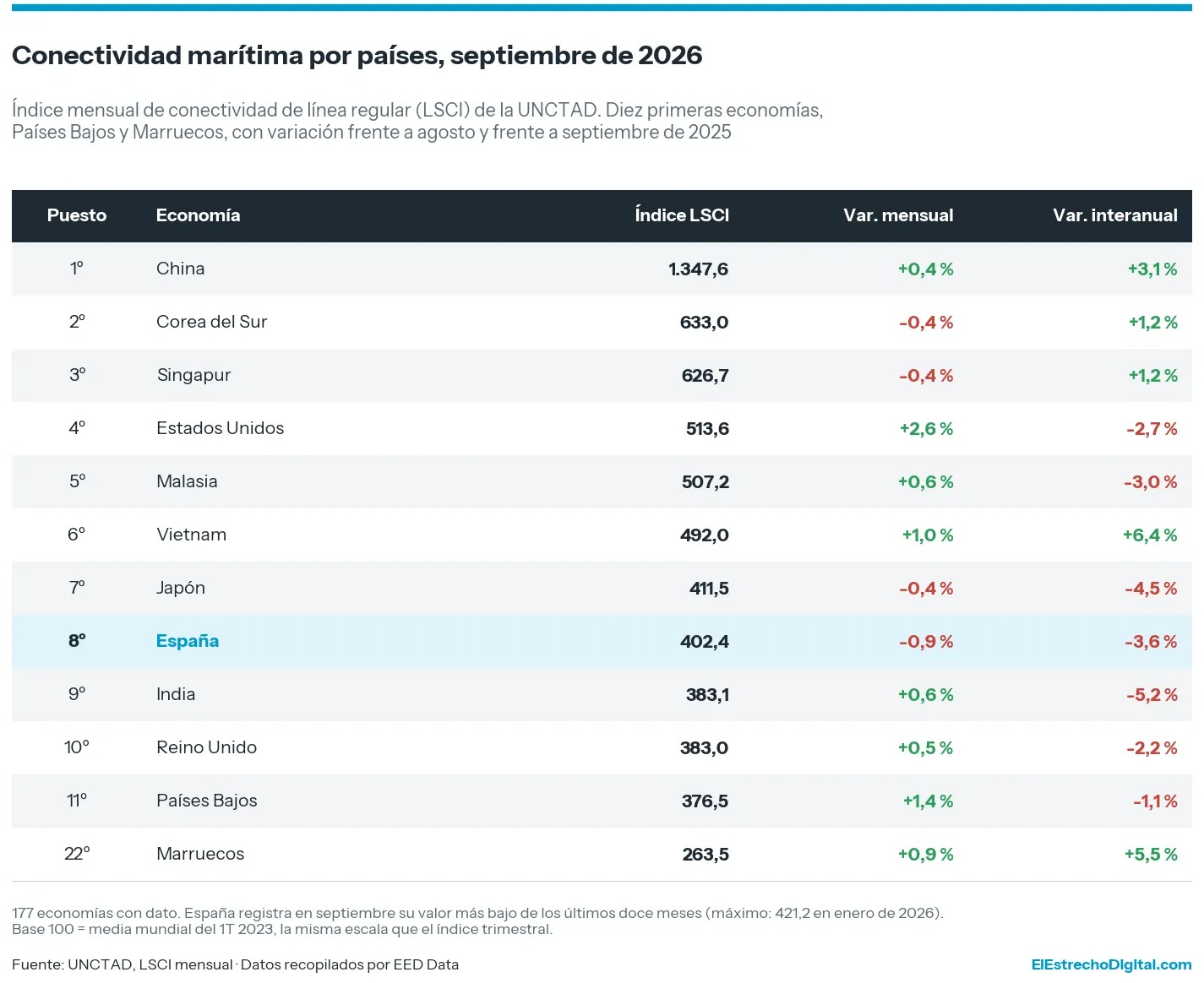
The main novelty of this edition is the monthly connectivity index by country, which UNCTAD introduced in 2025 alongside the quarterly series. It is calculated on the same scale, captures changes in routes and stops earlier, and has had monthly data since January 2023. There is no monthly version by port, but the data by country allows tracking Spain's evolution almost in real-time.
According to this indicator, Spain records 402.4 points in September 2026, 0.9% less than in August and 3.6% less than a year earlier, occupying the eighth place among 177 economies. It is the lowest value in the last twelve months. The maximum in that period was reached in January 2026, at 421.2 points, which means a 4.5% drop over eight months. The monthly series confirms that the loss of connectivity in Spain has been continuous throughout the year and that it has not stopped at the end of the quarter, as the September value falls below the quarterly average. Japan, seventh, totals 411.5 points in September, 9.1 more than Spain, against 5.45 difference in the quarterly average. India, ninth, is at 383.1, and Morocco reaches 263.5 points, 5.5% more than a year earlier.
The monthly series repeats the Gulf pattern, with year-on-year declines in September of 68.8% in Qatar, 60.9% in Bahrain, 54.9% in Iraq, and 38.3% in the United Arab Emirates. Among the increases are Venezuela (+110.9%), Syria (+107.5%), Djibouti (+33.4%), Mauritania (+31.1%), and Cyprus (+29.4%). Additionally, Venezuela's index grows 96.7% compared to August, a variation that shows how sensitive the monthly indicator is to specific scales in countries with a reduced service network. Compared to the previous month, Mauritania's index grows 22.9%, and Saudi Arabia's, 16.7%. Egypt, which falls in the overall quarter, rises 3.3% in September compared to August, a movement that coincides with the return of services to Suez.
The data comes from UNCTAD and has been compiled by EED Data, the data platform of El Estrecho Digital. The section on Connectivity of EED Data allows for consulting the complete ranking of ports and countries, the series of each port since 2006, and the detail of Spain, Europe and Andalusia.
Newsletter
The maritime briefing, every morning at 8:00
Ports, logistics and shipping essentials in your inbox, Monday to Friday, before the day starts.