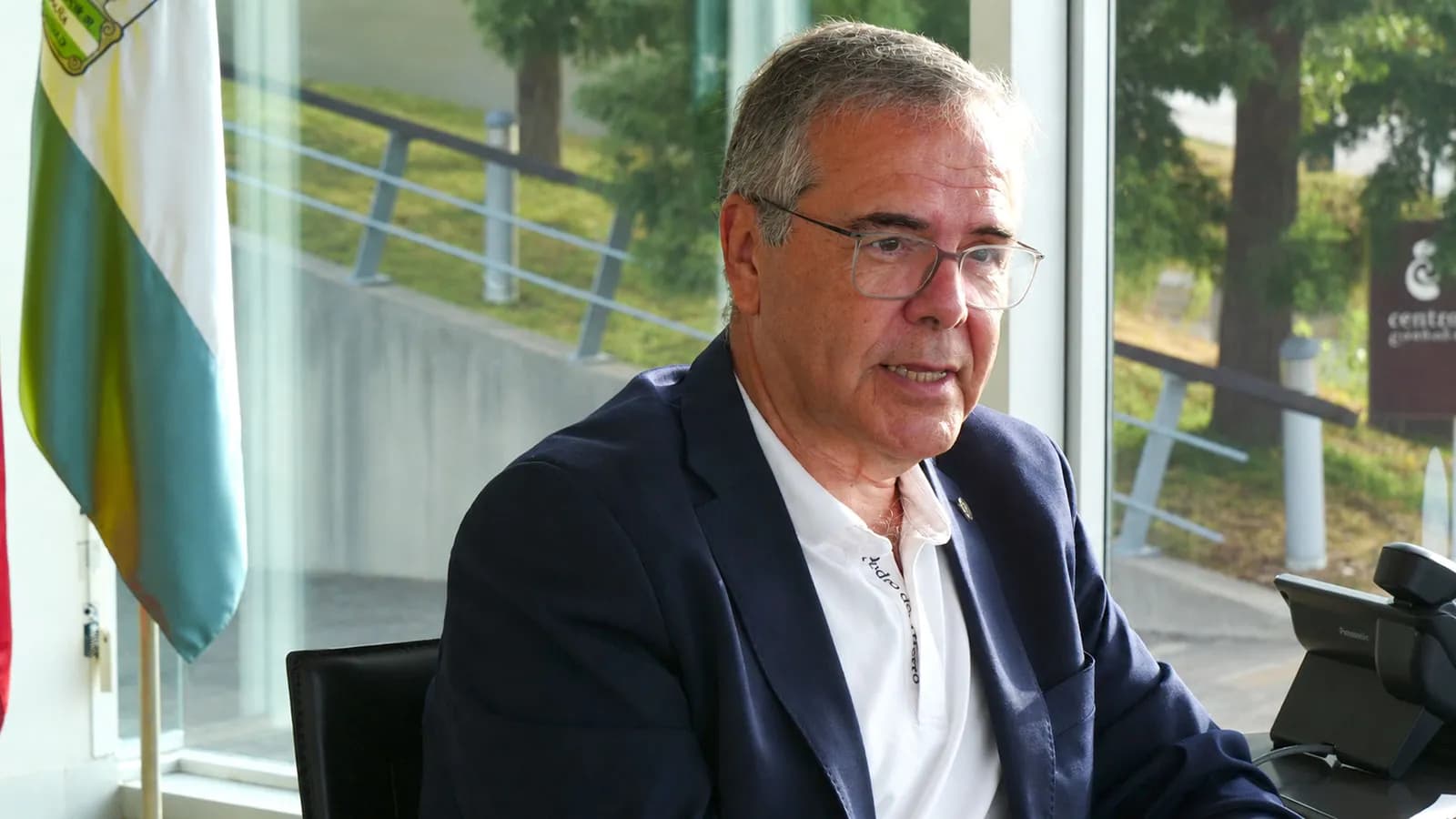
The president of the Chamber of Commerce of the Bay of Algeciras, Carlos Fenoy, has analyzed the operational balance corresponding to the first semester of 2026, detailing the evolution of the regional business fabric and the projects managed by the corporate entity. Fenoy has described the institutional performance in the first six months of the fiscal year as "very positive," a period in which the organization has focused its work on training for employment, entrepreneurship, and digitalization. According to the chamber representative, "at the beginning of 2026 we have focused a lot on all the training operations, on entrepreneurship, and on digitalization," adding that "the percentage we have already executed of the European funds, only in two years, is already exceeding half of what we did in the previous seven years."
This management has materialized in technical training programs framed in the initiatives Talento Joven and 45 Plus, aimed at covering operational vacancies in the regional industry. "We have conducted courses for welders, boilermakers, industrial assembly, supermarket assistant roles, forklift operators, and the truth is it is a very intense activity," Fenoy specified. Similarly, the institution has completed the first phase of the support program for startups and the cybersecurity projects managed alongside the National Cybersecurity Institute (INCIBE), an initiative that has received national recognition. For the second half of the year, the entity has economic incentives aimed at around fifty SMEs in the areas of digital transformation, innovation, and sustainability, while maintaining its consulting work in the bodies of the Operation Passage of the Strait (OPE), road infrastructures, and the Special Economic Zone.
In the analysis of the local business situation, Fenoy has recorded an uneven evolution depending on the sector of activity. Companies in the logistics and port sector have recovered their operational rhythms after the slowdown suffered at the end of last year and the interruptions caused by winter storms that affected the terminals. In construction, indicators are close to the values registered before the 2008 crisis, while the services sector maintains a positive trend supported by summer tourist influx, although with a reduction in average spending per customer. "More people visit us, but they consume less; these are effects of something that seems to be buried, but the economy is not as buoyant as politicians announce to us," he stated, pointing out that "despite everything that happens in the region, and when I say despite, I refer to infrastructures and communications, the economy in the region is in good health."
"Despite the deficits in infrastructure and communications, the regional economy is in good health."
In contrast, traditional commerce shows a more slowed behavior due to structural changes in consumption habits and the consolidation of online shopping after the pandemic. Regarding the entrepreneurs' requests, the chamber president has pointed out the lack of qualified personnel to fill vacancies as a constant obstacle, despite the area's unemployment figures. To cater to the age group between 30 and 45 years, the entity applies the Spain Emprende program with projects focused on talent acquisition and team management. Likewise, SMEs are demanding a reduction in bureaucratic complexity for granting commercial licenses. "The system should be much more agile, much easier so that those who want to undertake are assisted and not faced with so many obstacles," he argued. In financial terms, Fenoy pointed out that access to credit is not a determining obstacle due to the stability of interest rates. In the technological realm, he indicated that telematic processing with the administration and the use of artificial intelligence are integrated into the sector, although cybersecurity requires continuous technical advice. "Every day we receive alerts on our phones because bad actors take advantage of this window of opportunity and make you commit mistakes; when you make a mistake, they have cleaned your checking account," he warned.
In the institutional aspect, the corporation has completed the formal modification of its name, officially becoming the Chamber of Commerce of the Bay of Algeciras after a unanimous approval by its plenary. Fenoy explained that the change solves location inefficiencies and confusions in national and international environments with the colony of Gibraltar. "I often arrived at meetings in Madrid and they asked me if I was the Gibraltar Chamber," he recalled. The institution, founded in 1909 as the Chamber of Commerce of Algeciras and named in 1985 as Campo de Gibraltar, adopts the brand "Bahía de Algeciras," aligning with the Port Authority, the campus of the University of Cádiz, the Technological Campus, the facilities of the Free Trade Zone in El Fresno, and the projection of the metropolitan area. "We had a registered brand with tremendous power and were using one that generated confusion," he stated, adding that "the brand Bahía de Algeciras is already recognized worldwide, and companies are here to take advantage of opportunities and competitive advantages."
"The brand Bahía de Algeciras is recognized internationally, and we must take advantage of that competitive advantage."
In the investment attraction area, the Chamber advocates for the creation of a special statute or Special Economic Zone (ZEE) for the Campo de Gibraltar that allows for fair competition in the presence of four tax regimes in a small geographical space. Fenoy described the evolution of northern Morocco to exemplify direct competition. "In 2006, Tangier was a beach with a river in the middle; in 2026, twenty years later, we see ten million containers, the fishing, pharmaceutical, and textile industries with rail lines connected directly to the factories," he emphasized. After meetings with the Ministry of Economy — where the document was initially proposed to Minister María Jesús Montero — the General Directorate of Economic Policy has requested a detailed report on priority sectors to send to the strategic office of the Presidency of the Government in Moncloa. Meanwhile, the entity held a meeting with Daniel Calleja, director of the Representation of the European Commission in Spain, who indicated that the activation of community tools requires a prior formal request from the central government. "Daniel Calleja told us that the experience of Europe is there, with examples from Italy, Lithuania, Poland, or Romania, but that initially Europe is not going to move until the Government of Spain asks for it," Fenoy explained.
"Daniel Calleja confirmed to us that Europe will not act on the Special Economic Zone unless Spain requests it."
The proposed model includes tax incentives on Corporate Tax, reductions on hiring, and deductions on local taxes such as IAE or IBI, taking the regulations applied in southern Italy as a reference. The report prepared for the Ministry identifies four priority sectors: logistics-port, industrial and energy, technology — mentioning initiatives in La Línea de la Concepción with companies like Wiski or Fox Systems and the PTA of Andalusia — and high-value tourism in Sotogrande and Tarifa. This framework involves aligning Dual Vocational Training and the university offer along with the University of Cádiz and the Employment Counselor of the Junta de Andalucía, Rocío Blanco. In infrastructures, Fenoy recalled that the restoration of rail traffic for autumn 2027 will allow the operability of the rail highway, although he expressed concern over the administrative timelines of the road network. Likewise, the corporation has provided municipalities with a digital mapping tool on available industrial and logistical land.
Regarding the European environmental directive, Fenoy has analyzed the figures presented by the State Port Observatory, which indicate the diversion of transshipment ships from Algeciras to non-community facilities like Tangier Med due to the EU-ETS system. The chamber president explained that establishing the obligation to pay emission rights on the ship instead of on the goods creates market asymmetries compared to neighboring facilities, adding the upcoming entry into service of Nador West Med. In his view, maritime decarbonization should be regulated globally by the International Maritime Organization (IMO), citing the efforts initiated by fellow Algecireño Víctor Jiménez as president of that organization. "Our fellow countryman and president of the Council of the International Maritime Organization, Víctor Jiménez, had already seen this in the internal bodies, but there was a last-minute shift in the assembly," he stated, warning that "if we are going to have ETS, we need to offer other competitive advantages on the other side; otherwise, we will lose logistical sovereignty and control of our chains against third parties."
"If we apply the ETS without compensations, we will lose logistical sovereignty against third countries."
Fenoy added that the diversion of traffic to ports in the United Kingdom also affects facilities in northern Europe like Rotterdam. In this scenario, he pointed out the actions that the Port Authority of the Bay of Algeciras, led by Gerardo Landaluce and Luis Núñez, is developing in Brussels in coordination with the port authorities of Valencia, Barcelona, and Las Palmas.
In terms of external promotion, the Chamber of Commerce, the Port Authority, and the Comport association have agreed to concentrate the FEDER program budget in a commercial and institutional mission to Tokyo scheduled for October. This initiative will showcase the services of the port of Algeciras in the Asian market, in a context marked by the presence of operators like Ocean Network Express (ONE). The call has registered applications from more than thirty companies to fill the twenty available aid spots, with collaboration from Javier López from the commercial department of APBA, ICEX, Extenda, and the Embassy of Spain in Japan. "The port, Comport, and the Chamber have done joint work that has allowed our companies to be in South America, Africa, Asia, and all of Europe," Fenoy said, stating that "the proof of the pudding is that preparations for next year are already underway, and companies are calling the Chamber because the sector is convinced that this tool is essential."
"Going hand in hand with the port, Comport, and the Chamber gives us a very powerful image abroad."
For the second semester of 2026, the Chamber of Commerce of the Bay of Algeciras will allocate public aid for SMEs in digitalization, cybersecurity, and innovation through a notarized lottery, as the volume of applications exceeds the available funding. Among the new planned actions are accreditation as an examination center for Oxford, the launch of the mobile application Submarket for retail, a program with AENOR for training company tutors in Dual Vocational Training — with the precedent of IES Isla Verde in international commerce — and the opening in the last quarter of an office for innovation under the corporate coworking space. Finally, the entity will begin preparing the budgets for 2027 and monitoring the reindustrialization criteria set by the European Union for the next operational cycle.