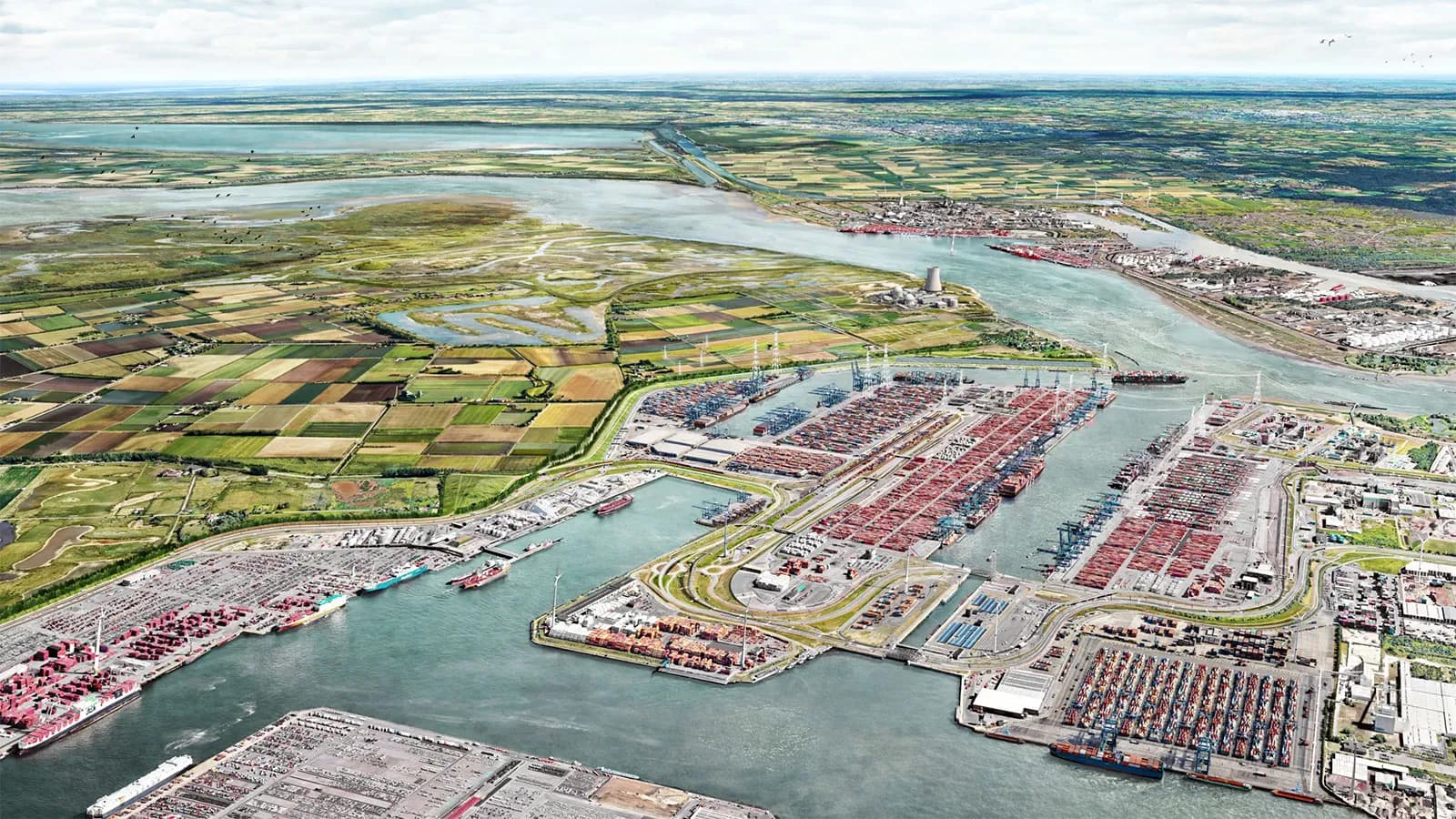
The Port of Antwerp-Bruges has passed a new administrative phase to expand its container capacity on the left bank of the Scheldt River. The Flemish Government approved on May 29 the preliminary project of the so-called Container Cluster Left Bank, one of the main actions of the Extra Container Handling Capacity Antwerp program.
The project, known by the acronym ECA, envisions the incorporation of capacity to handle around seven million additional TEUs per year. The initiative is jointly promoted by the Flemish Department of Mobility and Public Works, the Port of Antwerp-Bruges, and the corporation responsible for the development of the left bank of the Scheldt.
The action has as its central element the construction of a second tidal basin intended for container ships next to the current Deurganck Dock. Around this infrastructure, new terminals and spaces for logistics and industrial activities related to maritime traffic will be enabled.
The plan selected by the Flemish Government corresponds to the alternative called Duplex, combined with the railway location Bundel West. This configuration incorporates additional capacity in the new basin, logistical and industrial lands in the Three Docks area, and a railway facility for the training and management of freight trains.
The project also plans to fill the Northern Cut Dock to create a new surface intended for container handling, relocate high-voltage power lines, and develop the industrial and logistical area of De Bieshoek.
The set of actions is located in the municipal territory of Beveren-Kruibeke-Zwijndrecht. The file includes planning modifications, environmental authorizations, the necessary licenses to execute the works, and a soil sanitation project.
The expansion incorporates measures aimed at limiting the impact of the new facilities on residential areas, rural zones, and nearby natural spaces. Among them is the creation of a landscape strip with an elevation of land that will separate the port infrastructure from the polders and the locality of Doel.
The Port of Antwerp-Bruges anticipates that the new terminals will employ technologies aimed at reducing noise and avoiding local emissions during operations. The planning also reserves a greater weight for rail transport and inland navigation for movements with the continental territory.
The modal distribution is one of the main components of the project, due to the additional volume of goods that the expansion would generate. The new railway facility must facilitate the entry and exit of container trains, while part of the road traffic will be channeled through routes away from nearby urban centers.
The proposal also includes the creation of environmental compensation zones in Doelpolder South and Prosperpolder South. In the latter area, the recovery of wet spaces linked to the tidal dynamics is contemplated. The environmental file analyzes, among other aspects, the effects on water, soil, air quality, landscape, agriculture, and natural habitats.
The chairman of the board of the Port of Antwerp-Bruges, Johan Klaps, has linked the expansion to the international growth of containerized transport. He has indicated that the lack of additional space could divert goods and economic activity towards other European ports.
The Port Authority believes that the new node will maintain sufficient capacity to meet the expected growth and organize the associated logistical activities. The project is part of a planning initiative that began in 2016 to increase handling capacity, provide industrial and logistical lands, and improve multimodal connections with the main transport networks.
The approval of the document does not yet imply final authorization. The project is subject to public information for 60 days, from June 12 to August 10, 2026. During this period, individuals, companies, institutions, and organizations can submit comments and objections.
Once the consultation is completed, the content may be modified to incorporate the contributions received and the conclusions of the environmental evaluation. The file will subsequently have to go through the corresponding legal procedures before the Flemish Government makes a final decision.
The financing framework will also have to be approved before final authorization. Once the procedure is completed, the project can enter its execution phase, which will include the port, railway, electrical, logistical, and environmental works planned for the left bank of the Scheldt.