Gerardo Landaluce presents at the ESPO conference in Gdansk the commitment of the APBA to the electrification of its ports
The European Sea Ports Organisation (ESPO) held its General Assembly in Gdansk on May 6th, presided over by Ansis Zeltins, as a prelude to the 22nd edition of its annual conference.
The European Sea Ports Organisation (ESPO) held its General Assembly in Gdansk on May 6th, presided over by Ansis Zeltins, as a prelude to the 22nd edition of its annual conference, which takes place on May 7th and 8th in the Polish city. During the assembly, ESPO's Secretary General, Isabelle Ryckbost, presented the report on the progress of community policies, the activities carried out by the organization, and the strategic priorities for the coming years. In addition, work documents were approved that will be sent to the European Union bodies to contribute to defining future port policies. With that institutional base already established, the conference that follows has concentrated on the main concerns of the continental port sector: the reconfiguration of the global geopolitical order, the vulnerability of energy markets, the transition to alternative fuels, and compliance with European environmental commitments.
As the host of the conference, the President of the Port Authority of Gdansk, Dorota Pyć, contextualized the meeting by describing her port as "one of the fastest growing in Europe" and "an influential player in the maritime landscape," and expressed her confidence that if ports adapt to changes and remain strong, growth will continue to generate safe and stable conditions for all. Alan Aleksandrowicz, Vice President of the Board for Finance and Security of the same port authority, offered a historical perspective of the enclave: "A thousand-year-old port. The oldest part of the city and the port is right here." Aleksandrowicz reminded that Gdansk is among the six largest ports in the European Union and that 100% of petroleum products in Poland are processed through its fuel terminals.
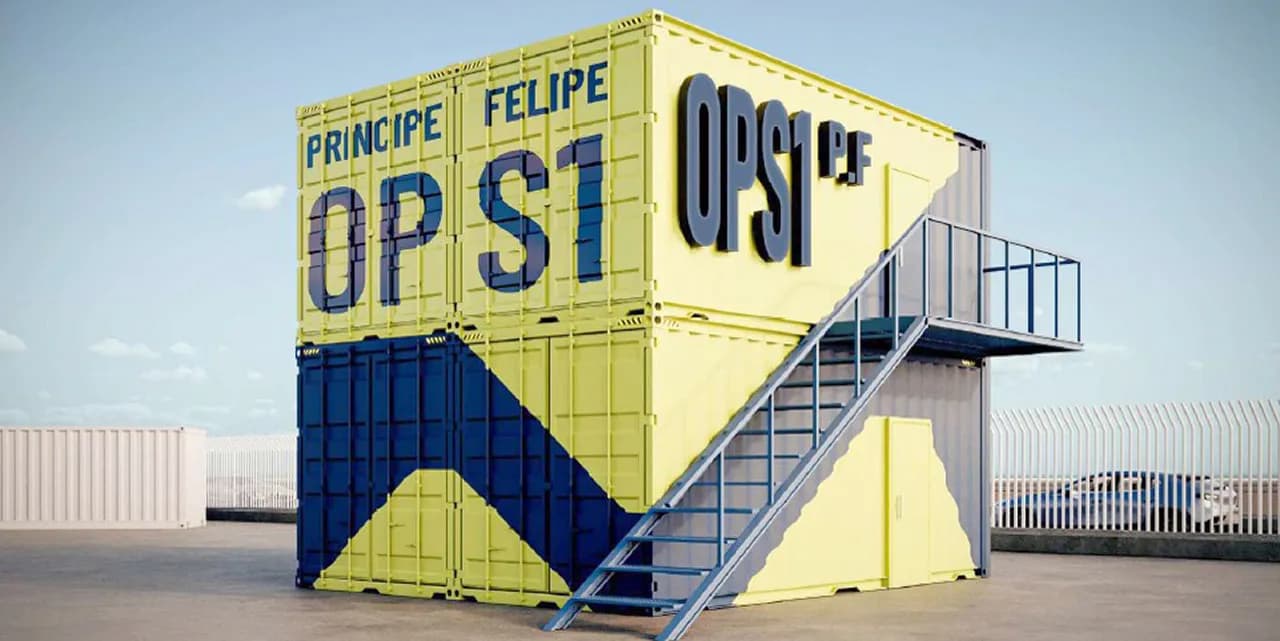
Gerardo Landaluce, President of the Port Authority of the Bay of Algeciras and Vice President of ESPO, intervened at the conference to present the situation of the port of Algeciras in light of European decarbonization commitments. Landaluce acknowledged that, although they have been fully aware of their obligations and commitments from the beginning, "there are still several aspects that need to be developed, particularly key elements of our infrastructure, especially concerning the OPS." The President of the Port Authority of Algeciras described the objective as ambitious but assured that the port is on the right track and hopes to be ready by 2027. Landaluce's intervention placed on the table one of the issues that generated the most debate throughout the conference: the degree of preparedness of European ports to meet the electricity supply requirements at the dock within the timelines set by Brussels.
Alongside Landaluce's intervention, other port officials addressed the challenges of OPS from complementary perspectives that highlight the disparity of speeds within the EU. Jaime Puna, financial director of APS (Ports of Sines and the Algarve), identified the electricity supply at the dock as "one of the biggest challenges" to achieving the 55% target by 2030, with the obligation to build and implement systems at its container and cruise terminals in the south of the country, while operating in two ports simultaneously. From Norway, Torfinn Gaupås, CEO of Karmsund Port, shared a considerably more advanced experience, with expected cruise connectivity rates ranging from 70% to 80% for this year: "Every cruise ship that can connect does so when there is available shore power supply." Gaupås explained that at the cargo terminals they have adopted a strategic approach, analyzing which customers are willing to pay for the service and where the demand is greatest.
José Alberto Carbonell, President of the Port of Barcelona, provided an investment-focused perspective by pointing out that the port sector is "quite attractive, particularly in the energy transition," and that the global analysis shows port operations with a high investment interest. Benoit Rochet, CEO of HAROPA Port, however, warned about the risk of focusing excessively on short-term problems and advocated for the need to transform ports from a long-term perspective: "We clearly need to change the existing model and adapt the industries built around our ports."
Geopolitics and the new world order
Geopolitical analysis has occupied a central space. Alex Krijger, founding partner of Krijger & Partners, referred to the financial updates from the IMF to point out that there is still global growth if a solution is reached in the Middle East, although he warned of a gradual shift in the center of economic gravity: "In the new world order, we will shift more towards the East, we will shift more towards the South, and yes, Europe's role will be different." Krijger recommended that the sector embrace this transformation and always start from its own values — people and principles — to move forward with a clear vision and strategy, not forgetting scenario thinking, "because more challenges will come."
Ben Chu, analysis and politics correspondent for the BBC and author of the book Exile Economics, delved into this reading by exposing the two branches of what he calls the exile economy: on one hand, "a rejection of the reality of interdependence between nations," with voices arguing that it is possible to "break that chain"; on the other, a degradation of multilateral collaboration between states, questioning the effectiveness of organizations like the World Health Organization or the United Nations.
Chu's analysis resonated with the intervention of Yasser Nassr Zaghloul, CEO of NMDC Group, who advocated for greater integration from the perspective of the Arabian Gulf: "We cannot see the Arabian Gulf as an isolated region. We must strengthen our networks and work more closely across the industry, developing alternative solutions to be prepared for any type of disruption."
In contrast to these cautious readings, several European port officials have offered a counterpoint of confidence in the continent. Luc Vandenbulcke, CEO of DEME, maintained that Europe remains "a very good place to invest, from multiple dimensions that most Europeans do not value enough," and argued that the continent maintains its status as a global actor and a stable political climate derived from collaboration among many countries, preventing "erratic turns." Boudewijn Siemons, CEO of the Port of Rotterdam, agreed that "Europe has awakened, in many ways, to this new reality" and expressed his firm confidence in the continent despite the inherent limitations of a democratic system. MEP Magdalena Adamowicz synthesized the sector's relevance with a resounding metaphor: "Transportation is the circulatory system of the economy; cut it, and the economy dies."
Jens Meier, CEO of the Port Authority of Hamburg, valued the exchange of knowledge with partners from the Middle East through platforms like ESPO and the IAPH as an essential element for cooperation and mutual understanding in this new geopolitical context.
Energy fragility and dependence on LNG
Another major theme of the conference has revolved around the fragility of energy markets and their consequences for port activity. Timothy Power, Managing Director of Drewry, classified crude oil and LNG as "important raw materials for the global economy" and warned about disparities in consumption reserves among countries, noting that while the OECD had 90 days of consumption in its reserves, not all countries are in that position, and some suffer with petroleum products. Power also defined resilience as "the capacity to face and recover from setbacks," a concept that has run throughout the entire conference.
Ana María Jaller-Makarewicz, Senior Energy Analyst for Europe at the Institute for Energy Economics and Financial Analysis, complemented that diagnosis with a warning about the structural vulnerability of the market: "We have a new crisis, and we have realized that energy markets are fragile, uncertain, and unpredictable." Jaller-Makarewicz added that the shift away from Russian gas has increased the EU's dependence on American LNG, an observation that underscores how the quest for energy security can generate new forms of vulnerability.
In the field of alternative fuels, Amitava Kumar Ghosh, Senior Consultant at DNV, noted that methanol and ammonia-powered vessels are progressing slowly, as the supporting infrastructure — production, distribution, and supply facilities — is still underdeveloped, "which makes shipowners more cautious when betting on these fuels at scale." Cas König, CEO of North Sea Port, concurred on the complexity of planning, pointing out that there is no clearly dominant single solution emerging as the future standard.
The Baltic dimension and intermodal connectivity
The conference also reserved its own space for the reality of the Baltic and Eastern European ports. Adam Hoppe, Strategy Director at the Port of Gdynia, presented its infrastructure as the largest grain port in the Baltic region, focused on refined petroleum products. Rafal Zahorski, representative of the ports of Szczecin and Świnoujście, called for modernization of the main railway line along the Oder River — 125 kilometers to Szczecin and 350 more to Wrocław and the Czech Republic — to make intermodal transport the priority of that route.
Gesine Meissner, European Coordinator of the European Maritime Space, closed the interventions advocating for pragmatic cooperation, pointing out that, while ports in the same region are and will continue to be competitors, they can identify areas where working together "creates a win-win situation for all, sharing resources and coordinating efforts to be faster, more efficient, and ultimately stronger."
The 22nd annual conference of ESPO in Gdansk has drawn a picture of the European port sector under simultaneous pressures on multiple fronts. The geopolitical dimension, with the shift of the global economic axis towards the East and South and the questioning of multilateral frameworks, forces ports to rethink their connectivity strategies and commercial alliances in an environment where the certainties of the past no longer serve as a guide.
On the energy front, Europe's dependence on American LNG as a substitute for Russian gas shapes a vulnerability scenario that ports must manage as critical nodes in the supply chain. And in the regulatory field, the decarbonization timetable imposed by Brussels — with OPS as the most immediate obligation and alternative fuels as a still blurry horizon — places port authorities before significant investments with no guarantees about which technology will prevail.
The distance between the Norwegian experience, with OPS connectivity rates nearing 80% in cruises, and the timelines that ports like Algeciras are working with, which are looking towards 2027, or Sines, which must build systems in two ports simultaneously to meet the 2030 target, illustrates the disparity of speeds within the EU itself. Port resilience — a concept reiterated throughout the conference — is no longer a rhetorical aspiration but an operational necessity that demands long-term planning, cooperation among competitors, and an adaptability that the sector itself recognizes as insufficient in its current state.
Newsletter
The maritime briefing, every morning at 8:00
Ports, logistics and shipping essentials in your inbox, Monday to Friday, before the day starts.