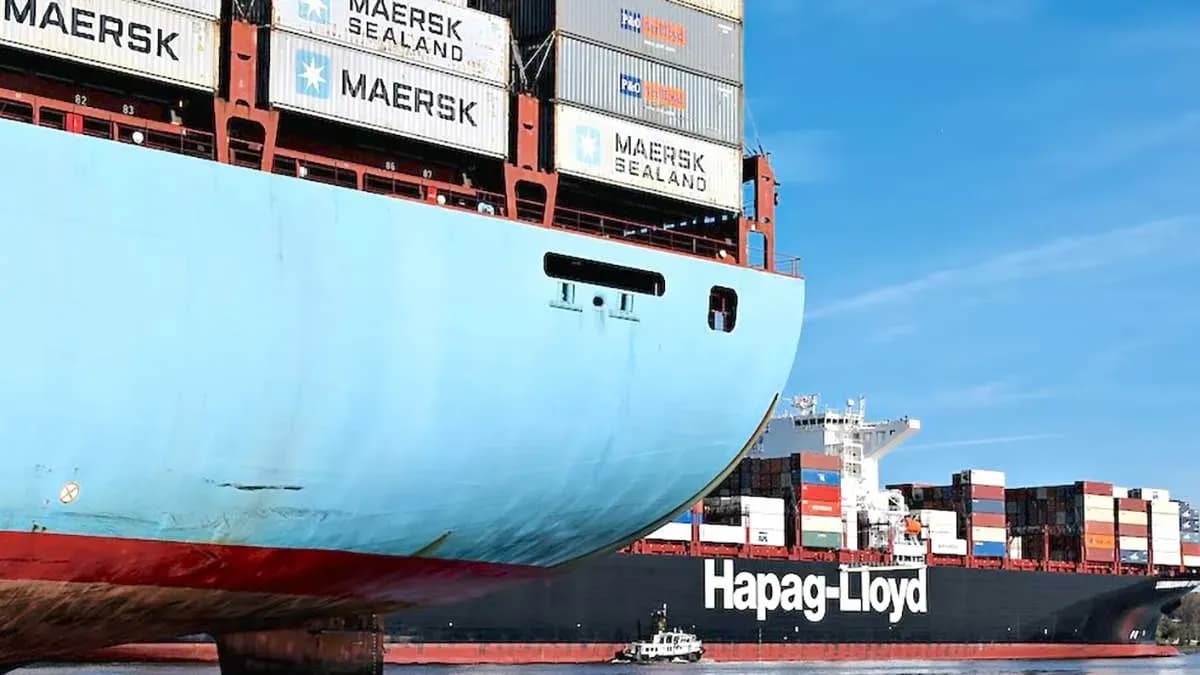
The Gemini alliance, formed by Maersk and Hapag-Lloyd, is recording a contraction of its market share in deployed capacity on the main trade routes from Asia, according to an analysis published by the consulting firm Sea-Intelligence in issue 756 of its publicationSunday Spotlight. The decline is concentrated on the Trans-Pacific and Asia-North Europe routes, and occurs in a context of strong global capacity expansion led by Ocean Alliance.
According to data from Sea-Intelligence, based on the eight-week moving average of deployed weekly capacity, Gemini shows a downward trajectory on the three main routes analyzed. On the Asia-West Coast North America route, Gemini's share will decrease from 15% in April 2025 to 13% in May 2026. On the Asia-East Coast North America route, the share reduces from 20% to 17% in the same period. And on the Asia-North Europe route, the contraction is from 27% to 23%. In all three cases, the decline is concentrated almost exclusively in a narrow window between mid-February and May 2026.
However, the Danish consulting firm's analysis clarifies that this loss of market share does not stem from a withdrawal of capacity by Gemini. The gross figures in TEUs show that the weekly deployed capacity by the alliance remains relatively stable on these routes. The drop in its relative share is, therefore, a direct consequence of the overall market deployment expansion, which, after the usual drop due to the Chinese New Year, is bouncing back rapidly. This expansion is predominantly being driven by Ocean Alliance, which is scheduling services close to maximum design capacity on these routes, with few canceled calls (blank sailings).
Sea-Intelligence points out that this divergence highlights two fundamentally different operational models. Ocean Alliance shows capacity growth accompanied by high weekly volatility, indicating a very elastic network architecture, capable of scaling its offer to absorb market volume expansion. Gemini, on the contrary, shows a low volatility profile. Its rigid deployment pattern indicates a synchronized and closed network that does not structurally flex to capture sudden demand spikes.
The result of these two approaches is a differentiated operational balance. Gemini offers a stable and predictable weekly capacity base, a coherent approach with the service model that Maersk and Hapag-Lloyd have defended since the launch of the alliance, focused on schedule reliability and regularity of calls. However, since that base remains fixed while competitors expand their offer, Gemini mathematically cedes relative market share.
The dynamics described by Sea-Intelligence occur at a time of intense competition in container shipping, where shipping alliances are reconfiguring their deployment strategies. Ocean Alliance, composed of CMA CGM, COSCO Shipping, and Evergreen, has opted to maximize the utilization of its fleet on the highest demand routes, allowing it to gain share at the expense of competitors with more conservative deployment models.
The underlying question raised by the analysis is whether the operational stability of Gemini can be sustained as a differentiated value proposition in a market where available capacity is growing rapidly, or if the alliance will be forced to adapt its deployment model to avoid losing commercial relevance on key trade routes between Asia and Western markets. So far, the data indicates that the alliance maintains its absolute volumes, but its relative weight in the market is progressively diluted as other operators expand their presence.