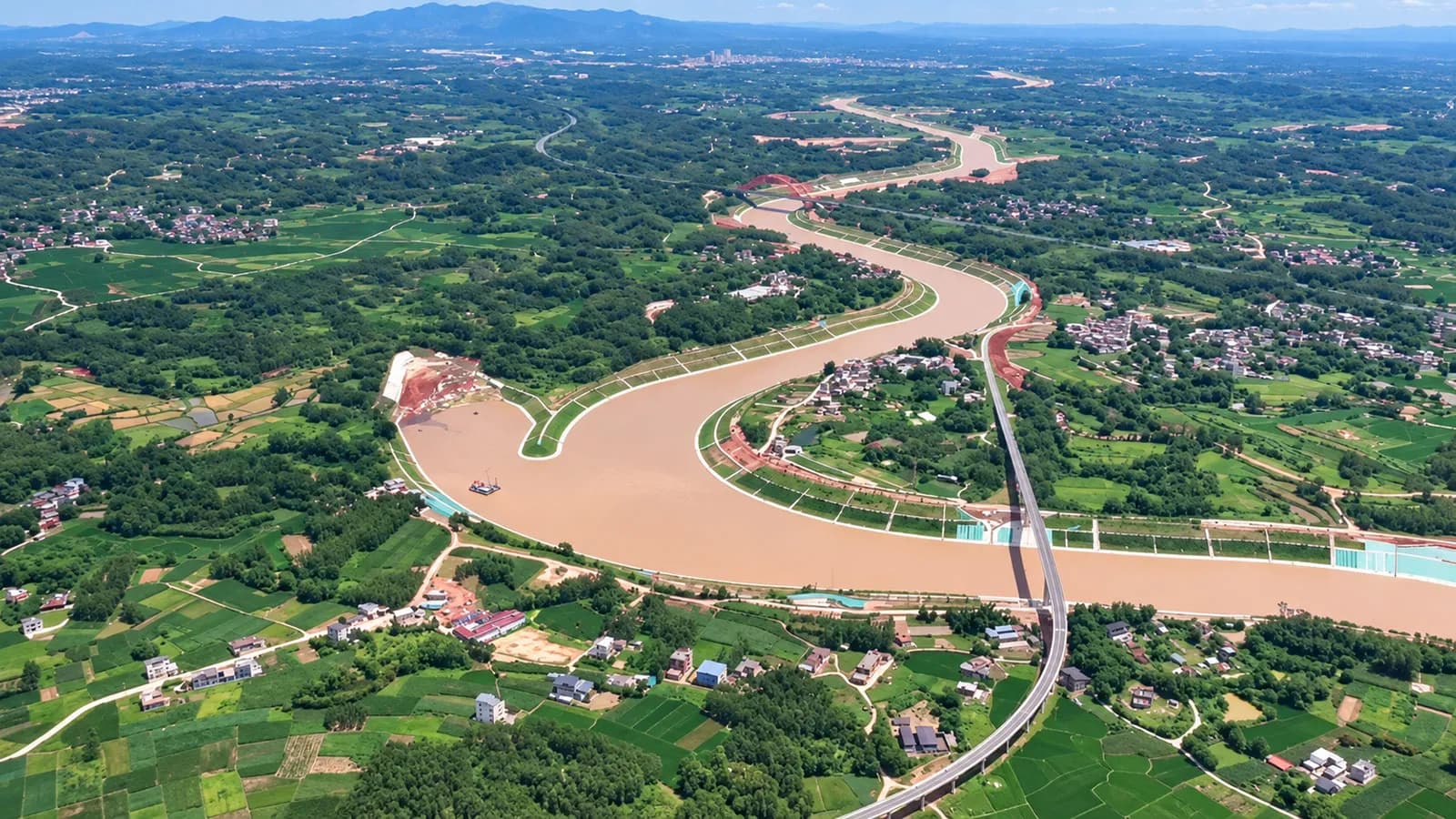
China has officially opened the Pinglu canal, a 134.2-kilometer infrastructure that establishes a new waterway connection between the southwestern provinces of the country and the Gulf of Tonkin. The project has involved an investment of 72.7 billion yuan, about 9.4 billion euros, and modifies the routes previously used to transport goods from the interior to the maritime routes of Southeast Asia.
This is the first arterial canal between a river and the sea built under a unified central coordination since the founding of the People's Republic of China in 1949. Its route connects the basins of the Pingtang and Qin rivers and allows for a reduction of more than 560 kilometers in transportation distances from the interior.
Until now, a significant portion of the river traffic from southwestern China followed the natural river systems eastward toward the Pearl River delta, which forced vessels to pass through Guangzhou before heading back to the western trade routes.
The new corridor provides an outlet to the south and is integrated into the so-called New International Land-Sea Trade Corridor, which connects productive areas of Yunnan, Guizhou, Sichuan, Chongqing, and Hunan with the markets of the Association of Southeast Asian Nations (ASEAN).
The project also gains relevant significance due to the volume of trade between the two regions. Bilateral trade between China and ASEAN countries reached 862.75 billion dollars, about 747.6 billion euros, during the first eight months of the year, with a year-on-year growth of 25.6%.
From an operational standpoint, the Pinglu canal is prepared to receive cargo ships of up to 5,000 tons deadweight. The infrastructure includes three large stepped lock systems, named Madao, Qishi, and Qingnian, which allow for a cumulative height difference of 65 meters along the route.
The construction has combined the excavation of new sections with the adaptation of existing natural channels. Of the total length of 134.2 kilometers, only 6.5 kilometers required more substantial excavation work through the watershed. The rest of the route uses natural river channels that have been dredged, widened, and straightened to allow for the expected navigation.
Economic estimates associated with the new infrastructure point to a reduction in transportation costs for goods. The Chinese Ministry of Transport estimates that the transfer of cargo to this waterway could decrease transportation expenses by 18% to 30%.
According to these forecasts, the annual savings in logistics costs could exceed 5 billion yuan, approximately 645 million euros.
The opening of the canal has been accompanied by the first commercial operations. Around 30 bulk carriers have used the new route to transport construction materials, coal, minerals, steel, and fertilizers.
Along with the start of these operations, a regular international connection has been put into service between Nanning and Can Tho in Vietnam. A national coastal service connected to the Yangpu Free Trade Zone in Hainan has also begun operating, in addition to the first of four planned links for passenger transport.
The use of the canal for the movement of industrial bulk goods will be conditioned by the functioning of the entire logistics chain. The competitiveness of door-to-door transport will depend on factors such as the capacity for handling goods on land, port transfer operations, and the frequency of hiring and circulation of vessels.
The availability of these services will also determine the degree of utilization of the capacities offered by the new infrastructure and its impact on the unit costs of transport.
The Pinglu canal is part of a broader program for the development of inland waterways in China. Other canal projects with investments of several billion yuan are currently under development in Jiangxi, Henan, Hubei, and Hunan.
With the commissioning of the new infrastructure, the productive areas of southwestern China have a shorter river route to the Gulf of Tonkin and maritime connections with Southeast Asia, while the first operations aimed at shifting some of the goods flows to the new corridor begin.