ECSA ranks Spain as the fourth European country by maritime revenue from the EU ETS
European Shipowners estimates for the first time the distribution by countries of the 9 billion that maritime transport contributes to the ETS, with Spain in fourth position.
Spain contributes up to 712 million euros annually to the European carbon market due to the inclusion of maritime transport in the emissions trading scheme (EU-ETS), the fourth highest figure among the 30 countries analyzed in a study by the European Shipowners Association (ECSA), which represents 21 shipping associations from the European Union and Norway. The report, titled "Maritime EU ETS: Shipping's contribution & national revenues," estimates for the first time the distribution by countries of the revenues generated by the sector and calls for a portion to be legally allocated to its energy transition.
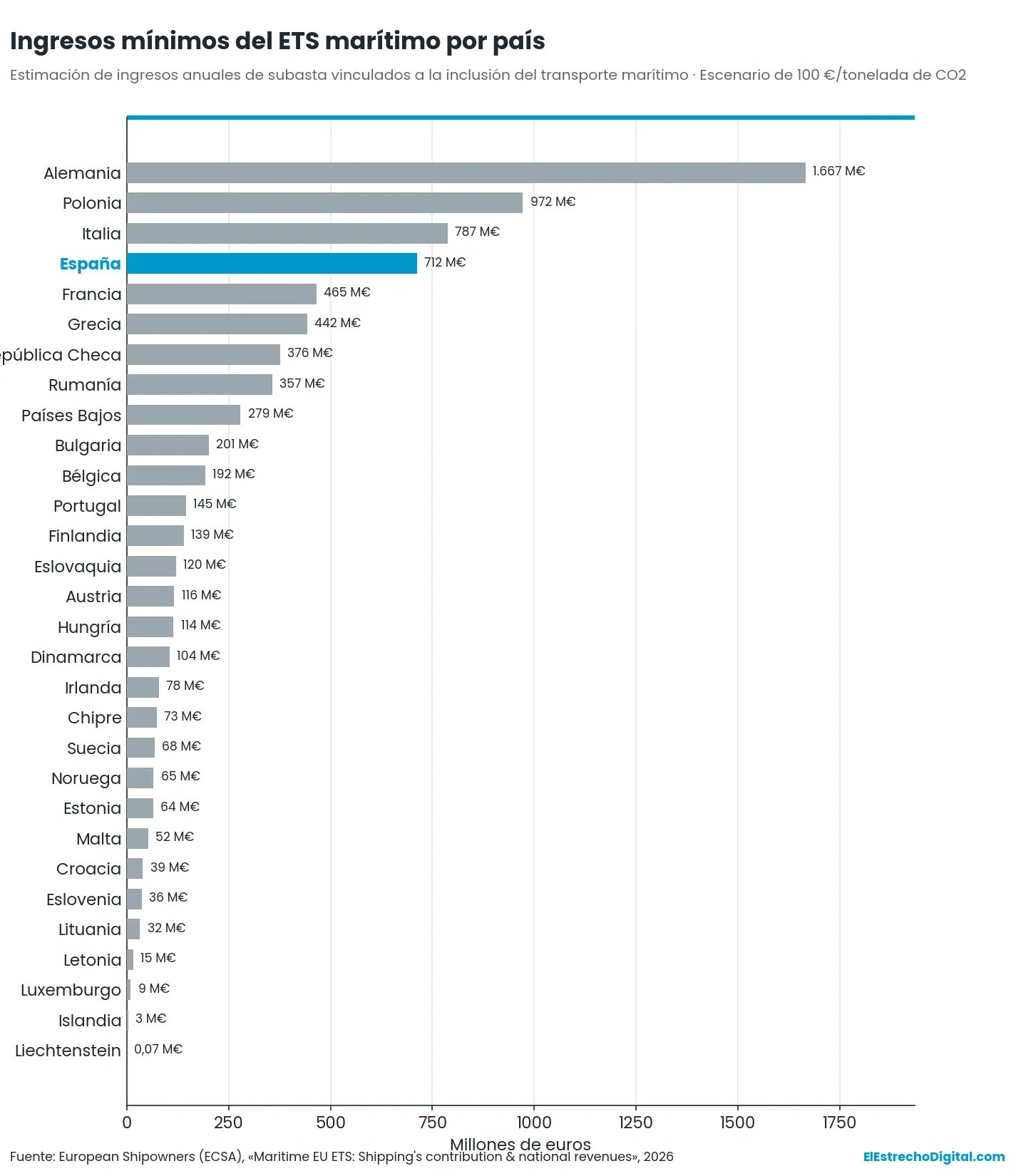
According to the study, if maritime transport had not been incorporated into the EU-ETS, Spain would have lost about 712 million euros annually in auction revenue in the reference scenario of 100 euros per ton of CO2, and 605 million in the lower scenario of 85 euros. This figure places Spain behind Germany, Poland, and Italy, while ahead of France and Greece, in a distribution that, the study itself emphasizes, does not reflect the actual maritime traffic of each country: it follows the existing General Distribution Key in the ETS, based on the historical emissions of fixed installations, now applied to the new rights generated by the inclusion of maritime transport.
At the European level, the sector contributes a total of up to 9 billion euros per year to the community and national coffers in the 100 euros per ton scenario, a figure that drops to 7.65 billion in the 85 euros scenario. From this total, the revenues that go directly to the budgets of EU Member States amount to 7.7 billion in the first scenario and 6.6 billion in the second; the rest is distributed among community funds such as the Innovation Fund and the Modernization Fund.
Maritime transport entered the EU-ETS on January 1, 2024. The system affects vessels of more than 5,000 gross tonnage (GT), regardless of their flag, that carry goods or passengers with calls at ports in the European Economic Area (EEA): it covers 100% of emissions on routes between two EEA ports and emissions produced while docked in port, and 50% on routes between an EEA port and one outside the area. Offshore vessels will be incorporated into the system on January 1, 2027, and from January 1, 2026, the maritime ETS also covers methane and nitrous oxide emissions, in addition to CO2. After a gradual implementation period — 40% of emissions in 2024 and 70% in 2025 — shipping companies must surrender rights for 100% of their emissions from the 2026 exercise. Unlike sectors such as steel, cement, chemicals, or aviation, maritime transport has never received free emission rights: each emitted ton must be covered with a right purchased in the market. According to the European Commission, shipping companies surrendered rights for more than 99% of their obligations for 2024 within the compliance deadline.
The lowest scenario of the study, at 85 euros per ton, includes a possible softening of the carbon market linked to the Commission's proposal to suspend the invalidation mechanism of the Market Stability Reserve, which would allow for maintaining rights as a cushion to give more stability and predictability to the price.
ECSA emphasizes that the contribution of shipping companies to the carbon market does not equate to the revenue each State receives, as companies buy their rights at auctions or in the open market, regardless of the country acting as the managing authority for each shipping company. In contrast, state revenues come from the auction of rights that the European Commission manages centrally through the European Energy Exchange (EEX) and assigns to each country according to that General Distribution Key of Annex I of Decision (EU) 2020/2166. Before reaching the States, a portion of those revenues is allocated to European funds: the rights specifically created by the expansion of the maritime scope — 2.37 million to cover methane and nitrous oxide in 2026, plus those added in 2027 with offshore vessels — go to the Innovation Fund, which in turn reserves 20 million rights for maritime decarbonization projects across the entire period of 2024-2030. This is complemented by an additional distribution — 3.5% of the additional rights granted due to the inclusion of maritime transport, calculated based on the 78.4 million rights added in 2024 — reserved for countries with the greatest administrative burden in managing the maritime ETS, which in 2026 amounts to about 2.5 million rights. The study itself warns that, overall, its country figures are a minimum estimate and not an exact accounting, as the Commission does not publish the complete details of its auction schedules.
With that caveat, the breakdown — covering the 27 EU Member States plus Norway, Iceland, and Liechtenstein — places Germany at the top, with 1.667 billion euros in the 100 euros per ton scenario (1.417 billion in the 85 euros scenario), followed by Poland (972 and 827 million), Italy (787 and 669 million), and Spain (712 and 605 million). Behind are France (465 and 387 million), Greece (442 and 375 million), Czech Republic (376 and 319 million), Romania (357 and 303 million), Netherlands (279 and 237 million), and Bulgaria (201 and 171 million). At the opposite end of the table are Luxembourg (9 million), Iceland (3.25 million), and Liechtenstein (70,000 euros).
The study warns that these revenues are hardly reinvested in the decarbonization of the sector. According to the European Commission's 2025 Carbon Market Report, Member States allocated in 2024 only about 5% of their national revenues from the ETS to industrial decarbonization, despite the legal obligation, set out in Article 10(3) of the ETS directive, to use those revenues for the energy transition, including maritime decarbonization. That report does not distinguish the portion corresponding to maritime transport, but according to ECSA, most countries have not set aside a specific portion of their ETS revenues for the shipping sector; France and Estonia are, according to the study, the only exceptions that have done so.
Looking ahead to the next ETS cycle, between 2031 and 2040, the study estimates that maritime transport will contribute a cumulative 90 billion euros, equivalent to the surrender of 900 million emission rights. The European Commission is preparing for this July the review of the EU-ETS directive, which will set the framework for that period. ECSA suggests that this review include the legal obligation for Member States to allocate part of their ETS revenues to the availability of sustainable fuels and clean technologies for the sector.
The study notes that sustainable marine fuels cost on average four times more than conventional fuels, and estimates the annual investment needs for the energy transition of maritime transport in Europe at around 40 billion euros. According to industry data, European shipping companies hold 44% of the global order book for vessels powered by sustainable fuels, while Europe produces only 10% of those fuels on a global scale — less than 5% for maritime use — compared to 74% of production projects concentrated in Asia.
"Our new analysis shows that maritime transport contributes up to 9 billion euros annually to European and national budgets. We need these revenues to be invested in the sector's energy transition. The upcoming review of the EU-ETS, planned for July, is an opportunity to demand that Member States use that money nationally to reduce the price difference and support the availability of sustainable fuels and clean technology projects," says European Shipowners in its statement.
The directive review, scheduled for this July, will determine whether the revenue distribution model of the maritime ETS changes before the next cycle of the regime begins in 2031.
Newsletter
The maritime briefing, every morning at 8:00
Ports, logistics and shipping essentials in your inbox, Monday to Friday, before the day starts.