Ports of the State and 19 Spanish port authorities participate this week in Breakbulk Europe Rotterdam, the main European fair dedicated to project cargo and breakbulk goods. The Spanish port system attends the meeting, which takes place from June 16 to 18, with the aim of presenting its operational, logistical and infrastructural capacities for handling, storage, assembly and transport of special loads.
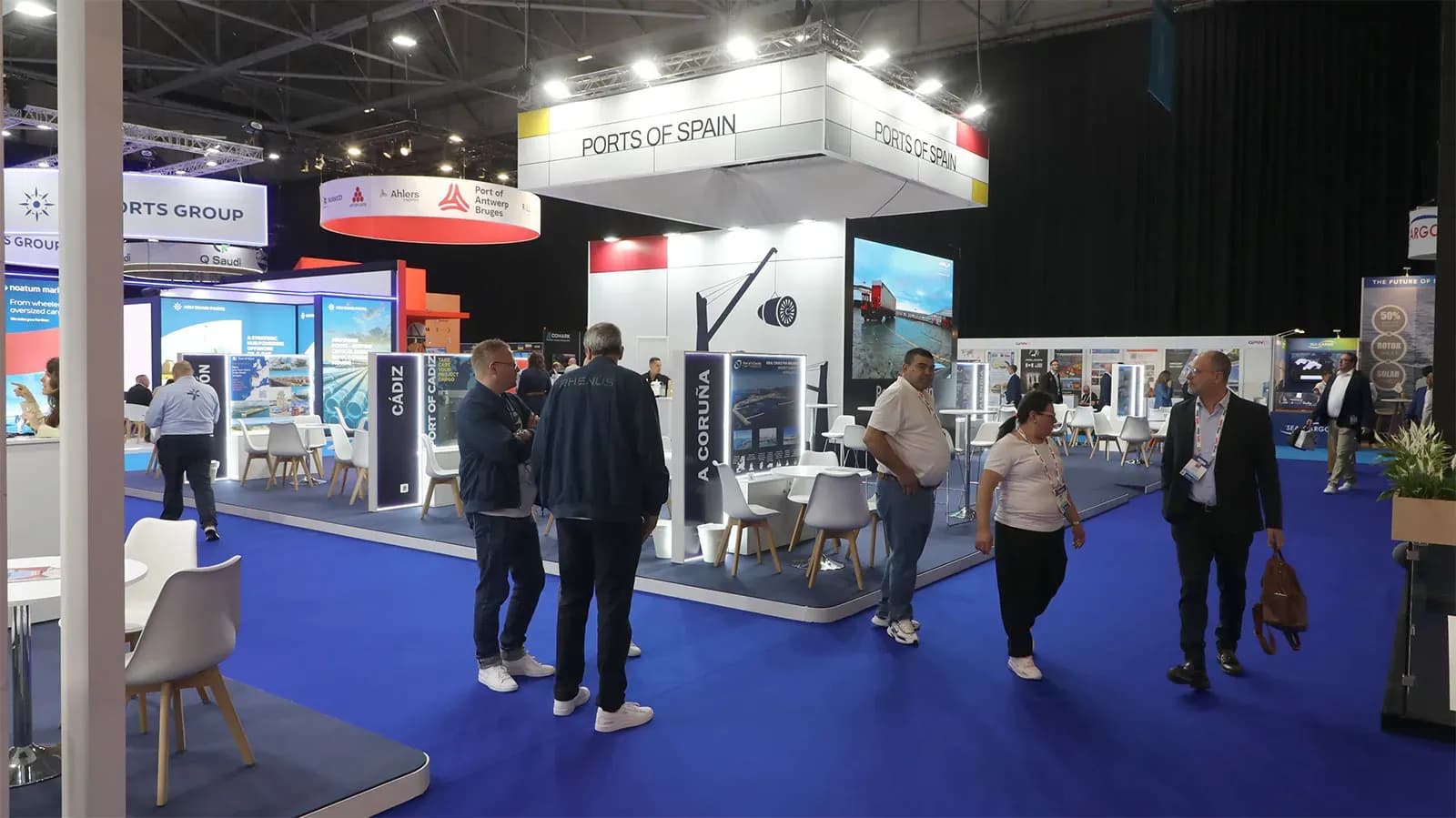
The Spanish presence is articulated through the Ports of Spain stand, in which the Port Authorities of A Coruña, Avilés, Algeciras Bay, Cádiz Bay, Cartagena, Castellón, Gijón, Huelva, Las Palmas, Motril, Santander, Santa Cruz de Tenerife, Sevilla, Tarragona, Valencia, Vigo, Almería, Barcelona and Ceuta participate. Under the slogan "Together Forward. Special ports for special loads", the space has 216 square meters allocated for professional meetings with shipping companies, logistics operators, freight forwarders, shippers and companies linked to project cargo.
During the fair, Spanish ports present their role as specialized nodes within international supply chains and as strategic connection points with the Trans-European Transport Networks. Project cargo requires specific infrastructures, ample operational surfaces, adequate drafts, prepared accesses and adapted handling equipment, due to the fact that these are goods that, due to their dimensions, weight or characteristics, cannot be transported in standard containers.
Among the sectors with the greatest activity associated with this type of traffic are renewable energies, especially onshore and offshore wind. Spanish ports have oriented part of their facilities to the operation of components such as blades, towers, gondolas, foundations and other oversized elements used in wind turbines. The versatility of docks, yards and port services has positioned various Spanish locations as alternatives for temporary storage, pre-assembly and dispatch of these materials to national and international projects.
Participation in Breakbulk Europe occurs in a context of growth in maritime traffic linked to clean energies and adaptation of port infrastructures to the needs of new industrial sectors. In this context, the Port EOL-Mar call is underway, a public aid program from the Institute for Diversification and Energy Saving, IDAE, integrated into the Recovery Plan. This line aims to support the adaptation of docks, yards, accesses, drafts and other port infrastructures to facilitate the deployment of offshore renewable energies, with special attention to offshore wind.
Ports of the State emphasizes that the Spanish port system is part of the European supply chain and has a network of infrastructures ready to handle highly complex technical traffic. Overall, Spanish ports have more than 395 kilometers of docks, of which 65 kilometers are dedicated to bulk, 47 kilometers correspond to multipurpose docks and 18 kilometers are dedicated to ro-ro traffic.
These assets allow for the handling of different types of special cargo, from industrial components and heavy machinery to pieces related to energy projects, capital goods or large-tonnage structures. The availability of operational surfaces, along with maritime and land connectivity, is one of the factors that Spanish ports communicate to the operators present in Rotterdam.
Breakbulk Europe brings together more than 11,400 professionals from 120 countries and around 700 exhibitors. The event functions as a point of contact between ports, shipping companies, logistics operators, engineering firms, industrial shippers, specialized transport companies and companies linked to large infrastructure, energy, construction and industrial manufacturing projects.
The coordinated presence of Ports of the State and the 19 port authorities allows for a joint offer of the Spanish port system, while each location presents its own capacities according to its location, specialization, connectivity, available surfaces and experience in project cargo. This strategy aims to attract high added value traffic and strengthen relationships with international operators requiring logistics solutions adapted to non-standardized goods.
In 2025, traffic through Spanish ports surpassed 556 million tons. Of that volume, 88 million corresponded to conventional general cargo and 262.3 million to liquid and solid bulk. Additionally, more than 40% of Spanish port traffic had European origin or destination, a figure that positions national ports within the main maritime and logistics corridors of the continent.
Participation in Breakbulk Europe Rotterdam allows the Spanish port system to present its capacity to handle operations linked to complex industrial sectors, with a special focus on energy projects, oversized cargo and breakbulk traffic. The combination of infrastructure, connectivity and operational experience constitutes the core of the offer that Ports of Spain conveys during these days to the international special cargo market.