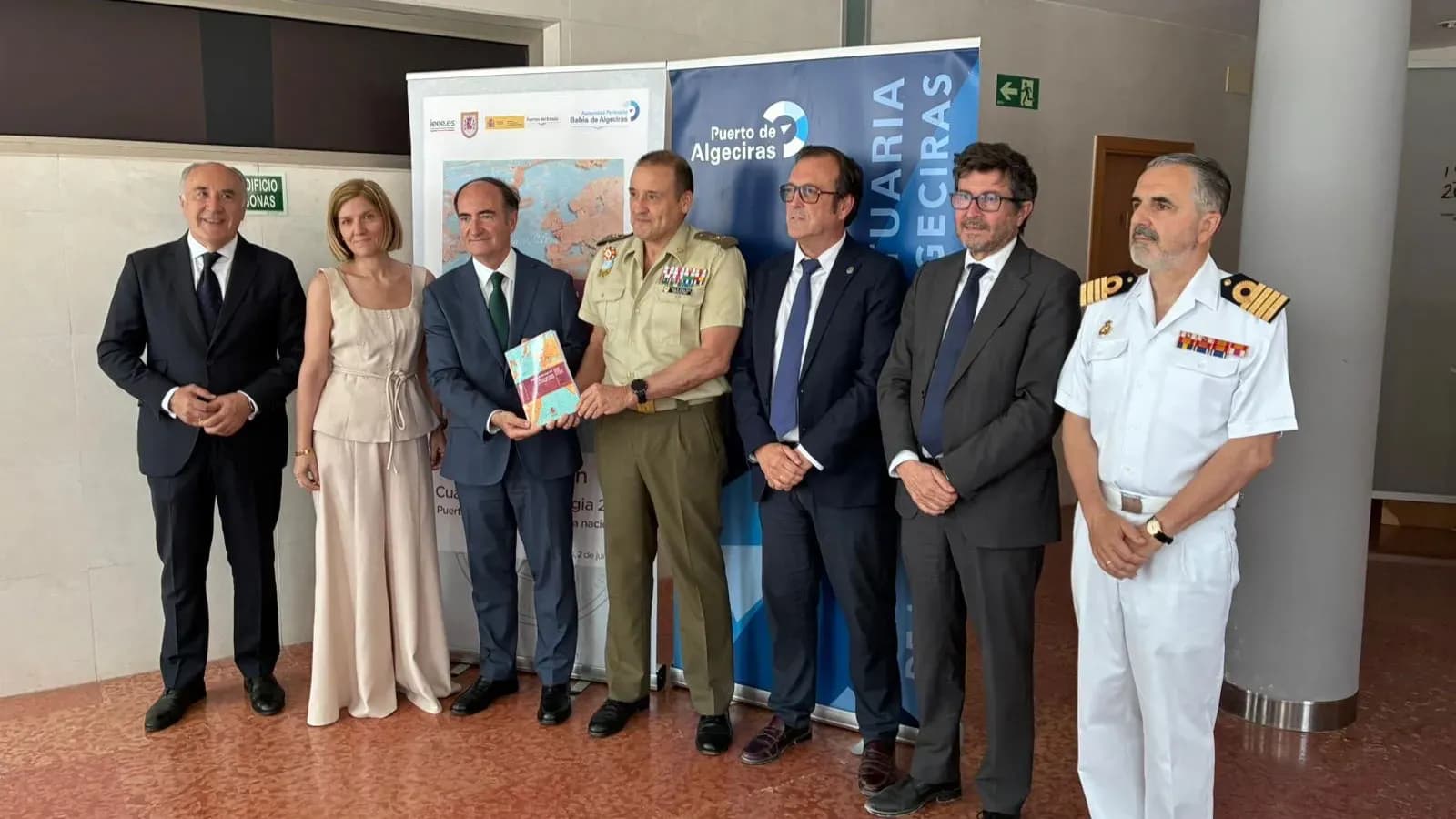
The Millán Picazo auditorium of the Port Authority of the Bay of Algeciras (APBA) has hosted the presentation of the Strategy Notebook 234, titled "State Ports and National Defense," a publication of the Spanish Institute of Strategic Studies (IEEE), dependent on the Higher Center for National Defense Studies (CESEDEN). The event was led by Brigadier General Víctor Mario Bados, director of the IEEE, and Álvaro Rodríguez Dapena, deputy director of Strategy and Business Development of State Ports and coordinator of the work. As host and author of one of the chapters, the president of the APBA, Gerardo Landaluce, intervened.
Landaluce thanked the authors and the IEEE for the assistance provided to move forward with the publication and emphasized the collective nature of a volume that brings together seven contributions. "The port, as you know, increasingly occupies a larger space in what is the field of society and the economy," indicated the president of the APBA, who added that port activity encompasses "not only economic issues, energy issues, and clearly security issues, both physical security and military security." The president of the APBA explained that the work has been approached "with great enthusiasm, with much excitement" under the coordination of Rodríguez Dapena.
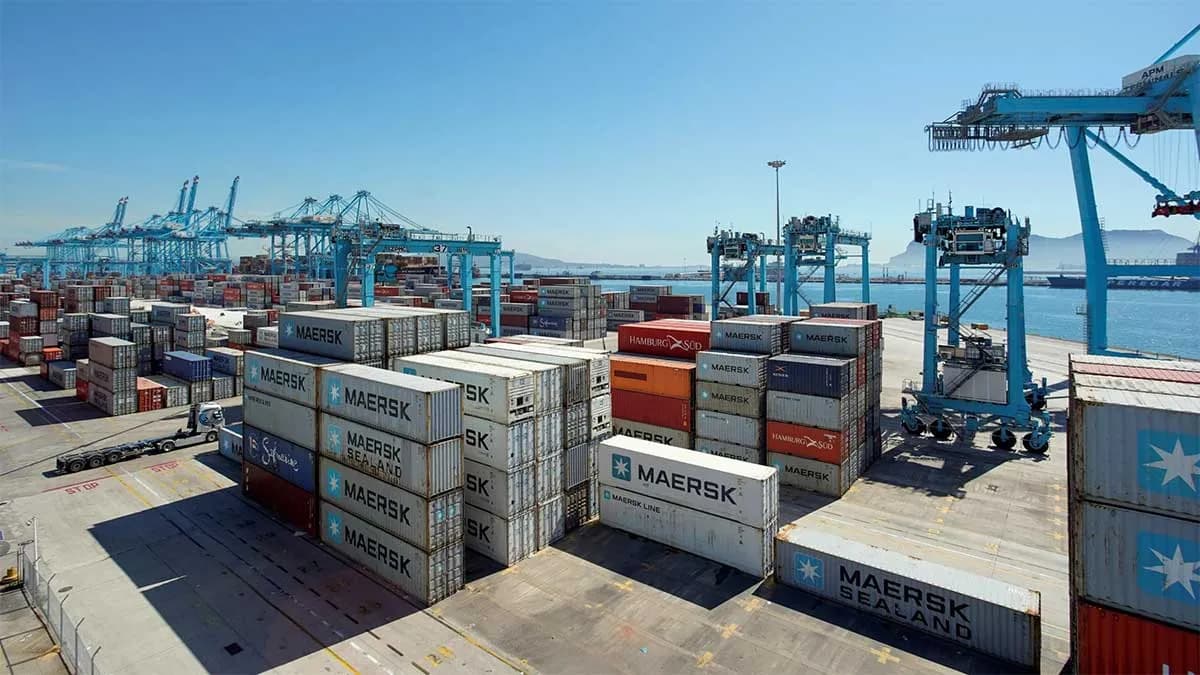
The chapter signed by Landaluce, titled "The Strait of Gibraltar. Strategic Point for National Defense," starts from a fact that situates the dimension of the analysis: 80% of global commercial exchanges are conducted by sea, and the Strait of Gibraltar, with 130,000 vessels per year, is the second global maritime highway, only surpassed by the English Channel. The crossing concentrates more than 300 vessels daily in a corridor of barely 14 kilometers wide and registers five times more traffic than the Suez Canal and eleven times more than Panama. The text defines the Strait as a first-order strategic asset for Spain, the European Union, and NATO, and positions the port of the Bay of Algeciras as a global maritime node with zero deviation on the east-west route.round the world and as a bridge between Europe and Africa.
The chapter describes the concentration of shipping power — five companies control more than 60% of the global container market, and the top ten reach 80% — and the transition from the "port-to-port" model to the "door-to-door" model, with examples like the entry of COSCO into Piraeus or the recent pressure on the Panamanian concessions of CK Hutchison Holdings. In the face of this scenario, Landaluce presents the dual strategy of the European Union: defensive, through the mechanism of control of foreign direct investment, and proactive, articulated through the Europe Global Gateway initiative, in which the Port of Algeciras participates with the green and digital maritime corridor with Panama and a digital interoperability project with the Central American Digital Trade Platform. The chapter also dedicates an extensive section to the impact of the Maritime Emissions Trading System (ETS), with six identified negative impacts — competitive inequality, carbon leakage, loss of investment, loss of connectivity, weakening of the fight against drug trafficking, and erosion of European logistical sovereignty — and proposes measures such as expanding the list of "transparent" ports and the Carbon Leakage Observatory promoted by State Ports along with Algeciras, Barcelona, and Valencia. The text calls for a specific state policy for the Gibraltar area, with the creation of a Special Economic Zone in the Campo de Gibraltar, better land connections, and effective civil-military coordination.
For his part, Rodríguez Dapena, who has excused the absence of the president of State Ports, Gustavo Santana Hernández, has framed the notebook in the need for greater coordination between the civil and military bodies in the port sector, particularly in ports of general interest. The deputy director of Strategy and Business Development has recalled that in the field of the security or protection, port administrations have been working with the Civil Guard and the National Police for years, through the port protection plans of the Ministry of the Interior, but has pointed out that the evolution of risks on a global scale, many of them against national sovereignty, requires tightening cooperation with the military body as well. "These are first-order strategic assets, and among them, in Spain, of course, is the Port of Algeciras," he noted.
Rodríguez Dapena has defined the notebook as "a space for understanding between military capabilities and port capabilities" aimed at improving two fundamental planes: the infrastructure plane, associated with the need to fit military and civilian mobility promoted by European institutions, and an operational and strategic plane, focused on incorporating coordination with the military body into port plans, from recognizing the risk map to adopting specific measures in the face of crisis, conflict, or deterrence scenarios.
The preliminary chapter of the work, also signed by Rodríguez Dapena, is titled "The Importance of the General Interest Port System for National Defense" and develops those two planes along three axes of joint action in ports: the infrastructure plane, aimed at ensuring capacity for military land and naval mobility in the face of mass deployments, paying attention to the current bottlenecks in rail and intermodal connections; the service provision plane, which includes berthing, fuel supply, repair, waste management, and attention to crews and military material; and the info-structure plane, with the integration of Defense into port digital platforms (Port Community Systems) and cooperation in cybersecurity. The chapter proposes articulating these actions through a national port action unit based in State Ports, with coordination between the Ministries of Transport and Sustainable Mobility, Interior, and Defense.
The notebook opens with a letter from the president of State Ports, Gustavo Santana Hernández, which contextualizes the publication in the National Maritime Security Strategy of 2024, where hybrid threats are listed as a central risk: cyberattacks, disinformation campaigns, terrorism, radicalization, illicit trafficking, and provoked marine pollution episodes. The letter places the work in relation to European Regulation 2024/1679, which incorporates the civil-military duality into the Trans-European Transport Network and obliges ports to guarantee both the mobility of passengers and goods as well as the rapid movement of personnel, material, and military equipment.
The publication brings together a broad vision of the relationship between ports, security, and defense. The publication is based on the idea that commercial ports are not merely logistical nodes, but necessary infrastructures for economic continuity, supply, the mobility of people, connectivity of extrapeninsular territories, and the state's response to risk situations. The work also incorporates the evolution of international and European regulations, from the protection of vessels and port facilities after the attacks of September 11, 2001, to the inclusion of military mobility in the Trans-European Transport Network.
The content is structured in seven chapters, in addition to the initial letter from the president of State Ports and the preliminary chapter. The work addresses an international perspective on the importance of ports for national defense, port governance as a key element, the role of the Navy in maritime security, the defense of extrapeninsular territories and their ports, the function of naval commands, choke points, and global geostrategy, and the specific case of the Strait of Gibraltar.
One of the main axes of the document is the adaptation of ports to a scenario of hybrid threats. The publication includes risks such as cyberattacks, sabotage, disinformation, terrorism, illicit trafficking, provoked marine pollution, and possible actions against critical infrastructures. In this context, the Notebook raises the need for stable cooperation between State Ports, port authorities, the Ministry of Transport and Sustainable Mobility, the Ministry of the Interior, and the Ministry of Defense, in order to integrate civil and military capacities in the protection of the port system.
The presentation in Algeciras has allowed linking the content of the Notebook with an enclave where international trade, maritime connectivity, logistical activity, energy transit, and security converge. The Port of Algeciras appears in the publication as a particularly relevant node due to its location next to the Strait, its function in global supply chains, and its ability to meet civil and military needs in a geostrategic environment of high sensitivity.