The EU-ETS Observatory confirms the loss of connectivity of European ports compared to the hubs of neighboring countries
The full report details the decline of transshipment in Algeciras, which falls from 5.2 to 4.6 million TEUs, while Tangier Med retains its entire volume
The Observatory launched by Port Authority of Spain to measure the impact of the European emissions trading scheme (EU-ETS) on maritime transport has published its second results, confirming the trend identified in the first report: the ports of the European Union are losing connectivity in long-distance container traffic compared to the ports of neighboring countries not subject to community environmental regulation. The measurement is carried out through the TEU-mile parameter, which combines the capacity of the ships calling at each port with the distance traveled.
The new report extends the analysis period from 2023 to March 2026 and incorporates two methodological innovations: tracking not only the ships but also the containers themselves, allowing assessment of what happens to the cargo when it reaches ports outside the EU, and for the first time analyzing ro-ro traffic between Spain and Italy. The detailed data reveal a drop in direct connectivity of five percentage points in northern Europe and 18 points in the eastern Mediterranean, from 68% to 50% of long-distance imports delivered directly.
The case study of the western Mediterranean, the Algeciras basin, presents a dual diagnosis. On the aggregate level, the region benefited most from route diversions around the Cape of Good Hope after the Red Sea crisis: long-distance transport work grew by approximately 76% as traffic from Asia, India, and the Middle East shifted towards the Strait of Gibraltar, and community ports maintained about 60% of deep-sea TEU-miles during the entire period, with direct connectivity even improving from 69% to 73%. Spain is also the first access country of the basin, with a share rising from 44% in 2022 to 47% in 2026, compared to Morocco's drop from 41% to 38%.
The deterioration is concentrated in the transshipment market, and there Algeciras is the most exposed port. The report notes that transshipment at the Algeciras dock has fallen from 5.2 to 4.6 million TEUs from its recent highs, and the pure replacement segment — transshipment whose cargo has no origin or destination in the region — has been halved as a proportion of its transshipment mix. The Suez crisis contracted that replacement market in the entire basin from 1.87 to 1.33 million quarterly TEUs, and the contraction almost entirely weighed on community ports: their replacement share dropped from 51% to 26%, with Algeciras, which was the largest replacement hub in the EU at the beginning of the period, yielding the most. Tangier Med, located opposite it in the same Strait and occupying the same position in the route diverted by the Cape, did not regress at all. The conclusion of the Observatory is literal at this point: geography cannot separate the two ports; the cost of the ETS for a replacement call on the European shore can.
The case that quantifies this mechanism is Maersk's MECL service, which connects the east coast of the United States with the Middle East and India and historically called at Algeciras in both directions as a European replacement hub. The Red Sea crisis, by forcing the route around the Cape of Good Hope, doubled the service's exposure to the ETS to €33 million annually and triggered a rapid reconfiguration: by the end of 2024, the westward call was moved from Algeciras to Tangier Med, thus reducing the cost by half, and in 2025 the eastward leg began operating directly and the remaining call was eliminated. The service was neither split nor interrupted: it maintained its traffic and frequency and was limited to relocating its exchange point, eliminating between €16 and €33 million annually of ETS cost without operational friction cost. In terms of shipping companies, the growth of the basin is concentrated in Maersk, which doubled its volumes both in Tangier Med and Algeciras, and in Hapag-Lloyd, which quadrupled its operations at the Moroccan port, while CMA CGM and MSC lost relative weight.
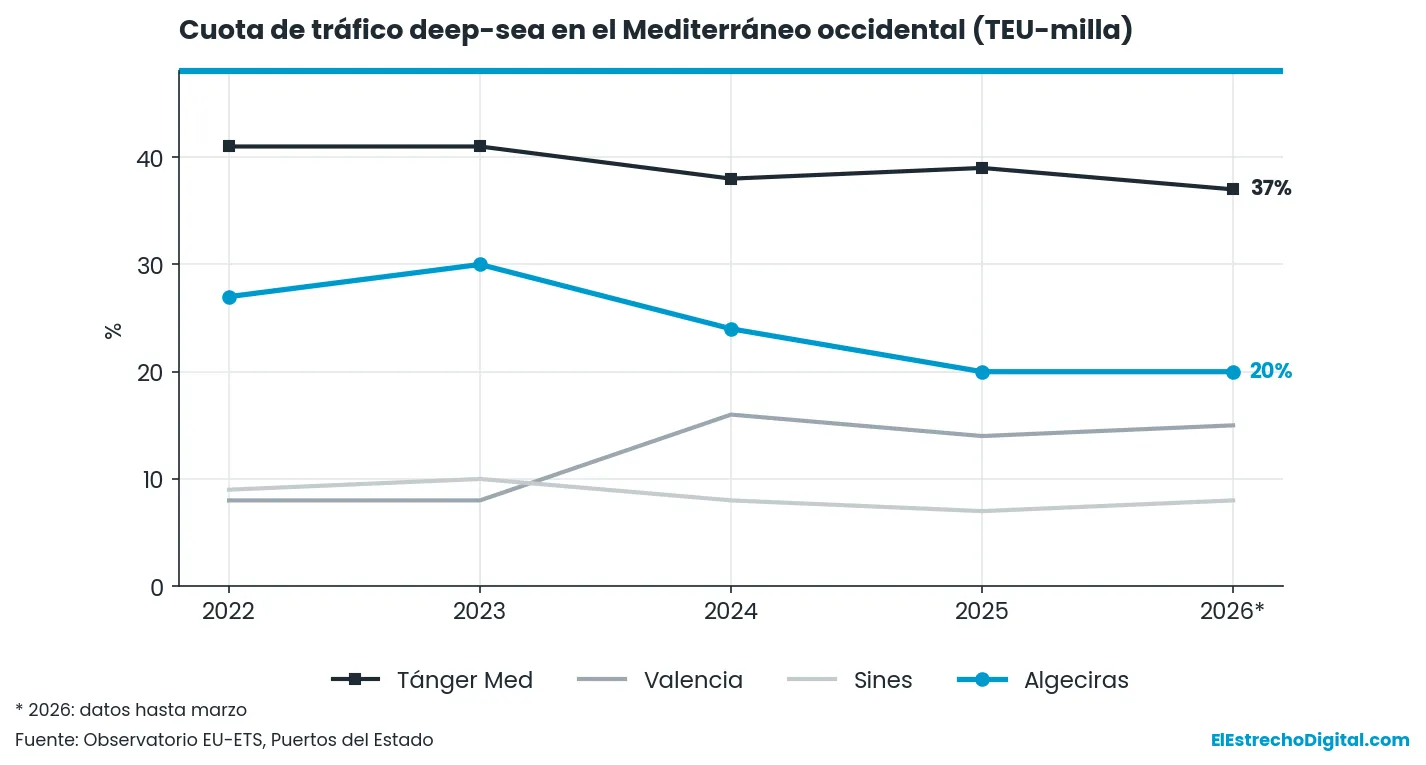
The attribution analysis dismisses alternative explanations. The Moroccan economic growth (between 3.7% and 4.6% annually in 2023-2025) is an insufficient order of magnitude to justify the 64% increase in the volumes of Tangier Med; there is no evidence of cost reduction in handling or port tariffs at the Moroccan port compared to its community competitors; and congestion does not explain the diversion, since Algeciras operates below its highs and Valencia absorbed a tripling of its import and export traffic in the same window. What coincided in time was the entry into production of new capacity on the southern shore: successive expansions of the TC4 terminal at Tangier Med added three million TEUs annually between 2023 and 2025, and expansion continues with the Nador West Med complex — three terminals between 2026 and 2029, largely linked to shipping companies through TIL-MSC and CMA CGM — and the new Atlantic port of Dakhla. In the ranking of gateway ports in the basin, Tangier Med retains the lead with 37% in 2026, Algeciras falls from 27% to 20%, and Valencia rises from 8% to 15%. On the community side of the investment balance, the first phase of the expansion of TTI Algeciras in Isla Verde appears, with €150 million and half a million TEUs annually projected for 2028.
In the overall Euromed region, the report quantifies the capacity of terminals committed between 2021 and 2030 at €14.9 billion and 41.7 million TEUs, with an asymmetric distribution: €9.3 billion and 25.7 million TEUs, 62% of the projected growth, are located in non-community docks, despite those ports only concentrating around 30% of import and export activity of containers. In the ro-ro corridor between Spain and Italy, the share of maritime transport compared to road has dropped from 49.4% in 2023 to an estimated 44.5% in 2025, a decrease that the analysis considers statistically significant. The Observatory has also implemented a prediction service to anticipate route reconfigurations, already operational in the four main Spanish ports — Barcelona, Valencia, Algeciras, and Las Palmas — in the at-risk northern European ports and in Piraeus and Marsaxlokk, with a planned extension to all exposed European ports.
The publication coincides with the draft amendment to the ETS directive presented by the European Commission on July 17, which recognizes the need to adjust the mechanism to avoid unintended effects on competitiveness and maritime connectivity, in line with the Observatory's conclusions. Among the proposed measures is the expansion of the designation criterion for "neighboring transshipment ports," based on connectivity measured in TEU-miles, and a discount factor on emissions subject to the purchase of rights, proportional to the distance traveled and the size of ships, aimed at disincentivizing the fragmentation of deep-sea routes.
The Observatory, promoted by Port Authority of Spain and developed by the consortium formed by Shipping Business Consultant (SBC), the Transport Innovation Center (CENIT), and Nextport, has the mission of detecting possible carbon leaks and traffic disruptions in ports subject to the EU-ETS, and its results can be consulted on the agency's website. With the review of the directive already underway in Brussels, the pulse between the two shores of the Strait offers the clearest measure of what is at stake: two ports with the same geography and equivalent positions in the network, separated only by the perimeter of application of the emissions rights system.