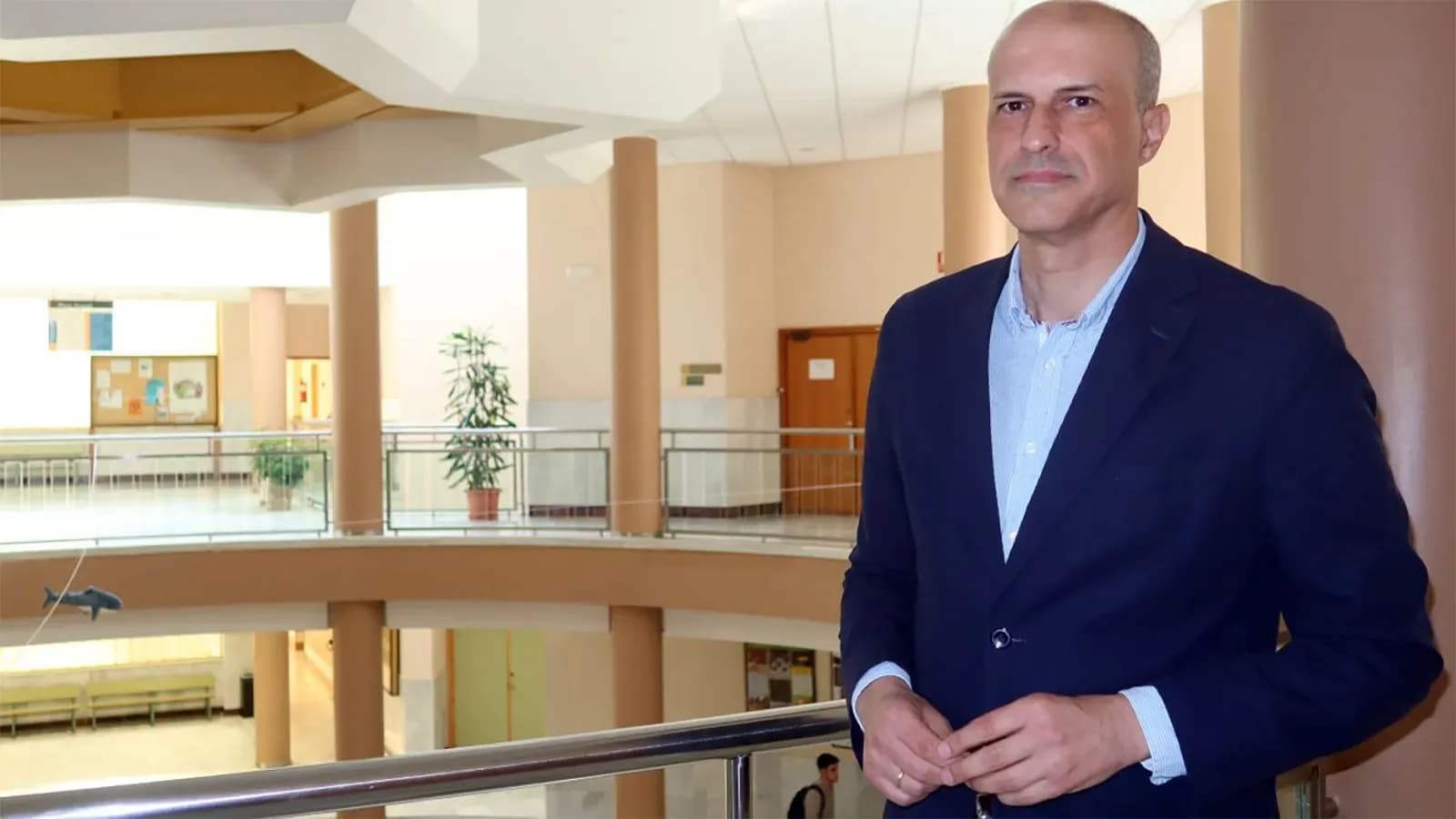
Víctor Jiménez sees at the University of Cádiz a model of connection between maritime research and the real needs of the environment.

Víctor Jiménez, a graduate of the University of Cádiz, defends in an interview granted to UCA the model of collaboration between administration, business, and academia.

Víctor Jiménez en la Universidad de Cádiz (Foto: UCA)
Add us as a preferred source on Google

Víctor Jiménez, from Algeciras and president of the Council of the International Maritime Organization (IMO), considers that the proximity to the Strait of Gibraltar constitutes a top educational asset for those studying nautical studies at the University of Cádiz (UCA), an institution to which he is still linked as a graduate teacher more than two decades after graduating from it. He explains this in an interview granted to the University of Cádiz where he reviews the role of the specialized United Nations agency that he presides over, the situation of maritime education in the province, and Spain's position in a changing international scenario.

Jiménez, who studied Nautical and Maritime Transport at UCA, attributes to that formative stage "practically everything" in the background with which he has developed his professional career. He considers that the degree provided him with a solid foundation and a set of key competencies for his career in the maritime sector, and he declares himself "very satisfied" and "very proud" to be a graduate of the Cádiz Nautical Faculty. In his view, the institution maintains a commendable level in these studies, as evidenced by the number of enrolled students and the associated job opportunities. In his professional environment, he claims to know no graduate who expresses dissatisfaction with the academic choice made.

The president of the IMO Council has been collaborating with the University of Cádiz for more than twenty years. He began teaching classes in the Master's in Port Management and Logistics in 2004 and has since maintained a continuous relationship with the center. He believes that students especially appreciate the contact with real experiences and with the vision of someone who works in an international environment like that of the International Maritime Organization itself, which brings a direct practical translation to the theoretical contents.

Asked in the interview about the importance of strategic maritime corridors, amid the public debate that the conflicts in the context of the Strait of Ormuz have raised in recent months, Jiménez recalls that Spain occupies a privileged position from a maritime point of view and that the province of Cádiz, with the Strait of Gibraltar as an immediate reference, constitutes an exceptional scenario for understanding the operation of the sector. "It is a permanent source of knowledge, experience, and opportunities for both professionals and students," he points out. The proximity of this maritime passage, integrated into the daily academic and professional life of the area, helps, in his opinion, to acquire a broad perspective both of the problems it entails and of the opportunities it offers and of the specialization its management requires.


Regarding Spain's capacity to face the maritime challenges arising from a volatile international context, the president of the IMO Council expresses his conviction that the country is prepared. He believes that Spain has first-rate maritime capabilities and a maritime administration sufficiently qualified to respond to both current challenges and those that may arise in complex scenarios. In his opinion, the combination of highly qualified professionals and a tradition linked to the sea allows for facing these challenges with guarantees.

In the part of the interview dedicated to the International Maritime Organization itself, Jiménez defines it as the global maritime authority in a functional sense: the specialized United Nations agency responsible for developing and enforcing the standards that govern international maritime transport. Its area of action covers maritime safety, marine environment protection, and international trade facilitation, and its function is to set the regulatory framework that allows maritime transport to operate safely and efficiently worldwide. The IMO ultimately seeks consensus among member states for the regulation of the sector.

The model of relationship that the University of Cádiz maintains with administrations, businesses, professional groups, and the Navy itself constitutes, according to Jiménez, an exportable scheme to other territories. Collaboration between the public, private, and academic spheres seems fundamental to the development of the maritime sector, as this transversal relationship facilitates knowledge sharing, generating solutions, and responding to emerging challenges. He believes it is a model present in numerous places around the world and particularly valuable in territories like Cádiz, where the sea is part of the economic, social, and academic identity. The UCA appears, in his analysis, as an example of capacity to connect research and training with the real needs of the environment.

The conversation, broadcast by the University of Cádiz itself, reveals two complementary planes: that of the institutional head of the IMO Council, who positions the agency as a key piece in the regulatory framework of international maritime transport, and that of the teacher who maintains a stable link with the public university of Cádiz. Both perspectives converge in the assessment of the Strait of Gibraltar as a training and professional space, and in that of the academic-professional fabric of the province as an ecosystem from which to address regulation, safety, and sustainability of maritime transport in a geopolitical context marked by uncertainty.

- A D V E R T I S I N G -

Share

Related content

You may also be interested in

NEXT TOTAL SOLAR ECLIPSEAugust 2, 2027

Totality returns to the Strait of Gibraltar

In less than a year, the Moon's shadow will sweep across southern Spain with over 4 minutes of total darkness over Algeciras, Tarifa, and Gibraltar.

---Days
--Hours
--Mins
--Secs
Explore Eclipse Special