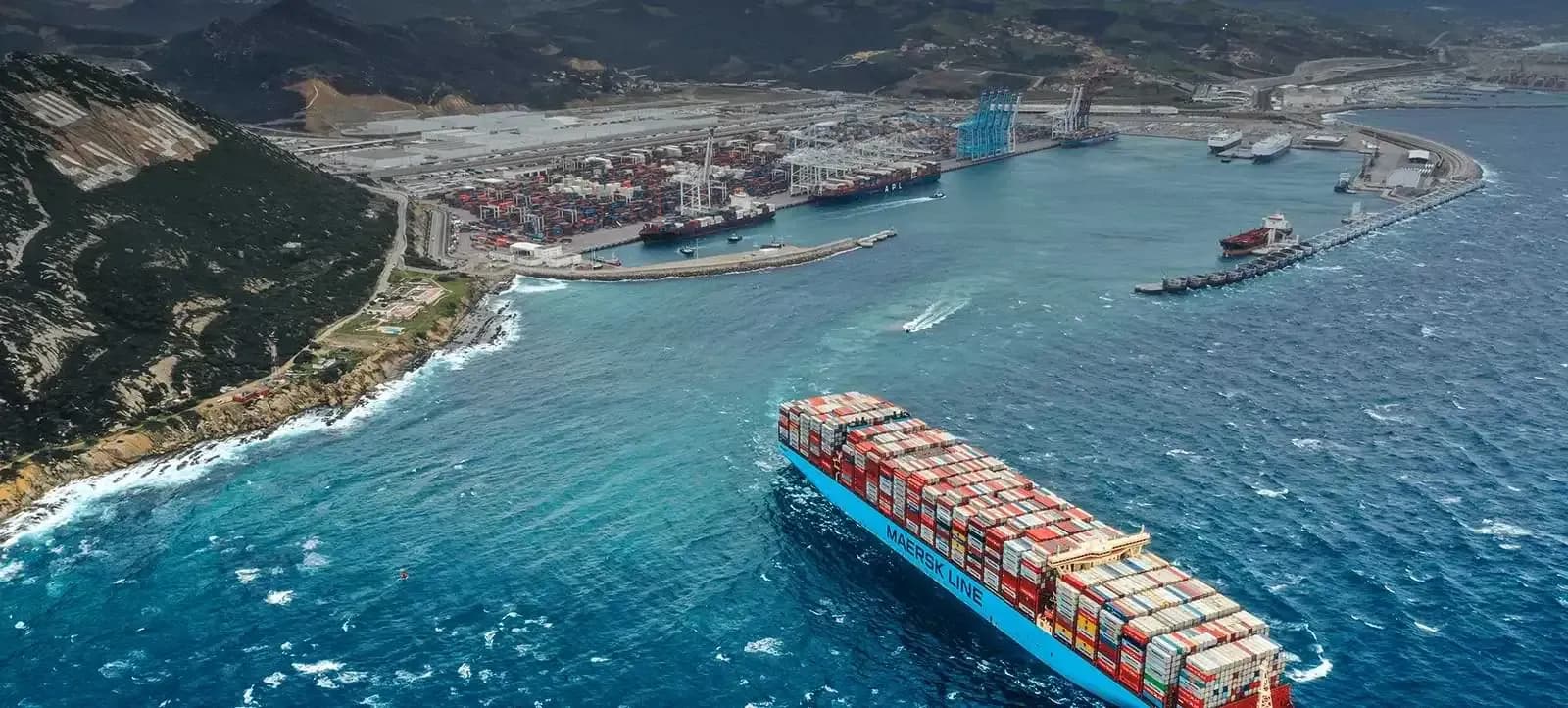
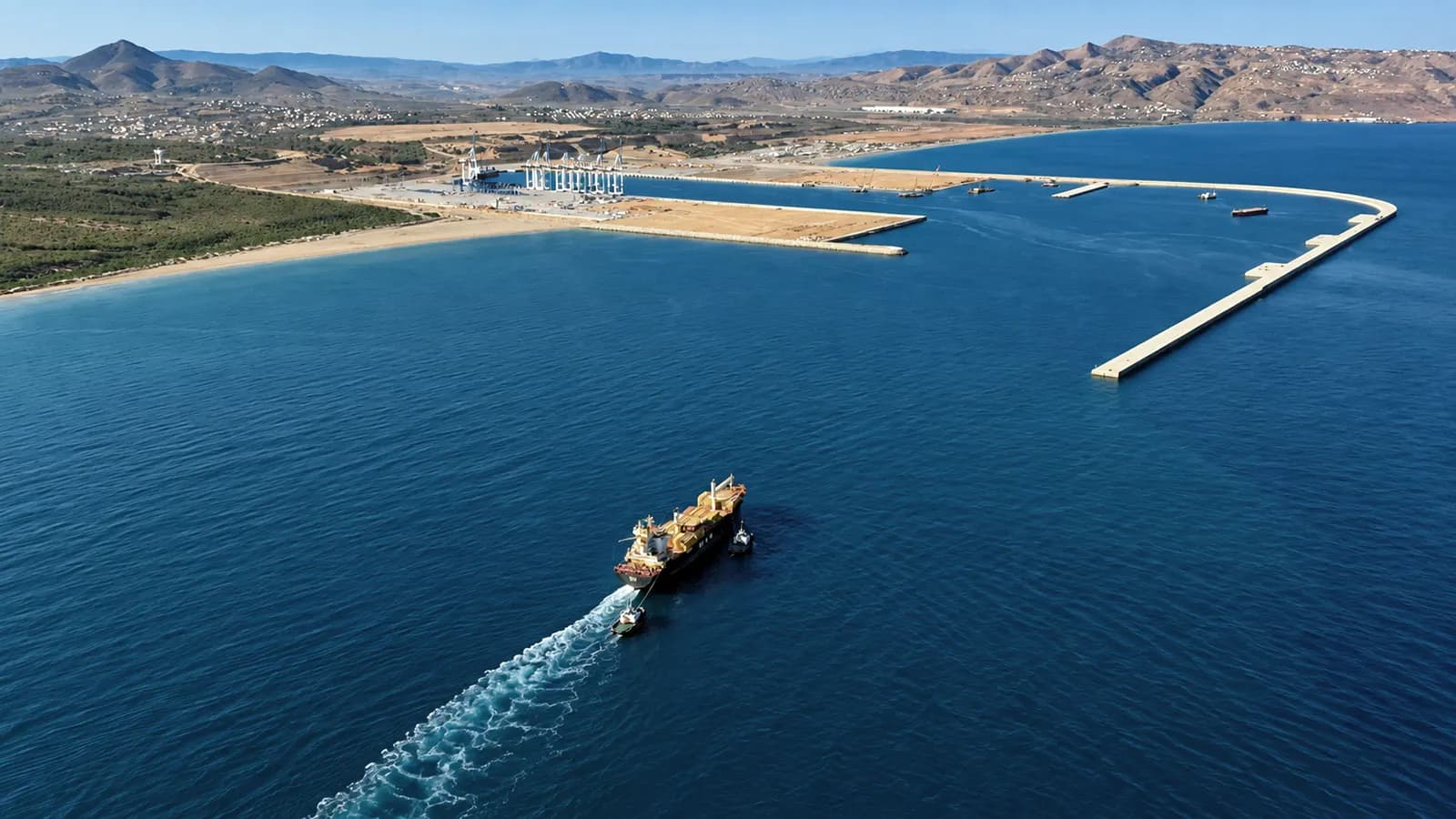
Maersk has launched a new weekly maritime service, called SLA (Baltic Sea – SLA service), which connects northern Europe and Italy with Egypt and includes a stop in Tangier-Med (Morocco) on its return journey, excluding the Port of Algeciras from its rotation. The line connects the ports of Gdansk, Bremerhaven, and Genoa with the Egyptian enclaves of Port Said East and Alexandria.
The complete rotation of the service follows this order: Gdansk – Bremerhaven – Genoa Vado Ligure – Port Said East – Alexandria – Tangier Port – Gdansk. Thus, the Moroccan stop is positioned in the return phase of the route, as the only stop in the region before returning to the Baltic.
With this new connection, the shipping company aims to offer a direct route to the eastern Mediterranean, shorten transit times, and provide greater reliability for traffic between both ends of the journey. The service is structured around a fixed weekly rotation with fewer transshipments, a configuration aimed at providing stability to trade flows between the European continent and Egypt.
Maersk's move occurs in a context of significance for trade between the European Union and Egypt, which reached 32.3 billion euros in 2025. The new line aims to channel part of those exchanges through a more stable route and with reduced stops.
The decision is consistent, according to the shipping company, with the 'Gemini Cooperation' plan of the company, whose approach consists of shortening transit times by reducing the number of stops along the routes. The choice of Tangier-Med as the only point of regional stop responds to that logic of operational simplification.
In this scenario, Tangier-Med is the only port in the region that has more than one terminal, a characteristic that gives it the capacity to absorb greater volumes of traffic. In addition, there are other advantages that the Moroccan enclave presents over its competitors: available surface area for operations, lower operating costs, and an environmental regulation positioned outside the framework of the European Union.
Given these conditions, the limitations of Algeciras have been reflected in the operator's own documentation. APM Terminals acknowledged in its annual accounts the restrictions it faces at the Andalusian port, including the lack of stacking space, to the point of stating that "it is not possible to grow physically." This lack of surface area conditions the capacity of the dock to attract new services.
The distribution of traffic in the area has also been altered by external factors. Geopolitical tensions, with the situation in the Strait of Hormuz and the Iran war as reference elements, caused a diversion of vessels to Tangier-Med, which generated saturation situations at the Moroccan port due to the increase in calls.
Despite the loss of this service, the Port of Algeciras shows uneven behavior in its recent figures. The facility recorded a 5% drop in its total traffic until April, although in the container segment it experienced an annual growth of 8.5%, surpassing the figure of 1.5 million TEUs. The data shows that container activity maintains an upward trajectory despite the decline in aggregate traffic.
In parallel, the TTI Algeciras terminal is working on an expansion plan valued at 150 million euros, promoted by Hyundai and CMA CGM. The project includes the addition of 160,000 square meters and would raise the terminal's capacity to 2.1 million containers annually. The TTI concession extends until 2065, a time horizon that provides margin for the development of these investments.
Maersk's new line again brings to the fore the competition between the two shores of the Strait for attracting long-distance services. While Tangier-Med adds calls supported by its available space, lower costs, and a differentiated environmental regulatory framework, Algeciras combines the physical limitation recognized by its operator with sustained growth in containers and a long-term expansion project aimed at increasing its future capacity. The outcome of this struggle will depend on how quickly the Andalusian port translates these investments into operational surface area in front of a competitor that is already gaining market share in the distribution of traffic in the western Mediterranean.