
Freight rail transport in Spain moved 5.63 million tons in the second quarter of 2026, 15.9% more than in the first and 3.9% more than in the same period of 2025, according to data from the National Commission of Markets and Competition (CNMC) collected by EED Data, the data platform of El Estrecho Digital. The agency notes that all activity indicators of the sector improved by around 16% compared to the previous quarter. In the year-on-year comparison, however, only net tons grew and, to a lesser extent, train-kilometers.
Net ton-kilometers, which combine the cargo transported with the distance traveled, totaled 2.426 billion, 17.3% more than between January and March and 1% less than in the second quarter of 2025. Train-kilometers, which measure the total distance traveled by trains, reached 5.68 million, with a 15.5% quarterly increase and a 0.5% year-on-year increase. Sector revenues were at 74.6 million euros, 17.2% more than in the first quarter and 2.7% less than a year earlier.
The quarterly rise occurs after a particularly weak first quarter. Between January and March, the railway transported 4.86 million tons, the lowest figure in the CNMC series since the second quarter of 2020. In the first half of 2026, the sector moved 10.49 million tons, 2.1% less than in the same period of 2025, while ton-kilometers decreased by 7% and revenues by 9.3%, according to EED Data's calculation based on the quarterly series.
The statistics from the National Institute of Statistics (INE), developed with a different methodology, provide a similar load figure for the same quarter, at 5.64 million tons, but with a year-on-year decrease of 2.2%, and record 2.344 billion ton-kilometers, 3.6% less. El Estrecho Digital already analyzed that INE data, which placed the first half as the worst since 2020. The CNMC is the only one of the two sources that publishes the distribution of activity among operators.
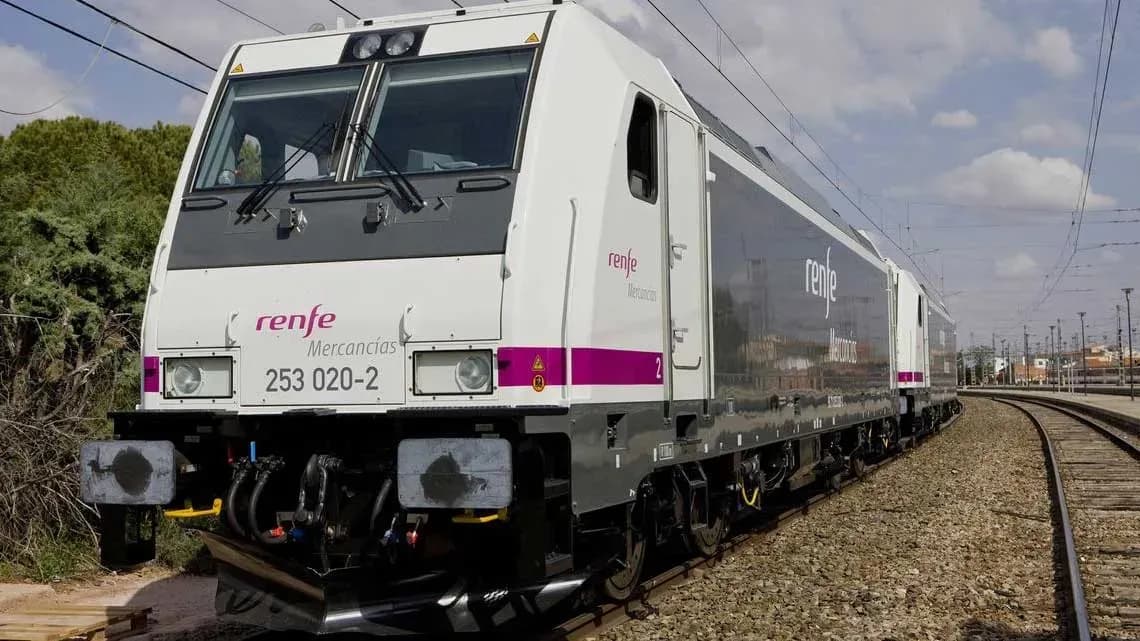
By companies, Renfe Mercancías maintains the first place, with 29% of net ton-kilometers, two percentage points less than in the second quarter of 2025. According to the CNMC, its activity in ton-kilometers grew by 7.6% compared to the previous quarter, but fell by 22.4% compared to the same period last year. Captrain Spain occupies second place, with a 20% market share, two points more than a year ago. Its activity increased by 30% compared to the first quarter, although it decreased by 6.7% in year-on-year terms.
Medway, the third operator, reaches 17% of the ton-kilometers, one point more than in the second quarter of 2025, with quarterly growth of 24.2% and year-on-year growth of 36.7%. Continental Rail maintains its share at 14%, with increases of 14.4% and 5.9%, respectively. Transervi, with 5% of the market, grew by 40.5% compared to the previous quarter and by 2.6% compared to the same period in 2025, and Logitren Ferroviaria, with 4%, registered increases of 2% and 3.1%.
The distribution changes if measured by tons transported instead of ton-kilometers. With 1.9 million tons, Renfe Mercancías moves 33.8% of the cargo, almost five points more than its share in ton-kilometers, and accounts for 36.7% of the sector's train-kilometers. The difference reflects the average distance of its shipments, about 364 kilometers per ton, compared to 601 kilometers of Continental Rail or 508 of Medway, according to EED Data's calculation based on CNMC data. Captrain Spain transports 23.8% of the tons, Medway 14.2%, Continental Rail 10.1%, Transervi 3.8%, and Logitren Ferroviaria 3.4%. The rest of the operators account for 10.9%.
Regarding the type of cargo, intermodal transport, which includes containers, mobile boxes, and semi-trailers, moved 2.88 million tons in the second quarter, accounting for 51.1% of the total. A year earlier, that proportion was 52.5%. Intermodal tons grew by 12.4% compared to the first quarter, but remain 1.3% below the same period of 2025.
The data by operator, the development of intermodal transport, and the quarterly series of freight rail transport since 2017 can be consulted in the railway section of EED Data, the data platform of El Estrecho Digital.