
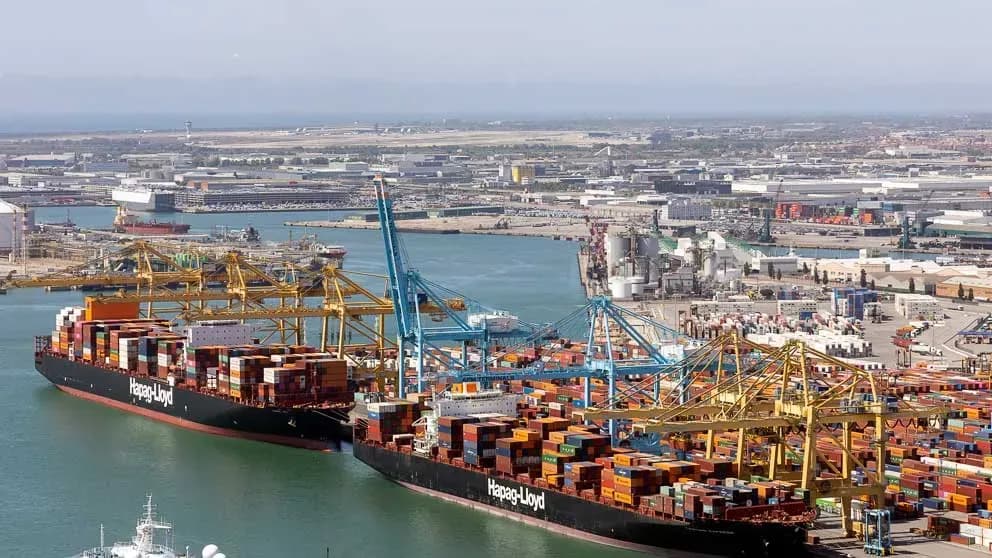
Between January and July 2026, Spanish companies sold goods worth 236.587 billion euros abroad, 2.2% more than in the same months last year. During that time, Spain imported products worth 274.592 billion, a 5.3% increase. These are provisional data from DataComex, the foreign trade statistics of the Spanish Secretariat of State for Trade, compiled by EED Data, the data platform of El Estrecho Digital.
Imports are growing at more than double the speed of exports, and that is why the difference between the two, known as the trade deficit, is increasing. By July, it amounted to 38.005 billion euros, compared to 29.122 billion in the same period of 2025, a 30.5% increase. In other words, for every 100 euros that Spain paid for foreign products, it gained 86 euros from what it sold abroad. A year ago, that ratio, known as the coverage rate, was around 89 euros.
The month of July followed the same pattern, although with less intensity than the previous months. Exports totaled 35.454 billion euros, a 3% increase compared to July 2025, and imports reached 40.678 billion, a 5.9% increase. The month closed with a negative balance of 5.224 billion. May and June had recorded the two highest monthly deficits in the last two years, at 8.245 billion and 7.687 billion, respectively.
If you look at what Spain sells, cars and other vehicles are still at the forefront, with 33.119 billion euros, practically the same figure as a year earlier. Next are machinery, with 17.264 billion and an increase of 5.1%, and fuels and petroleum derivatives, with 14.840 billion. The latter are the family of products that grows the most among the main exports, increasing by 23.1%. Electrical materials total 13.508 billion (+7.1%), while medicines and pharmaceuticals fell by 13.6% to 10.694 billion. In the agri-food sector, fruits reached 7.904 billion (+2.3%) and vegetables, 6.416 billion (+6.6%).
In the list of imports, fuels occupy the first place, with 36.993 billion euros and an increase of 13.6%. Vehicles are in second place, with 31.961 billion, a 13.8% increase, followed by machinery, with 26.967 billion (+7.6%), and electrical materials, at 25.377 billion (+9.9%).
The automobile sector is one of those where Spain sells more than it buys, but that advantage is narrowing. Vehicle sales remain stable while imports have grown by almost 14%, meaning the favorable balance of the sector dropped from around 4.858 billion euros between January and July 2025 to 1.158 billion in 2026, according to EED Data calculations based on year-on-year variations. This reduction of about 3.700 billion accounts for four out of every ten euros of the total deficit increase. In fuels, the opposite occurs: the country was already buying much more than it was selling, and the negative balance increased by about 1.630 billion, up to 22.153 billion.
Spain's main customers continue to be its European neighbors. France ranks first, with imports of Spanish products totaling 34.519 billion euros (+2.8%), followed by Germany with 24.844 billion (+5.6%); Portugal with 21.369 billion (+9.1%), and Italy with 20.639 billion, the market that grows the most among the top ten, at 10.4%. The United Kingdom purchases Spanish products worth 15.763 billion, and the United States, 10.483 billion, with increases of 0.5% and 1.8%, respectively. Conversely, sales to the Netherlands fell by 18% and those to Belgium by 15.5%. Morocco, with 7.580 billion and a 3.4% increase, is Spain's eighth customer and the only African country among the top ten.
Among suppliers, China tops the list with 31.449 billion euros in products sold to Spain, an increase of 10.1%. Thus, it surpasses Germany, which held that position in the same period last year and now totals 30.421 billion (+2.4%). They are followed by France, with 23.517 billion; Italy with 18.963 billion; and the United States with 17.973 billion, a decrease of 3%. With the United States, Spain buys more than it sells, with a difference of around 7.490 billion. With the United Kingdom, the opposite occurs: although purchases from the British market grew by 16.9%, Spain maintains a favorable balance with that country of over 8.000 billion.
By region, the province of Barcelona concentrates most of the foreign sales, with 47.514 billion euros and an increase of 1.8%. Madrid, in second place with 31.082 billion, records a decrease of 2.9%, and Valencia, in third, grows by 7.2% to 13.414 billion. Among the provinces with the most weight, Bizkaia shows the largest increase, at 14.1%, up to 7.303 billion. Andalusia, as a whole, exported 25.698 billion, 4.7% more, contributing 10.9% of Spain's foreign sales.
The cumulative total up to July comes after a year 2025 that Spain closed with exports of 387.092 billion euros, imports of 444.146 billion and a deficit of 57.055 billion, the highest since 2022, when it reached 71.604 billion.
The monthly evolution of Spanish exports and imports, their main partner countries, products and the breakdown by provinces can be followed in the foreign trade section of EED Data, the data platform of El Estrecho Digital.