
The struggle among the major Spanish ports to attract cargo from Asia is becoming more than just a commercial competition; it is turning into a reorganization of the port system around decarbonization, energy offers at the dock, and the ability to transform memorandums into measurable operations. Agreements signed by the port authorities of Valencia, Barcelona, and Algeciras with Chinese partners—Ningbo-Zhoushan in the cases of Valencia and Algeciras, and Shanghai in the Catalan case—create a map in which each facility tries to assert its business structure, its hinterland, and its level of technological maturity to capture Asian traffic in an increasingly demanding European regulatory environment.
The regulatory framework that is accelerating these decisions combines global pressure and immediate obligations within the European Union. The 2023 Strategy of the International Maritime Organization (IMO) establishes, among other elements, a reduction of the carbon intensity of international maritime transport by at least 40% by 2030 and a penetration of technologies, fuels, and energy sources with zero or near-zero emissions of at least 5%, aspiring to 10%, also by 2030. The net zero emissions framework approved in principle by MEPC 83 in April 2025 was not formally adopted in October of that year and discussions have continued into 2026, so the decarbonization trajectory is marked, but its legal landing remains open.
The economic pressure that shipping companies already face today when porting in Europe mainly comes from community regulations. Starting January 2024, the EU ETS covers CO₂ emissions from large ships over 5,000 GT entering EU ports: 50% of emissions from non-EU routes and 100% of emissions between EU ports and during port stays. The system is gradually implemented, with the allocation of allowances for 40% of reported emissions in 2024, 70% of those in 2025, and 100% starting in 2027. In addition, FuelEU Maritime, applicable from 2025, requires reducing the intensity of greenhouse gas emissions from energy used onboard in five-year increments, starting from 2% in 2025 to 80% by 2050, and will mandate the use of OPS or other zero-emission technologies at berth for container ships and passenger vessels at ports covered by AFIR starting in 2030. The regulation provides for monetary penalties for compliance deficits and, in the case of repeated non-compliance, consequences that may include expulsion or restriction of access to ports.
The concept of green maritime corridor emerged in the context of the Clydebank Declaration of 2021 and has consolidated as a tool to concentrate investment, public-private coordination, and technological decisions on specific routes between two or more ports. According to the latest annual report from the Global Maritime Forum, in November 2025 there were 84 active green corridor initiatives worldwide. A green corridor does not exempt itself from compliance with European regulations: what it does is reduce the risk of non-compliance by aligning fuel, infrastructure, digitalization, commercial scale, and port planning. The exemption or regulatory savings do not stem from the corridor's label, but from the ship and the company truly lowering their emission intensity or replacing fossil fuel with fuels and electricity compatible with FuelEU, EU ETS, and, in due time, the global framework of the IMO.
Against this backdrop, Valenciaport enters the race with a solid commercial base. China was its main trading partner in 2025, and the facility closed that year with 5,662,661 TEUs, a 3.41% increase over the previous year. In the first four months of 2026, the Port Authority of Valencia handled 25.5 million tons and 1,813,446 TEUs; exchanges with China during this period exceeded 3.3 million tons, a 23.78% year-on-year increase, and reached 308,206 TEUs, a 25.25% increase. The corridor with Ningbo-Zhoushan is thus built not on a hypothetical market, but on an already massive and expanding commercial relationship.
The distinguishing feature of the Valencian case is that its project with Ningbo-Zhoushan has taken a step that is not yet clearly visible in other Spanish facilities: the transition from political declaration to pilot operation. On May 27, 2026, Valenciaport reported that both port authorities supported the first operational agreement of the green corridor between the two ports, linked to MSC's Jade maritime service. The alliance includes MSC, Senior Auto, the China Waterborne Transport Research Institute, and the Valenciaport Foundation, aiming to establish the corridor through case analysis, carbon footprint calculation, and goal definition for the different links in the logistics and maritime chain.
The credibility of this bet rests on investments and projects already underway. The OPS Valenciaport program, co-financed by the European Union and active until 2028, intends to deploy electrical supply to ships at three terminals in the Port of Valencia and has been presented as the piece with the highest capacity to reduce the facility's carbon footprint, approximately 40%. The Valenciaport Foundation estimated the project budget at around 80 million euros. Additionally, the awarding of a renewable fuel plant in Sagunto for 20 million euros and the granting of two new authorizations for LNG supply to ships are part of this, along with the growth of rail traffic between January and April 2026, with 97,155 TEUs moved by train, a 21.69% increase. The Valencian corridor is thus read not only as a maritime matter but as a reconfiguration of the entire port-hinterland chain.
The strategy of the Port of Barcelona differs in partner, cargo profile, and technological narrative. The agreement with Shanghai International Port Group was signed on August 4, 2025, and seeks to intensify the relationship between the two ports in digitalization, standardization, and decarbonization of maritime transport. The Catalan facility itself emphasizes that Shanghai is the largest container port in the world and that China is its main trading partner, accounting for nearly 50% of the imports arriving at the port. In 2025, China, the United States, and Turkey were its main partners in containerized goods, with shares of 28%, 6%, and 5%, respectively.
Port statistics for 2026 help define what this relationship means in business terms. As of the end of April, Barcelona accumulated 1,266,611 TEUs, a 2.7% increase over the previous year. In the full traffic not transited by countries, China accounted for 148,105 TEUs, 29.8% of the total, and particularly dominated the unloading: 128,650 TEUs, 51.2% of the unloaded units. This bias confirms that Barcelona's relationship with China is highly import-focused and aligns with the automotive dimension and high added-value distribution that the port authority has sought to give to the corridor with Shanghai. In 2025, the Port of Barcelona closed with 3.7 million TEUs, a 4.2% decrease from 2024, but the filled import and export containers—the most valuable for a gateway port—grew by 4% and 3%, respectively.
The Catalan facility has defined more clearly than other ports which "product" it wants to associate with its corridor: digitalization and green methanol, with particular attention to the automotive sector. The agreement signed with SIPG contemplates developing a Green Shipping and Digital Corridor, with capacities and regulations to supply those fuels in both ports and offer neutral emission maritime services between East Asia and the Mediterranean. The PierNext knowledge platform, linked to the port, has explained that the Barcelona-Shanghai route is conceived around energy efficiency, logistical digitalization, and transport of vehicles using green methanol. Although operational maturity still seems less defined than in the Valencian case, Barcelona has integrated the corridor into a broader smart port strategy, automotive, and alternative fuel.
In infrastructure, the Port of Barcelona arrives with visible assets. In July 2024, it inaugurated the first OPS for a container terminal in a Mediterranean port at the BEST terminal, as part of the Nexigen plan; in April 2025, it put into service the first OPS for ferries at Grimaldi Terminal Barcelona; and its electrification plan surpasses 200 million euros. Concurrently, the port supplied a total of 236,946 m³ of LNG as marine fuel in 2025, with 547 operations, and initiated bio-LNG bunkering operations. The facility itself has indicated that in 2026 it will be able to supply green methanol and can already supply bio-LNG or B100. Barcelona has thus worked in three layers simultaneously: electrification at berth, transitional fuel, and preparation for fuels with a smaller footprint.
The Algeciras case requires a different interpretation as it competes with Valencia and Barcelona, but not from the same business structure. The Port of Algeciras closed 2025 with 100.7 million tons and 4.74 million TEUs, remaining above 100 million tons for the tenth consecutive year. The APBA highlighted the growth of import/export against a slight decline in transshipment, along with the strength of the ro-ro services in the Strait, close to half a million trucks annually only on the Algeciras-Tangier Med route. The Andalusian facility approaches the climate agenda not only as a node for Asia-Europe cargo but as a significant transshipment hub, gateway to the Strait, and vessel service platform.
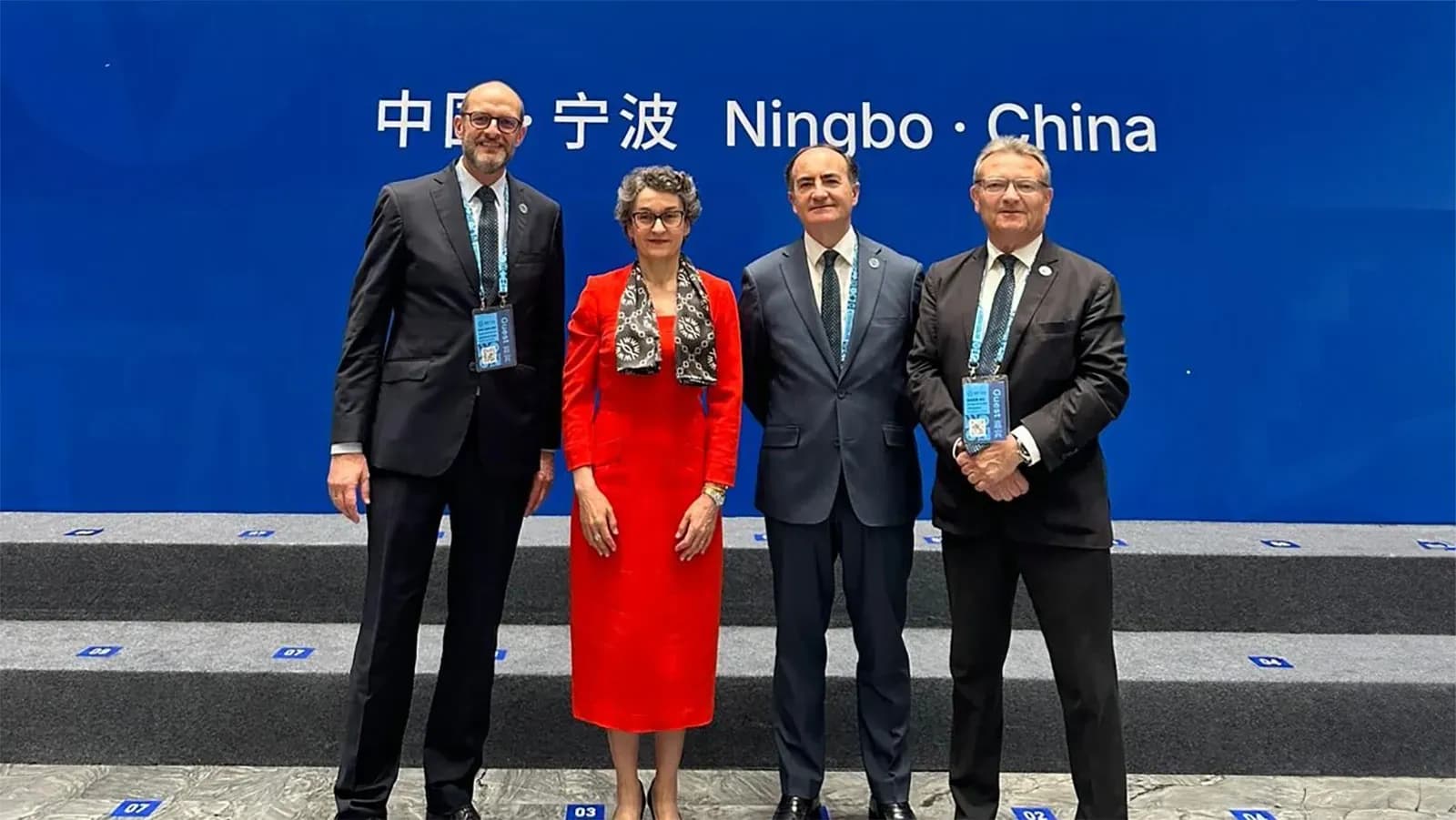
The signing of the green corridor with Ningbo-Zhoushan occurred last week and is supported by a prior relationship between both ports dating back to the memorandum of understanding signed in 2018 to promote trade flows between southern Europe and Asia and share knowledge about applied technologies to port management. The information released after the signing indicated that Ningbo is Algeciras' primary trading partner in containerized goods and that bilateral container traffic had grown significantly in the past year.
Where Algeciras presents a more tangible operational advantage is in energy. In 2025, it supplied 333,833 m³ of LNG to vessels, with 78 ship-to-ship operations, positioning it, according to the APBA and GASNAM, at the forefront of the peninsula's ports and in the top three in Europe after Rotterdam and Marseille Fos. Of that volume, 51,923 m³ were bio-LNG, almost 16% of the total. Additionally, there is a planned investment of 92 million euros in OPS for the terminals of Algeciras and Tarifa, along with the experience accumulated in the green and digital corridor with Panama, presented in Brussels in 2025, whose feasibility study estimates an annual reduction of 800,000 tons of CO₂ and specifically mentions biofuels, e-methanol, ammonia, OPS, and logistical digitalization. The Algeciras facility still needs to translate its agreement with Ningbo into a specific route but already has a more mature base in energy supply to vessels than in commercial visibility of the corridor service.
The comparison among the three ports shows that not all compete for the same thing nor with the same primary tool. Valencia is using the corridor with Ningbo to secure its relationship with the largest external market of its port community and has been the first to link it to an identified service, MSC Jade. Barcelona has aligned its corridor with Shanghai with its specialization as a high-value gateway port, heavily dependent on Chinese imports, and wraps it in a narrative of digitalization, automotive, and green methanol. Algeciras, for its part, asserts its scale as a hub, its Strait connectivity, and its leading position in LNG and bio-LNG bunkering, suggesting a strategy more supported by vessel services, transshipment, and scale reliability than the hinterland pattern that characterizes the other two.
As of June 2026, Spanish port decarbonization is more advanced in OPS, LNG, bio-LNG, and biofuels than in a massive commercial deployment of methanol or ammonia. Barcelona is already electrifying berths and operating bio-LNG, with green methanol planned for 2026; Algeciras leads in LNG and bio-LNG and rolls out OPS; Valencia is progressing with OPS, new LNG authorizations, and a renewable fuel plant in Sagunto, while maintaining research projects on methanol and ammonia. Available evidence indicates that Spanish green corridors are today more a tool for coordination and market preparation than a fully decarbonized product in all its layers.
Green corridors agree that it is not enough to have a fuel at origin and destination: it requires compatible fleet, regulatory security, bunkering services, digitalization, contractual coordination, and shippers willing to bear the transition's additional cost. The corridor is thus becoming a commercial instrument as well as a climate one. The open race among Valencia, Barcelona, and Algeciras is not just about capturing more Asian cargo, but about deciding which port will be the most reliable, competitive, and climatically aligned access point for that cargo in a Europe where carbon already has a direct economic translation.