

The Port of Algeciras is one of the main protagonists of the case study of the western Mediterranean in the second report of the EU-ETS Observatory, published by State Ports to measure the impact of the European emissions trading scheme on maritime transport. The analysis, covering from 2023 to March 2026 and for the first time incorporating container tracking in addition to ships, paints a two-sided picture for the Algeciras dock: import and export traffics remain intact, but the most dynamic segment of its business — the cargo exchange between transoceanic services — is steadily shifting towards the Moroccan shore of the Strait.
That segment, which the report calls interlining or relay, is a specific type of transshipment: the cargo has neither origin nor destination in the region, but passes from one long-distance route to another, and the port acts solely as a crossing point between two ocean lines. It is the most volatile transshipment, as it is not anchored to any local activity, and it is also the most affected by the ETS: a stop of this type on the European shore generates emission costs on both transoceanic routes that intersect, while the same operation in Tangier Med generates none.
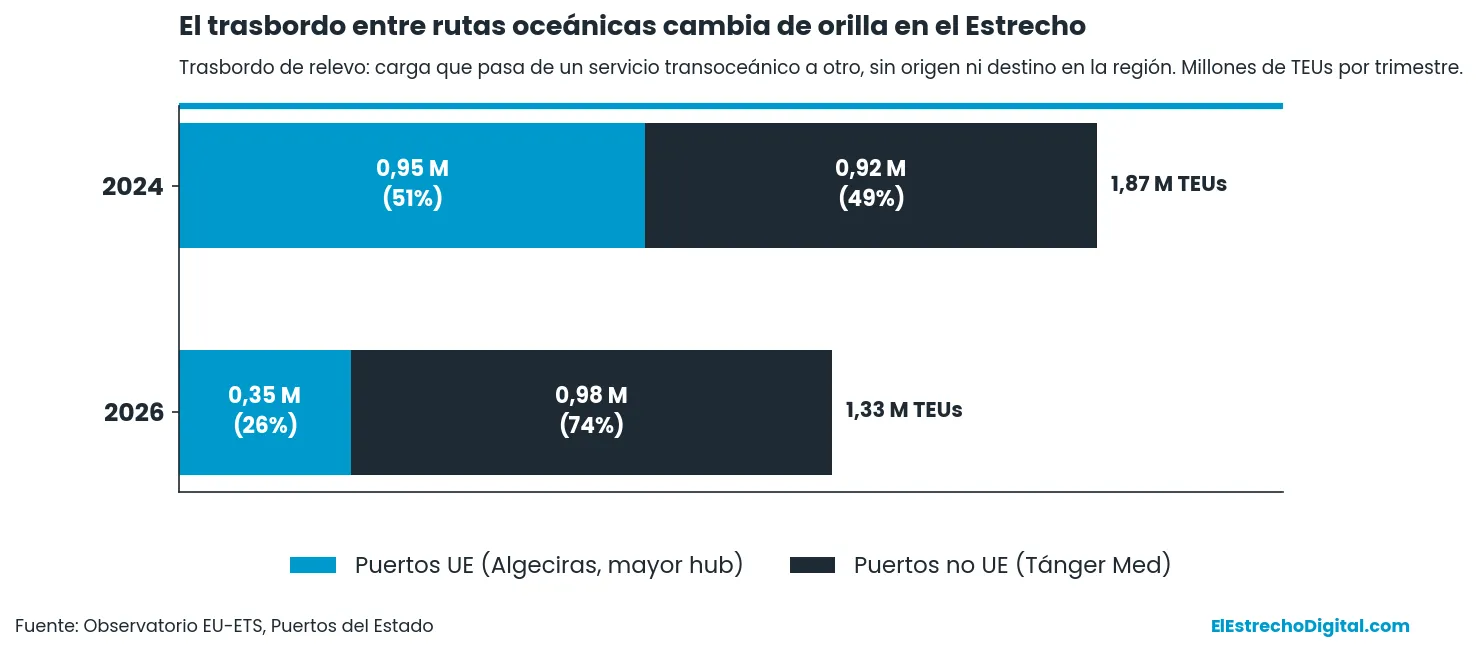
The central data is compelling. Total transshipment in Algeciras has fallen from 5.2 to 4.6 million TEUs compared to its recent peaks, and the interchange between ocean routes has been reduced to half as a proportion of its transshipment mix. The crisis in the Red Sea and the diversion around the Cape of Good Hope contracted that market across the basin from 1.87 to 1.33 million quarterly TEUs, and the contraction fell almost entirely on community ports, whose share dropped from 51% to 26%. Algeciras, which was the largest hub in the European Union in this segment at the beginning of the period, is the one that yields the most. Tangier Med, located across the way and with an equivalent position in the network diverted by the Cape, did not retreat at all. The report's conclusion is literal: geography cannot separate the two ports; the cost of the ETS of a call on the European shore can.
In the ranking of entry ports in the basin, measured in TEU-miles, Algeciras drops from 27% in 2022 to 20% in 2026, after a peak of 30% in 2023, while Tangier Med retains the leadership with 37% and Valencia rises from 8% to 15%. The paradox is that the basin as a whole was the most benefited by the diversion around the Cape: long-distance transport work grew around 76% as traffics from Asia, India, and the Middle East shifted towards the Strait, and Spain is the first access country with a share that increases from 44% to 47%. However, that growth was unevenly distributed: Tangier Med consolidated its position until reaching full capacity, while Valencia, Algeciras, and the rest of the community ports grew well below the market. In transshipment, European volumes in the region remain flat around one million TEUs monthly, while non-community volumes have grown about 60% since early 2023.
The case quantifying the mechanism is Maersk's MECL service, which connects the east coast of the United States with the Middle East and India and historically made stops in Algeciras in both directions, using it as its European cargo exchange point with other routes. Navigation around the Cape doubled the service's exposure to the ETS to 33 million euros annually and triggered a rapid reconfiguration: by the end of 2024, the westbound stop moved from Algeciras to Tangier Med, reducing the cost by half, and in 2025 the eastbound segment began to be operated directly, eliminating the remaining stop. The service was neither split nor interrupted; it maintained its traffic and frequency and simply relocated its exchange point, eliminating between 16 and 33 million euros annually in ETS costs. In terms of shipping companies, Maersk doubled its volumes in both Tangier Med and Algeciras, and Hapag-Lloyd quadrupled its operations in the Moroccan port, while CMA CGM and MSC lost relative weight. The report concludes that since the inclusion of maritime transport in the EU-ETS, such connections in community ports between transoceanic services linking Asia and America have practically been entirely transferred to ports in neighboring countries.
The attribution analysis rules out one-by-one alternative explanations. Congestion does not push traffic towards Morocco: Algeciras operates below its peaks and Valencia absorbed three times the import and export traffic in the same window. There is no evidence of a reduction in handling costs or port tariffs in Tangier Med compared to its community competitors during the period; what the Moroccan port offers is scale and specialization, as the largest container facility in the Mediterranean and a platform almost entirely dedicated to transshipment, which accounts for 97% of its activity in 2025. And Morocco's economic growth, between 3.7% and 4.6% annually compared to the 0.5%-3.5% of its northern neighbors, is an insufficient order of magnitude to justify the 64% increase in Tangier Med's volumes. What coincided in time was the new capacity: the successive expansions of the TC4 terminal added three million TEUs annually between 2023 and 2025, just as the diversion around the Cape was reshaping the network. The cost of the ETS emerges, according to the report, as a highly probable cause of the restructuring of these services.
The investment race in the Strait environment prolongs the imbalance. Non-community countries in the western Mediterranean and the Atlantic have committed 2.796 billion euros in terminals between 2021 and 2030, with 6.4 million additional TEUs of capacity: the Nador West Med complex adds 893 million in infrastructure plus the terminals awarded to Marsa Maroc with TIL-MSC (253 million) and with CMA CGM (250 million), and the new Atlantic port of Dakhla adds 1.4 billion expected for 2029. On the community side, the figure rises to 2.738 billion and 7.04 million TEUs, and includes the first phase of the expansion of TTI Algeciras in Isla Verde, with 150 million euros and half a million TEUs of annual capacity expected for 2028. In the entire Euromed region, 62% of the planned capacity growth until 2030 is located outside EU ports.
Algeciras also appears in the report as a methodological reference. It is the graphic example with which the Observatory illustrates the route fragmentation strategy — a direct service that splits into a deep-sea segment with a hub in Tangier Med and a feeder to community ports — and the technical annex uses the joint MedCar service of CMA CGM and Marfret, which starts and ends in Algeciras with eight ships between the Mediterranean, the Caribbean, and the gulf of the United States, to calculate how much it would cost to split a route of this type with Tangier as a pivot. The port is also one of the four Spanish ports, along with Barcelona, Valencia, and Las Palmas, where the Observatory's prediction service is already operating to anticipate route reconfigurations, whose model correctly identifies 77% of the routes that actually underwent reconfiguration.
The positive counterpoint is the resilience of the base traffic: the direct connectivity of community ports in the basin improved from 69% to 73%, confirming that import and export flows remain intact, and the absolute volumes of European transshipment do not fall; the erosion is limited to the cargo exchange from third countries between ocean routes. The publication coincides with the draft of the directive amendment presented by the European Commission on July 17, which recognizes the need to adjust the mechanism, and among the measures proposed by the Observatory are the expansion of the criteria for neighboring "transshipment ports" and a discount factor on emissions proportional to distance and ship size to disincentivize route fragmentation. The conditions under which Algeciras competes with the opposite dock, separated only by the perimeter of the application of the emissions trading system, will depend on this review in Brussels.