
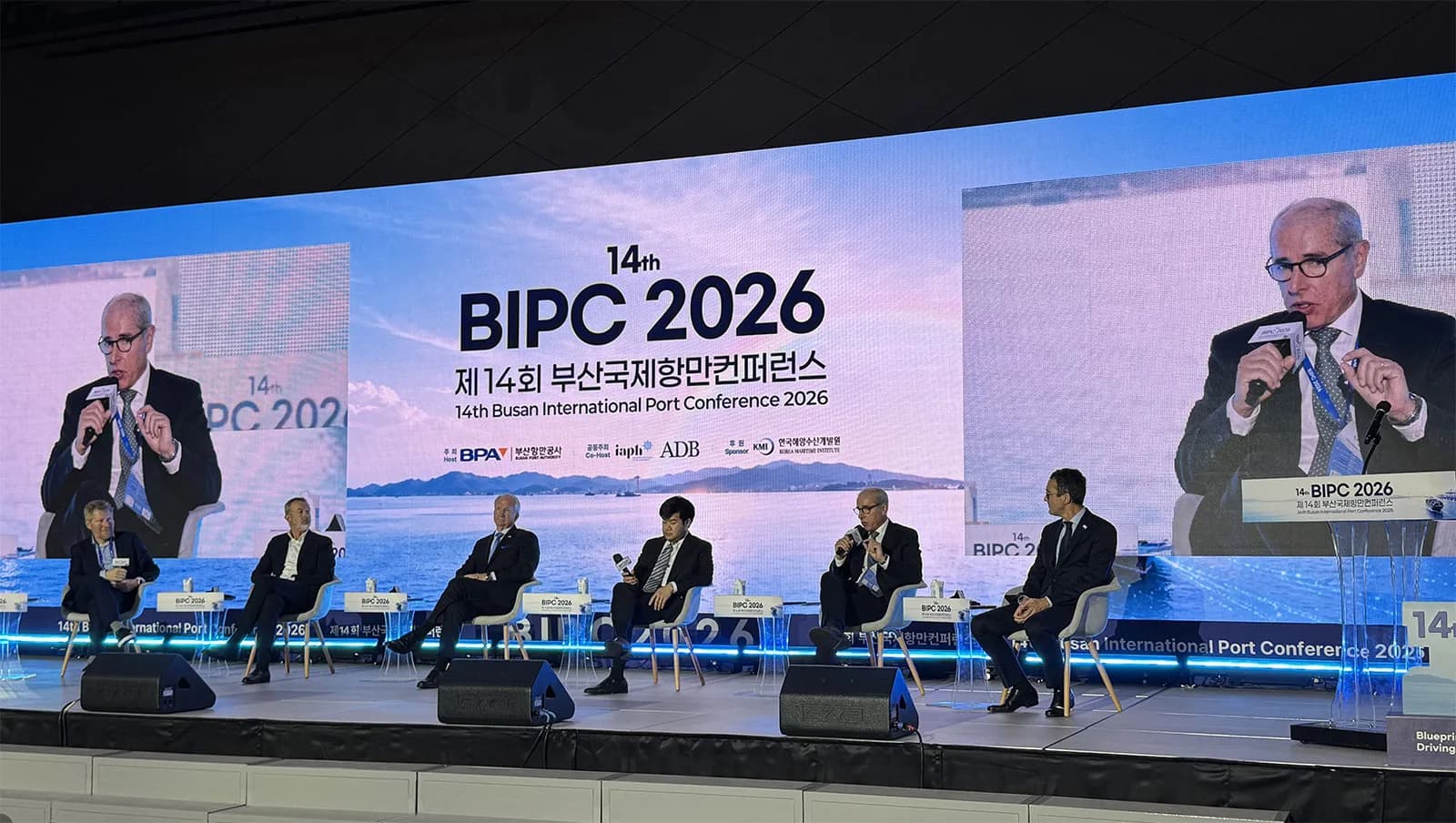
The Port of Barcelona is among the eleven promoting ports of the Busan Port Declaration 2026, an international declaration signed by some of the main port infrastructures in the world, aimed at advancing innovation, enhancing the resilience of global logistics chains, and accelerating the energy transition of maritime transport and port infrastructures. The text was adopted at the meeting of port executives held in Busan (South Korea), coinciding with the 150th anniversary of the commissioning of the Korean port.
The declaration sets commitments on data interoperability and digital collaboration between ports, the application of artificial intelligence to logistics chain management, the promotion of sustainable fuels and low-emission technologies, and the exchange of knowledge and best practices among ports worldwide. In this regard, the document explicitly mentions the International Association of Ports and Harbors (IAPH) and the International Maritime Organization (IMO) as key platforms for articulating that cooperation.
Barcelona was one of the few European ports invited to the CEOs meeting, where it shared a table with representatives such as Rotterdam, Los Angeles, and Hamburg. Its president, José Alberto Carbonell, participated on Monday in that meeting along with representatives from the ports of Busan, Rotterdam, Los Angeles, Hamburg, Antwerp-Bruges, HAROPA, Singapore, Long Beach, Seattle, and Ningbo. During the session, the port leaders presented their vision on the main challenges facing the maritime and logistics sector in a scenario conditioned by climate change, geopolitical uncertainty, rising protectionism, and technological advancements, including AI, which reshape global supply chains and transform the role of ports.
"The Busan Declaration highlights that the major challenges of the maritime sector can only be addressed through international cooperation," said Carbonell, who called on ports to work together in digitalization, resilience of logistics chains, and accelerating decarbonization.
On Tuesday, the president of the Port of Barcelona spoke at the fourteenth edition of the Busan International Port Conference (BIPC), one of the main international meetings of the Asian port sector. Carbonell, accompanied by the director of Institutional Relations of the port, Ingrid Boqué, participated in the session dedicated to decarbonization, where he presented the Catalan experience in the deployment of the wharf electrification system (Onshore Power Supply, OPS), one of the central actions of his energy transition strategy.
In his speech, he explained the methodology that the Port of Barcelona uses to quantify greenhouse gas emissions and noted that moored ships represent a significant part of port emissions, which makes the electrification of wharves one of the measures with the highest potential for reducing environmental impact.
Carbonell detailed the investments that the infrastructure develops through Nexigen, its wharf electrification plan, to make that energy transformation possible. He also outlined the technical and economic challenges linked to the simultaneous connection of large ships at the same wharf, an operation that requires a high capacity of electrical supply.
The president argued that wharf electrification represents a strategic and competitive long-term solution towards more sustainable ports, complementary to the deployment of new decarbonized fuels, and positioned the economic viability of investments as a condition for accelerating sector decarbonization. "The OPS deployment and the commitment to electrification are a fundamental step towards building the emission-neutral port that society demands from us," he asserted.
The Busan International Port Conference brings together port authorities and operators from Asia, Europe, and North America each year, and the declaration adopted in 2026 groups ports from those three continents around the working frameworks of the IAPH and the IMO.