
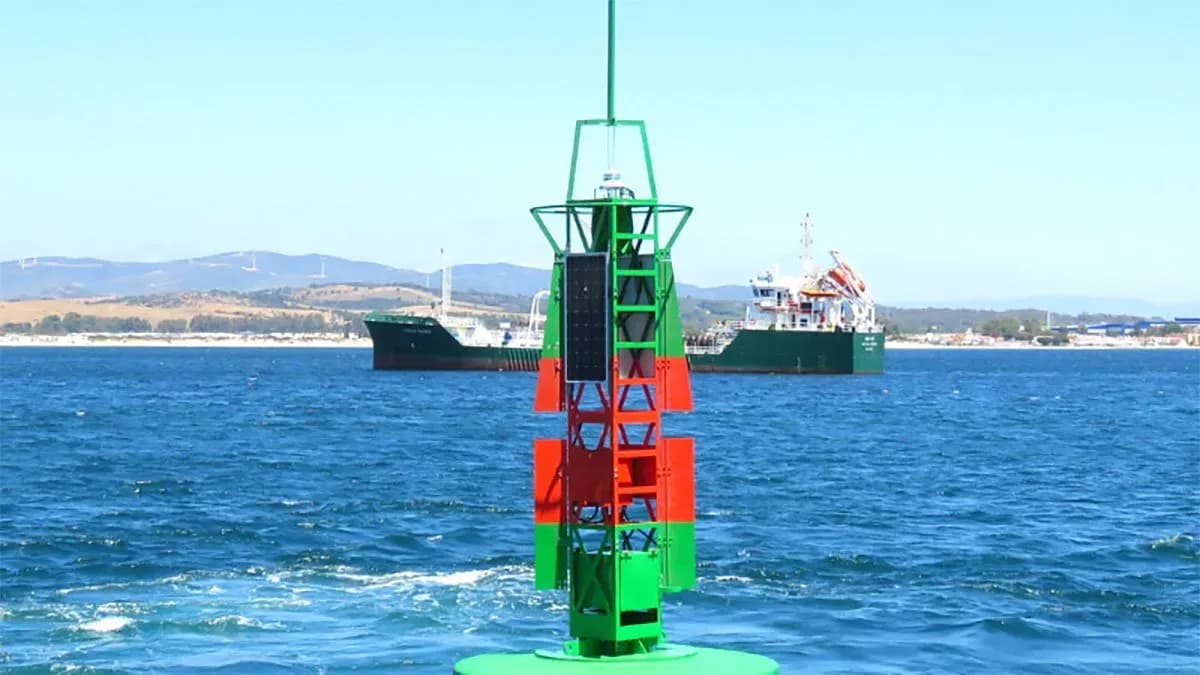
The Port Authority of the Bay of Algeciras (APBA) is going to renew the lanterns that guide ships in their transit through the waters of the southern coastline of Cádiz, from Sotogrande to Río Barbate. The port authority has put out to tender a contract to acquire 30 new maritime signaling lanterns equipped with LED technology and IoT connectivity, which will allow real-time monitoring of the operational status of each one from a control center. The planned investment amounts to 52,800 euros (excluding VAT) and the contract will extend over three years.
The lanterns to be replaced are those that the Navigation Aids Service (SAN) of the APBA has identified as deteriorated or that have reached the end of their useful life and no longer offer the necessary reliability to guarantee navigation safety in one of the maritime areas with the highest traffic density in the world, the Bay of Algeciras and its surroundings in the Strait of Gibraltar.
The main qualitative leap introduced by this renewal is the incorporation of IoT connectivity to all the lanterns. Until now, to check whether a beacon was functioning correctly, it was necessary to physically travel to it. With the new lanterns, SAN will be able to know from its facilities at the Isla Verde Dock in Algeciras if any light has stopped working, if a buoy has moved from its position, or if the battery of a lantern is low, among other parameters. The lanterns will send all this information to the SCADA NETCOM supervision system already used by the APBA for controlling its navigation aids.
The supply includes four different types of lanterns adapted to the various needs of buoyage. The most numerous, 15 units, are autonomous lanterns with a range of 3 nautical miles and standard autonomy, designed for small and medium-sized buoys. Another 6 units correspond to lanterns with the same range but with extended autonomy, equipped with higher power solar panels. The order is completed with 6 autonomous lanterns of 5 nautical miles range, intended for large towers, and 3 non-autonomous lanterns of 5 miles with GSM/IoT connectivity. In addition, the contract includes the acquisition of 15 replacement batteries.
All autonomous lanterns operate on solar energy and have 12-volt rechargeable lead batteries. Their four solar panels are positioned almost vertically to prevent bird droppings from covering them and reducing their charging capacity, a common problem in maritime beacons. The minimum autonomy without sun for each lantern will be at least 16 days in the coordinates of the Bay of Algeciras, which guarantees that they will continue to function during prolonged periods of bad weather or overcast skies.
The lanterns will not be delivered all at once, but as the Navigation Aids Service needs them over the three years of the contract. The delivery timeframe after each order will be two weeks. It is expected that 10 lanterns and 5 replacement batteries will be acquired per year. All units will come with a minimum two-year warranty.
The specification requires that the manufacturer of the lanterns be an active industrial member of the International Association of Maritime Aids to Navigation (IALA), the international body that establishes global maritime signaling standards. The lanterns must also be programmable by infrared and Bluetooth, have GPS synchronization, and feature an automatic reduction system for light output when the battery is low to prolong their operation.
Regarding cybersecurity, the specification establishes that the communication systems of the lanterns must comply with the National Security Scheme (ENS), a requirement that responds to the growing concern for the protection of critical port infrastructures against possible cyberattacks.
The contract will be awarded exclusively on price, given that these are products with defined technical specifications. The total budget, of 52,800 euros without VAT (63,888 euros with VAT), will be distributed over three annual installments of 17,600 euros each.