

The thirty-seventh edition of the Operation Passage of the Strait (OPE) will officially start this Monday, June 15, and will last until September 15, although the previous weekend will already concentrate a significant flow of travelers heading to Morocco. The operation faces its greatest regulatory uniqueness in years: it will be the first complete summer campaign with the Entry and Exit System (EES) of the European Union fully operational at all external border crossing points of the Schengen area. The ports of Algeciras and Tarifa, which last year absorbed more than 73.63% of the total travelers from the operation, will again be the center of gravity for a seasonal migratory movement that reached historic figures of 3,488,885 passengers and 857,784 vehicles nationwide in 2025.
The Secretary General of Civil Protection and Emergencies of the Ministry of the Interior, Virginia Barcones, and the Deputy Delegate of the Government in Cádiz, Blanca Flores, chaired the meeting of the Provincial Director Committee of the OPE 2026 this Friday in Algeciras, which analyzed the planned operation with the participation of the Director General of Civil Protection and Emergencies, Benjamín Salvago, and representatives from the Port Authority of Algeciras Bay (APBA), the State Security Forces and Corps, Maritime Captaincy, the Junta de Andalucía, the Provincial Traffic Headquarters, the State Highway Demarcation, the Red Cross, the Andalusian Health Service, and the Provincial Consortium of Firefighters.
Official forecasts point to an increase close to 3% compared to the previous edition. Flores emphasized that "the ports of Algeciras and Tarifa play a fundamental role in this operation again" and noted that "the accumulated experience, the capacity of our infrastructures, and the commitment of the professionals involved in the operation allow us to face this new edition with maximum guarantees." The Deputy Delegate described the operation as "a logistical and coordination challenge" and characterized it as "a fully consolidated device recognized for its effectiveness," whose objective, she added, is "to anticipate the needs of travelers, incorporating new technological tools."
The departure phase will concentrate its most critical days between July 31 and August 3, while the return operation will peak from August 28 to 31. The Fleet Plan will be established by the General Directorate of Merchant Marine in coordination with Moroccan authorities and shipping companies, fixing the number of ships, capacities, and necessary rotations for embarkations and disembarkations. The Civil Guard and National Police are already preparing the increase in personnel to handle the expected increase in activity during the summer period, especially at border controls, traffic regulation, and security at port facilities. The General Directorate of Traffic will maintain the Border Information System (SIF), which allows monitoring vehicles from their entry into Spain and anticipating their arrival at the ports of embarkation. The State will mobilize more than 31,500 professionals, an increase close to 10% compared to 2025, and will coordinate the actions of more than twenty public agencies.
Among the innovations of this edition is the launch of an advanced digital operational management system that will integrate for the first time real-time information on traffic, port operations, weather conditions, and incidents, with the aim of optimizing decision-making during peak periods. The bilateral Spanish-Moroccan planning will also impact the information provided to travelers beforehand and the advance purchase of closed tickets, a measure considered key to reduce waiting times, avoid crowds, and improve embarkation efficiency.
The main variable of the campaign, however, is of a border nature. The EES was configured by Regulation (EU) 2017/2226, began its gradual deployment on October 12, 2025, under the aegis of Regulation (EU) 2025/1534 and the Implementing Decision (EU) 2025/1544, and since April 10, 2026, it has been fully operational at the external border crossing points of user countries. The system replaces the manual stamping of the passport with a digital record of entries, exits, and denials of entry of nationals from third countries on short stays, with biometric capture and verification of facial images and fingerprints. This OPE will, therefore, be the first without a cushion phase or manual stamping as ordinary backup. ETIAS, the prior authorization for visa-exempt travelers, will not come into effect until the last quarter of 2026 and, consequently, does not condition the current campaign.
The operational effect of the EES in Algeciras and Tarifa is not strictly legal, but of capacity. Each first crossing involves document scanning, biometric capture, consultation of interoperable records —VIS, SIS, EES, ETIAS, Eurodac, and ECRIS-TCN— and automatic management of the authorized stay; subsequent crossings are resolved through biometric verification and documentation of the already opened file. The additional friction will focus on the direct links with Morocco —Algeciras-Tanger Med and Tarifa-Tanger Ville— without ruling out cross-effects on the Algeciras-Ceuta line due to shared access, platforms, and ship departure windows. In OPE 2023, the Algeciras-Tanger Med line accounted for more than 45% of departures from Spanish ports, the Algeciras-Ceuta connection 16.2%, and Tarifa-Tanger nearly 11%. The report on the state of Schengen in 2026 has recognized that during the first months of the EES application, some States faced difficulties related to infrastructure, the functioning of self-service systems, the capacity to fully register biometric data, and congestion at specific times.
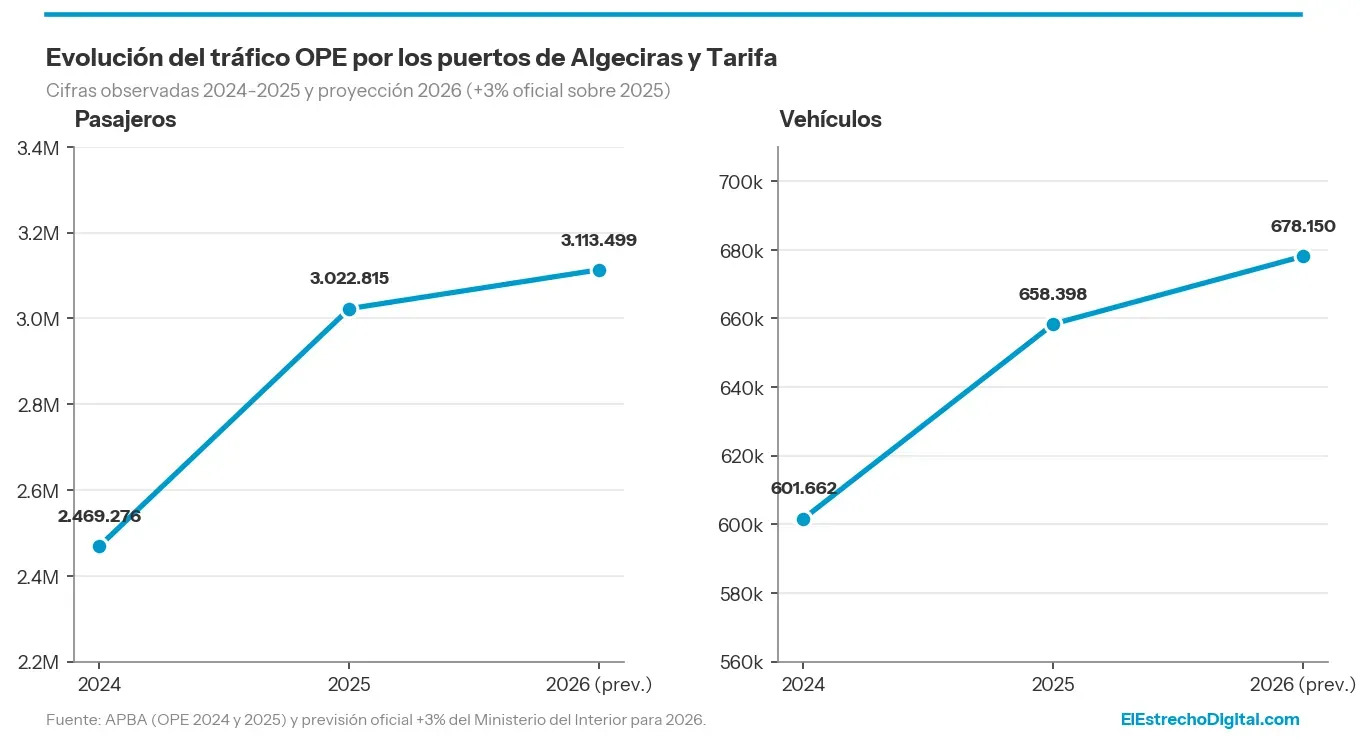
The operational exposure of both Andalusian ports is very high. The APBA closed OPE 2025 with 3,022,815 passengers and 658,398 vehicles, compared to 2,469,276 passengers and 601,662 vehicles in 2024. Applying the official growth forecast of 3% for the overall operation to the local exercise, the order of magnitude for Algeciras and Tarifa in 2026 could be around 3.11 million passengers and 678,000 vehicles, a projection not officially published by the port but consistent with recent series. The APBA absorbed approximately seven out of every eight passengers and more than three out of every four vehicles from the state operation in 2025.
The historical snapshot of risk is not in the daily average but in the peaks concentrated during busy weekends. The APBA reported that in OPE 2023, one weekend had 120,000 passengers and 30,000 vehicles in 72 hours, and in the return operation of 2024, one weekend alone left 111,487 passengers embarking in Algeciras and Tarifa, according to information published at the time. In that kind of temporal compression, the additional seconds per traveler added by the EES procedure can translate into significant queues if control positions, flow segregation, and sorting personnel are not expanded.
The material conditions of both sites are unequal. The maritime station in Tarifa has 2,116 square meters distributed over two floors and operates the regular passenger line to Tanger Ville through docks 2 and 3. Since 2025, this route has been operated by Baleària with a fifteen-year concession, after DFDS ceased operations in May of that year and focused on the Algeciras-Tanger Med and Algeciras-Ceuta services. Algeciras has a maritime station of 12,000 square meters, an adjacent commercial and service building of 7,900 square meters, and a parking building with capacity for 810 vehicles, whose ground floor is used for sorting embarkations, as well as an OPE Command Center and specific control points. The larger size of the Algeciras port provides room for managing surges, but it also bears the overlap of lines with Ceuta and Tanger Med and absorbs a large part of the peaks of the national operation.
The shipping companies are already applying rules aligned with the logic of the new border system. Baleària requires access to the port area in Algeciras with a boarding card or reservation within 24 hours and, for Tanger Med, a closed ticket for the exact date, redirecting travelers without valid documentation to an external area. The Joint Spain-Morocco Commission held in May consolidated bilateral coordination and the recommendation of closed tickets as a tool to decongest the platforms. Meanwhile, the Ministry of the Interior has confirmed that the control of border posts in Spanish territory continues to correspond to the National Police, while the Civil Guard maintains its functions of fiscal protection and combating customs and smuggling offenses.
The combination of upward forecasts, the full-scale debut of the European biometric control, and the temporal compression of departures creates a campaign in which the predictability of the flow will be crucial. The physical segmentation of travelers between EU citizens, nationals of third countries in the first EES registration, and nationals of third countries under verification, along with the pre-filter of closed tickets and the technological continuity of the system, delineates the main points of tension of an OPE that, due to volume and new regulatory debut, will establish the Campo de Gibraltar as a testing ground for the new external maritime border of the European Union over the next three months.