
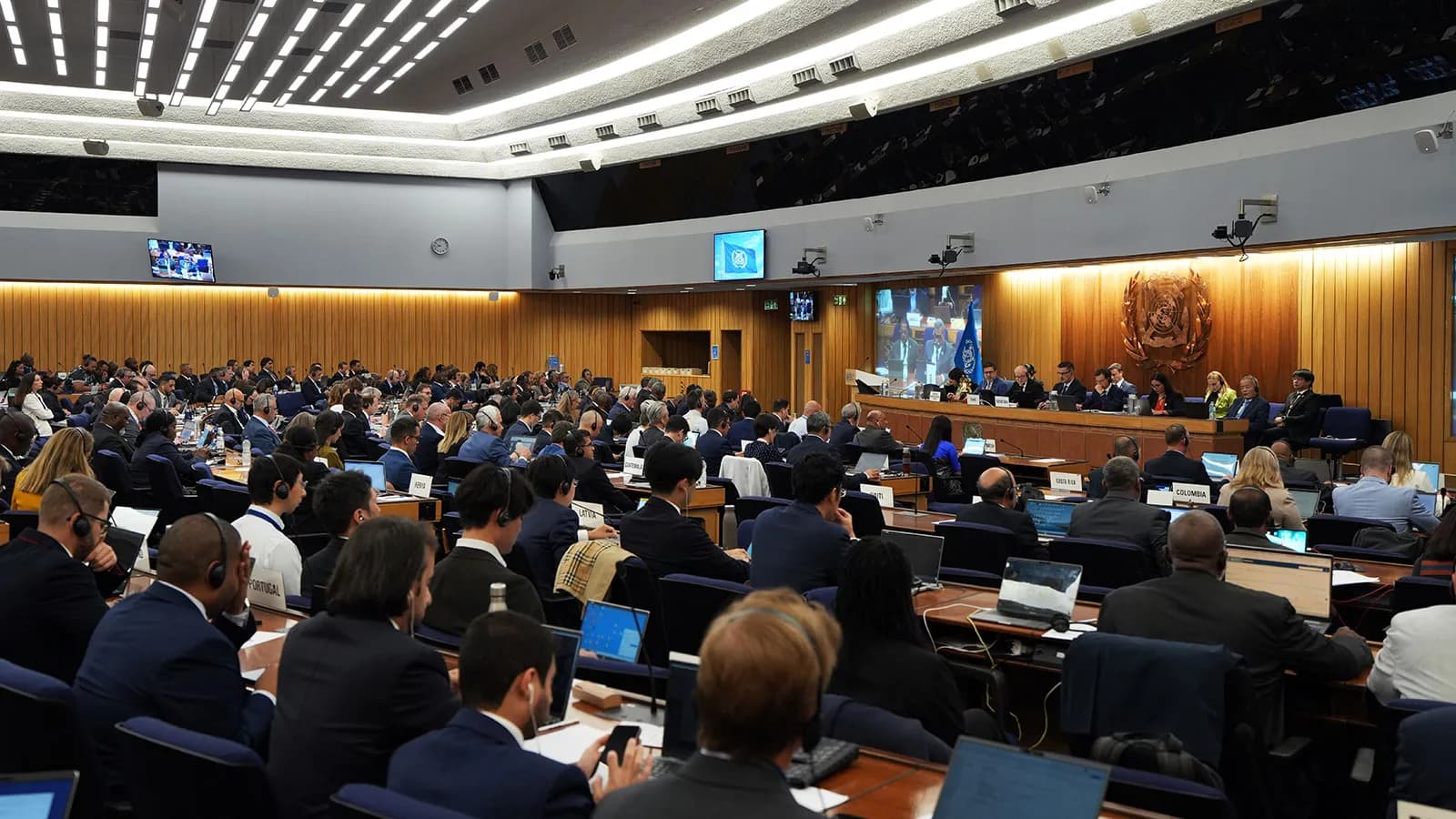
Negotiations on the International Maritime Organization (IMO) Net-Zero Framework have concluded this Friday without a new agreement among member states after four days of meetings of the Intersessional Working Group on greenhouse gas emissions from ships, ISWG-GHG 22.
The meeting was held between September 1 and 4 at the IMO headquarters in London with over a thousand registered delegates and had among its main issues the analysis of the different proposals presented to address existing objections regarding the future international framework for reducing maritime transport emissions.
The meeting was conducted behind closed doors and without access for the media. The IMO itself had announced before it began that it would later provide information on the discussions. Late this Friday, the international body listed the meeting as completed in its public calendar, although it had not yet published a detailed summary of its results.
Transport & Environment (T&E), an organization that has followed the negotiations, reported after the meeting's closure that states have not reached an agreement on pending issues. According to the entity, differences persist among delegations regarding key elements of the system, including the economic mechanism related to emissions, the management of the resources that would be generated, and the levels of greenhouse gas reductions contemplated in the framework.
T&E points out that during the discussions some delegations, including the European Union, showed willingness to consider modifications regarding the initially planned centralized fund and certain reduction targets, while the United States and Saudi Arabia held opposing positions to some of the components of the proposed scheme. The environmental organization considers that this is the third consecutive meeting in which negotiations have not succeeded in closing an agreement on the framework.
The Net-Zero Framework combines two main instruments. The first establishes a global fuel standard aimed at progressively reducing the greenhouse gas intensity of energy used by ships. The second introduces a pricing mechanism associated with emissions to incentivize compliance with those levels. The measures have been proposed through modifications to Annex VI of the MARPOL convention.
The regulatory process remains open after the postponement of the extraordinary session of the Marine Environment Protection Committee that was to address the adoption of the modifications. Since then, member states have submitted various proposals to modify certain aspects of the system, including approaches related to emission intensity targets, compliance mechanisms, and the configuration of the fund envisioned in the original project.
The agenda agreed upon by the IMO now contemplates a new meeting of the Intersessional Working Group, ISWG-GHG 23, between November 23 and 27, 2026. Its results will be forwarded to MEPC 85, which will be held from November 30 to December 3.
The second extraordinary session of the Marine Environment Protection Committee, suspended in October 2025, is scheduled to resume on December 4, conditioned on the decisions made by MEPC 85 beforehand. This calendar keeps the negotiation on the text open that will determine the final configuration of international emission reduction measures applicable to maritime transport.