
The main container shipping lines closed the second quarter of 2026 with an average operating margin of 11.2%, more than double the 5.2% recorded in the first three months of the year and above the 9.9% obtained in the same quarter of 2025, according to data published by the consulting firm Alphaliner. The recovery is supported by the accelerated rise in maritime freight rates, caused by route diversions, congestion at several ports, and a cargo demand that has remained strong.
The results represent a change in trend compared to the beginning of the year. Unlike the previous two quarters, none of the nine listed shipping lines included in the analysis reported operational losses between April and June. Hapag-Lloyd, however, remains in the red when considering the overall semester.
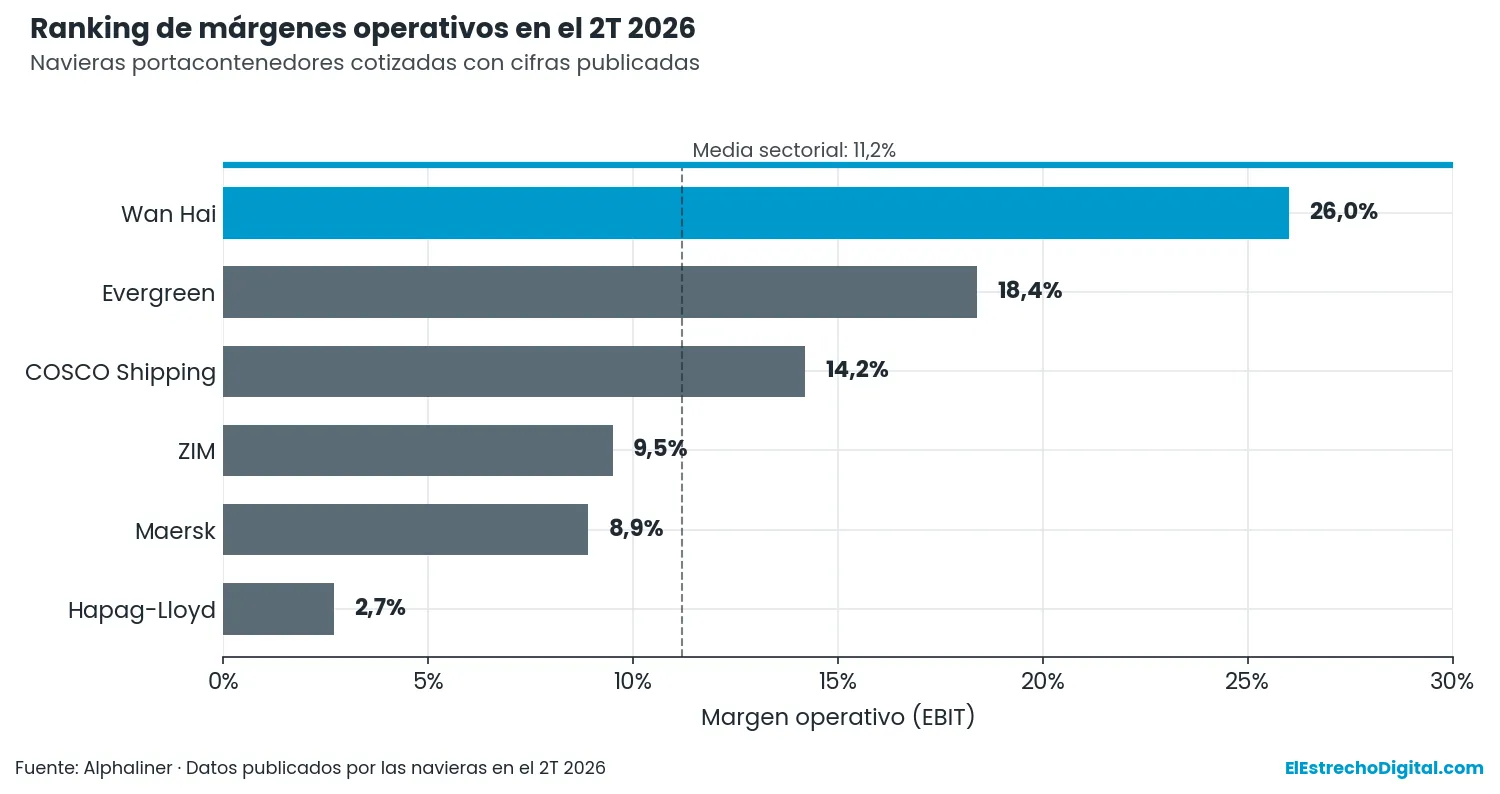
The most striking movement of the quarter is led by A.P. Moller-Maersk, which surpassed the margin of the Korean HMM for the first time since 2023. The Danish shipping line, which had recorded a negative margin of 2.3% in the first quarter, climbed to 8.9% in the second, reaching the sixth position in the sector ranking. This advance breaks the usual pattern of dominance of Asian shipping lines — more exposed to the spot market — over European lines, which are traditionally oriented towards long-term contracts.
Behind Maersk's jump are two factors identified in the analysis. On one hand, exposure to the spot market: 56% of its product portfolio is traded at spot prices, a mix that allowed it to capture the rise in rates faster. On the other hand, the redeployment of its network, with increases of 28% in East-West route rates and 21% in North-South routes. The group's CEO, Vincent Clerc, also attributed part of the improvement to the company's digital investments, without providing further details. The group closed the quarter with a consolidated EBIT of $3 billion, a figure that exceeded analysts' forecasts by nearly $900 million.
The year-on-year increase in rates of 22% achieved by Maersk is above that recorded by its direct competitors: COSCO (+13%), HMM (+10%), ZIM (+8%), ONE (+2%) and its partner in the Gemini Cooperation, Hapag-Lloyd (+9%).
At the top of the ranking, Taiwanese Wan Hai Lines again occupies the first position with an operating margin of 26.0%, marking the fifth consecutive quarter that the medium-sized line leads the ranking. Evergreen and COSCO Shipping, which have been alternating in second and third positions for some time, swapped their places this time: Evergreen rose to second place with a margin of 18.4% compared to 14.2% for COSCO. The reason, according to Alphaliner, is that East-West routes have become the main revenue driver detracting from intra-Asian traffic, a change that benefited both Evergreen and Yang Ming compared to the more contained growth of COSCO.
ZIM Integrated Shipping Services also experienced a notable recovery. The Israeli shipping line went from being in the red to an operating margin of 9.5%, supported by Transpacific volumes and the fuel consumption efficiency of its chartered fleet.
The lower part of the table illustrates the other side of the quarter. Hapag-Lloyd raised its margin from the severe contraction of the first quarter (-3.6%) to 2.7%, but it remains in the trailing group alongside Ocean Network Express (ONE) and HMM. ONE and HMM are the only two shipping lines in the analysis that did not manage to improve their operational results compared to the previous quarter. These three companies agree in pointing out that the operational cost associated with diversions due to the conflict zone in the Middle East absorbed a significant part of the improvements achieved in billing.
The analysis excludes the private shipping line Mediterranean Shipping Company (MSC) and the French CMA CGM, neither of which had published detailed financial statements for the period at the time of the report. The absence of the two largest container shipping lines in the world by capacity limits the reading of the sector's aggregated performance, although available data indicates that the gap between the lines more exposed to the spot market and those more oriented to contracts has narrowed in recent months.