
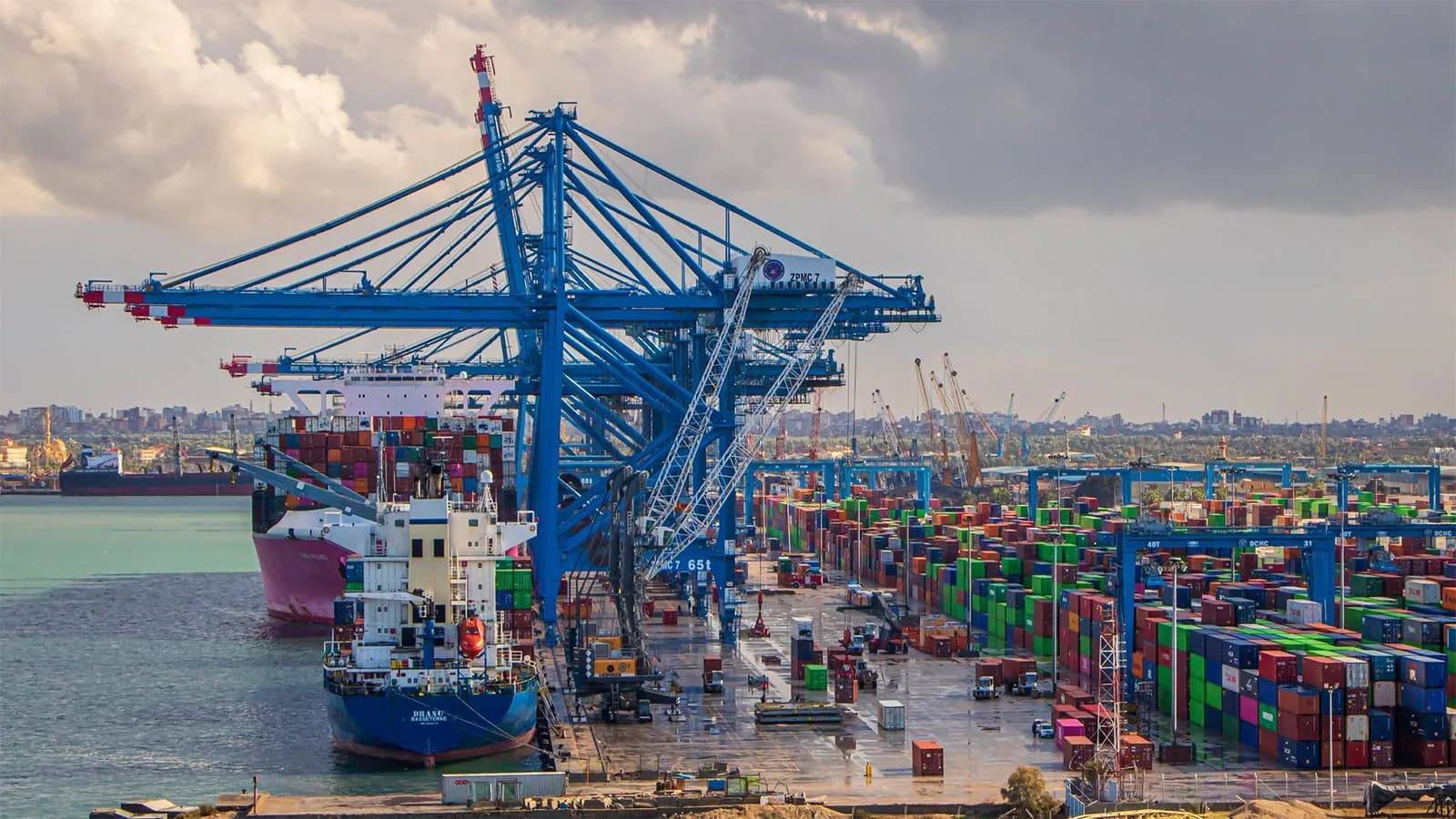
The European Commission presented this Friday in Brussels its proposal for the review of the emissions trading system (EU ETS), the first since the regime included maritime transport. The text includes part of the sector's requests, including several from the maritime-port sector, and directly addresses a sensitive issue for European Mediterranean ports with transshipment profiles, such as Algeciras: the list of neighboring ports where shipping companies can stop to avoid paying allowances for their emissions.
The classification of this list has been one of the main battlegrounds for European Mediterranean ports, including those in Spain, in their demands for a review of the ETS to the European Union. When a nearby dock receives this designation, the stopover at it does not count when calculating the percentage of emissions that a vessel must declare on a route with European facilities, which eliminates the incentive to divert regular lines to these locations. Competition with this type of port is particularly sensitive for European Mediterranean enclaves oriented to transshipment, like Algeciras.
Brussels proposes reducing the transit container quota that defines a neighboring transshipment port from 65% to 50%. The Community Executive argues that the new figure is 'more appropriate' to take into account ports outside the Union with a high potential to attract transshipment activities, to which regular lines could be diverted to evade payment for carbon emission credits.
Today that list includes only Tanger Med (Morocco) and Port Said (Egypt). The change opens the door to the incorporation, in the short to medium term, of bays like the Turkish Tekirdag or the Egyptian Damietta, both explicitly mentioned in the regulatory documentation released by Brussels. The Commission also mentions Nador West Med (Morocco), Dakhla (Morocco), and Cherchell (Algeria) as developing enclaves in the European vicinity that could become alternatives to evade the ETS. The list will be reviewed annually instead of every two years.
The proposal also excludes from the definition of 'stopover port' facilities with transshipment container infrastructure located less than 150 nautical miles from a port of a Member State, unless equivalent measures exist in third countries. It also expands that definition to include operational offshore sites, in order to curb evasion by vessels engaged in offshore activities.
Another change affects the size of the ships subject to the system. The rule in force since 2024 requires the purchase of allowances only for vessels larger than 5,000 gross tonnage. The review extends this obligation to certain ships of at least 400 tons, of general cargo and offshore units, which today represent about 15% of emissions from the already covered fleet despite their large number. At this point, the Commission departs from what the shipowners requested and aligns with the requests of environmental associations, arguing to balance competitive conditions against larger vessels. The expansion would come into effect on January 1, 2029.
By at least December 31, 2031, the Commission must present to Parliament and the Council a report evaluating the viability and economic, environmental, and social impact of a potential extension of the system to ro-pax vessels and passenger ships under 5,000 tons.
In sustainable fuels, instead of requiring States to use ETS revenues for the decarbonization of maritime transport —as demanded by the European shipowners' association ECSA—, the Community Executive creates the Sustainable Maritime Alternative Propulsion (SMAP) mechanism. This reserves 110 million free emission allowances between January 1, 2028, or the first year after the directive comes into force, and December 31, 2040. The fund will be distributed among shipping companies on a transparent, equitable, and nondiscriminatory basis and will cover part of the price differential between conventional fossil fuels and alternatives, as well as the additional costs of zero-emission propulsion technologies, such as electric or wind-assisted.
The text also incorporates a deduction mechanism linked to the International Maritime Organization (IMO). If the organization approves a global measure to decarbonize international maritime transport, the Commission will have 18 months to assess its ambition and coherence with the EU ETS and avoid double payments, without the obligation to accompany that report with a legislative proposal. The mechanism would allow companies to submit fewer allowances to the extent that their emissions are already taxed under the IMO framework.
Current exemptions for ice-class vessels, routes to outermost regions and small islands without regular connections to the mainland, and passenger services subject to public service obligations were set to expire on December 31, 2030. The proposal extends them until December 31, 2035, without making them permanent, contrary to what ECSA had requested. Before September 30, 2033, the Commission will assess whether to further extend the exemption for ice-class vessels based on available technical progress.
The Italian shipowners' association Assarmatori described the proposal as 'too timid,' although it recognized favorable aspects. Its president, Stefano Messina, lamented the lack of instruments to protect connections with larger islands and the Motorways of the Sea and warned that this jeopardizes the principle of territorial continuity. Among the positive elements, he cited the extension until 2035 of the exemption for links with smaller islands, which he attributed to the work of the Executive Vice-President of the Commission, Raffaele Fitto, and the Italian Government. He also appreciated the special discount regime on the ETS cost for intercontinental container transshipment, limited to routes entering the Union, the scope of which he considered 'still insufficient.'
Messina criticized the extension of the 300 nautical mile rule as a punitive and ineffective measure to curb transshipment. Regarding support for alternative fuels, Assarmatori noted that it should be financed with free emission allowances, as is already the case in aviation, but warned that the text includes among the financable items propulsion technologies, which could translate into a market incentive that is unclear.
In other modes of transport, the proposal excludes road transport, already regulated by the separate ETS2 system, created in the review of the 2023 directive and fully operational in 2028. For aviation, it applies the EU ETS to international flights departing to destinations located less than 5,000 kilometers from the center of the EU and to all movements in and out of business aircraft.
The proposal thus incorporates several requests from shipowners, with the new SMAP mechanism and the extension of exemptions for islands, outermost regions, and ice-class vessels, without paving the way towards ECSA's more ambitious objectives: the exemptions remain temporary, the clause regarding the IMO introduces a deduction of allowances instead of an automatic withdrawal from the EU ETS in the event of a global measure, and double taxation with energy taxation is excluded from the text. The document now begins its processing in the Council and the European Parliament, where shipowners hope to expand the scope of measures on transshipment and fuels.