
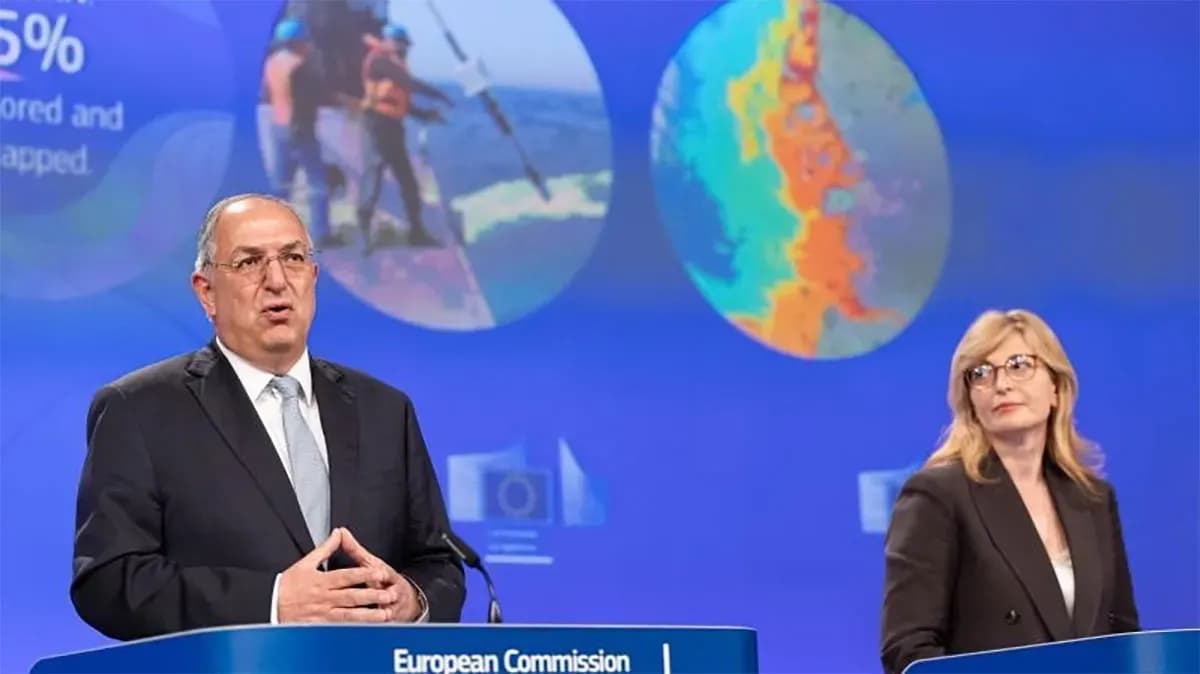
The European Commission has adopted the OceanEye initiative, a new framework of action with which the European Union aims to position itself as the world's main supplier of information about the oceans. The goal set by Brussels is for the EU to contribute 35% to the global ocean observation system by 2035 and also reach 35% of the market linked to marine observation technologies.
The proposal is based on a widely shared observation in the scientific and maritime fields: the ocean covers about 70% of the Earth's surface, but only a small part of its extent has been explored. According to the Commission, barely 5% of the ocean has been subject to exploration, despite its relevance for environmental protection, climate forecasting, maritime security, and the development of economic activities such as fishing, aquaculture, marine renewable energies, and maritime transport.
OceanEye is configured as one of the main measures derived from the European Pact for the Ocean, adopted by the Commission in June 2025. This pact brings together European policies related to the ocean in a single framework and addresses the threats affecting coastal communities, islands, and outermost regions. The initiative incorporates a scientific, technological, economic, and geopolitical dimension, with special attention to European autonomy in marine data.
The Commission's approach relies on four lines of work: more coordinated governance, international leadership through alliances, the development of the European digital replica of the ocean alongside technological innovation, and citizen participation through training and ocean cultural actions. Brussels considers that stable financing will be a determining element to guarantee long-term observation series and sustain the necessary infrastructures.
The President of the European Commission, Ursula von der Leyen, has stated that OceanEye will allow Europe to be "a reference in the knowledge and protection of our ocean" and in the sustainable use of its potential. She has also urged member states and international partners to join the initiative and contribute to the global ocean observation system.
One of the main problems identified by the Commission is the fragmentation of ocean observation in the EU. OceanEye aims to organize coordination between member states, scientific bodies, industry, and specialized entities, in order to align investments and priorities, reduce duplications in data collection, and cover information gaps. The details of this new governance model will be included in the legislative proposal for a future Ocean Law, expected by the end of the year.
The initiative contemplates the creation of a European digital system for the oceans that groups existing services, such as the Copernicus Marine Environmental Monitoring Service, the European Marine Observation and Data Network, EMODnet, the Water Information System for Europe, WISE Marine, and WISE Freshwater. This system will function as a single point of access to high-quality oceanic information and marine knowledge.
Within this digital ecosystem, the European digital replica of the ocean will be integrated, a virtual representation that will provide continuous access to marine information. The Commission expects it to be fully operational by 2030 and to facilitate real-time observations and predictive models useful for administrations, policymakers, and industry. This tool is conceived as an instrument to anticipate risks, plan maritime activities, and support sustainable management of the marine environment.
On the international level, the EU will launch an International Alliance aimed at improving the global ocean observation system. Brussels identifies particularly relevant deficiencies in the southern hemisphere, the Arctic, the deep seas, and coastal areas, where the lack of data limits analytical and response capacity for climate phenomena, ecological changes, or maritime security risks.
The Commission will allocate 92 million euros from the Horizon Europe program to the launch of OceanEye. Of this amount, 50 million will be assigned to increase the European contribution to the global ocean observation system, 12 million to resilient global marine information systems, and 30 million to technological projects through the European Innovation Council in the field of ocean observation technologies.
OceanEye also seeks to promote the development of sensors, autonomous systems, artificial intelligence, and new solutions for capturing and processing marine data. The Commission aims to accelerate the transition of these technologies from research to market, foster public-private partnerships, improve access to funding for startups, and connect research with the real needs of the blue economy.
The social dimension of the initiative will be articulated through outreach, education, and skills development actions. The Commission will launch a Laboratory for oceans, coastal, and island communities of the New European Bauhaus, aimed at presenting marine information through public installations, exhibitions in museums, and collaborations with artists and designers. Additionally, an OceanEye label will be created to identify the infrastructures that are part of the program.
National and international funding will be another key element. Brussels has invited member states, third countries, philanthropic organizations, and the private sector to join the alliance through financial resources, observation capabilities, sensors, drones, oceanographic vessels, submarine cables, digital infrastructures, technical personnel, and relevant data for bodies such as the Intergovernmental Oceanographic Commission or the Global Ocean Observation System.
The Commission places this initiative in a context where the blue economy is strategic for the EU, with 70,000 kilometers of coastline, 40% of the European population living in coastal communities and islands, five million jobs linked to ocean sectors, and an estimated gross added value of 250 billion euros.